

19 Nov What are areas of learning and development?
Learning and Development Areas: The Complete Guide
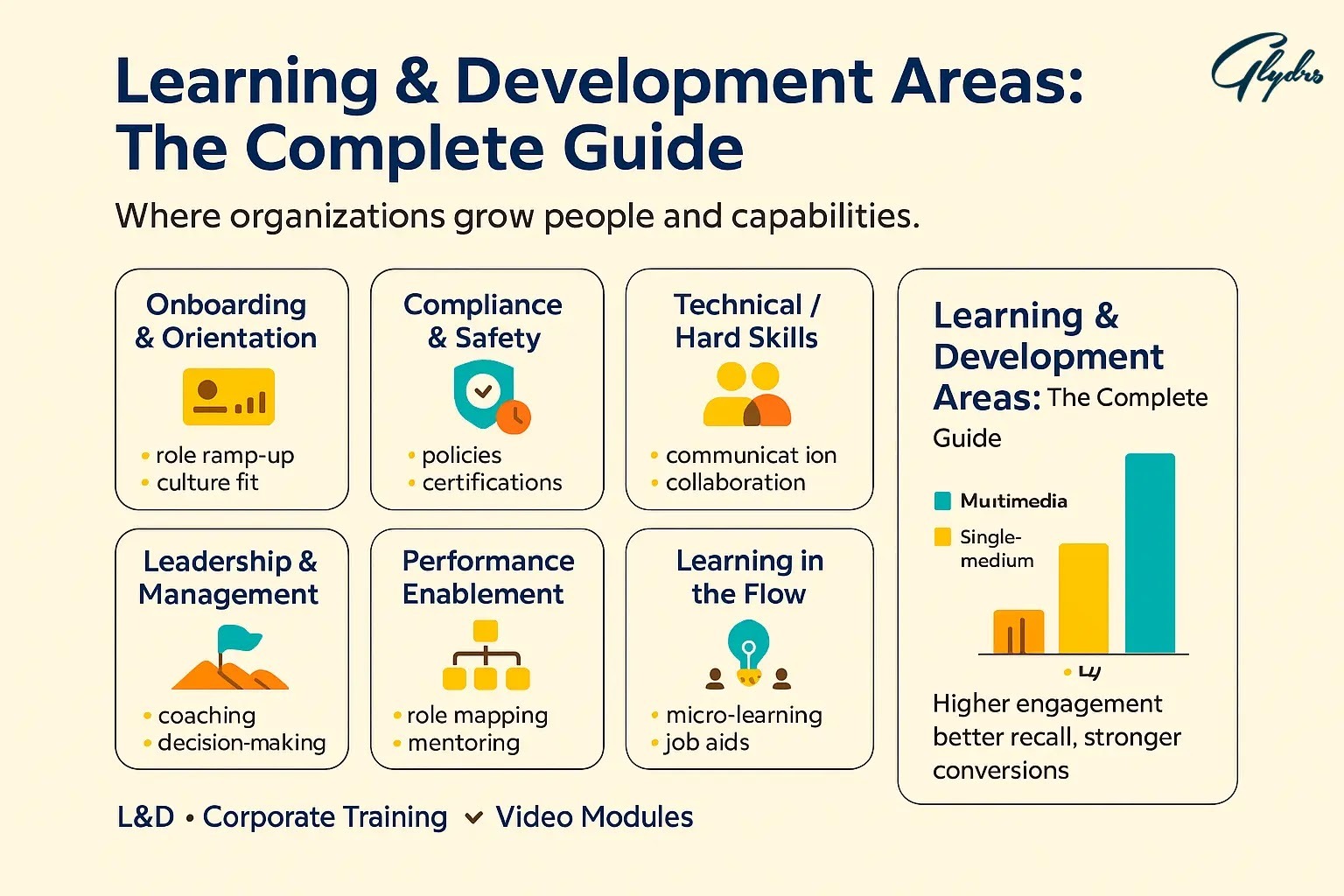
When you step into the world of learning and development, you’re entering a vast ecosystem of interconnected disciplines that shape how organizations grow their people and capabilities. Learning and development isn’t just about traditional training sessions or compliance workshops—it’s a comprehensive field that encompasses everything from onboarding new employees to developing tomorrow’s leaders, from bridging critical skills gaps to fostering innovation through continuous learning.
You might wonder exactly what areas fall under the learning and development umbrella and how they all fit together to create meaningful organizational growth. The reality is that modern L&D has evolved far beyond the classroom-based training of decades past, expanding into a multifaceted discipline that touches every aspect of employee experience and business performance.
Foundations: Understanding the Learning and Development Landscape
The Modern Definition and Evolution
Learning and development represents a systematic approach to enhancing employees’ skills, knowledge, and competencies to drive both individual growth and organizational success. You’ll find that it’s become a core HR function and a significant part of any organization’s overall people development strategy, playing a crucial role in attracting and retaining talent while enriching company culture and engaging employees.
The field has undergone a dramatic transformation from its traditional roots. Where L&D once focused primarily on formal training sessions and standardized curricula, you now see a dynamic landscape that embraces agile methodologies, personalized learning experiences, and multi-modal delivery approaches. This evolution reflects the changing nature of work itself, where continuous adaptation and skill development have become essential for both individual career success and organizational competitiveness.
The Interconnected Ecosystem
Understanding how different L&D areas interconnect is crucial for your success in this field. Each area doesn’t exist in isolation but rather forms part of a complex web of learning experiences that support employees throughout their entire journey with an organization. From the moment someone joins your company, through their career progression and leadership development, these areas work together to create comprehensive development pathways.
Distinguishing Key Concepts
You’ll encounter several related terms throughout your L&D journey, and understanding their distinctions is important. Learning refers to the acquisition of knowledge, skills, behaviors, and attitudes that lead to improved job performance. Development focuses on the broadening and deepening of knowledge in line with long-term professional goals, expanding potential for future opportunities. Training represents instruction for specific skills or tasks that employees need for immediate work scenarios, while education provides more formal, broadly applicable knowledge that builds foundational understanding.
Core Functional Areas of Learning and Development
Employee Onboarding and Orientation Programs
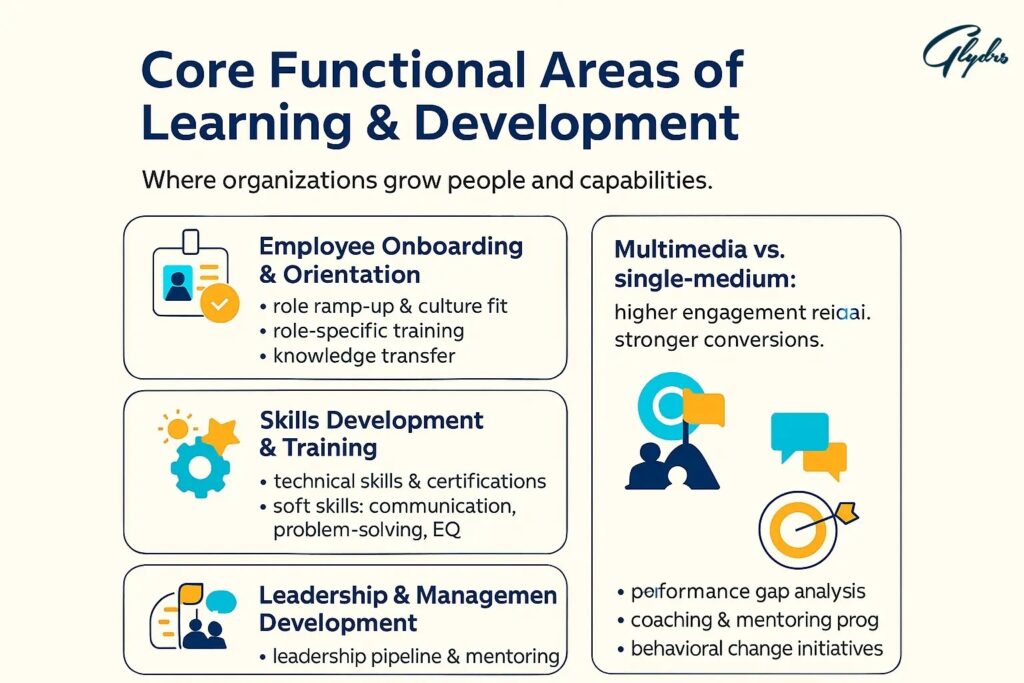
Your onboarding programs serve as the foundation for all future learning experiences within your organization. This area encompasses new hire integration processes that help employees understand their roles, responsibilities, and place within the larger organizational structure. You’ll design role-specific training components that ensure new team members can perform their duties effectively while also facilitating cultural assimilation and organizational knowledge transfer.
Effective onboarding goes beyond simple paperwork and policy reviews. You’re creating experiences that help new employees build relationships, understand organizational values, and develop the confidence they need to contribute meaningfully from their earliest days. This area of learning and development often determines whether employees will engage fully with future learning opportunities and remain with your organization long-term.
Skills Development and Training
Technical skills advancement forms a cornerstone of most L&D programs, addressing the specific competencies employees need to excel in their current roles. You’ll work to identify skill gaps and create targeted interventions that bridge these gaps effectively. This includes everything from software training and industry-specific certifications to emerging technology skills that prepare your workforce for future challenges.
Soft skills enhancement represents an equally important component of this area. You’re developing communication abilities, problem-solving skills, emotional intelligence, and other interpersonal competencies that enable effective collaboration and leadership. These skills often prove more challenging to develop than technical abilities but are frequently more predictive of long-term career success.
Job-specific competency building ensures that employees can perform their roles at the highest level possible. You’re creating learning experiences that directly translate to improved performance, whether that involves mastering specific tools, understanding industry regulations, or developing expertise in particular methodologies or processes.
Leadership and Management Development
Leadership pipeline programs represent one of the most strategic areas within learning and development. You’re identifying high-potential employees and providing them with the experiences, knowledge, and skills they need to take on greater responsibilities. This involves not just formal leadership training but also stretch assignments, mentoring relationships, and exposure to senior leadership decision-making processes.
Management skills training focuses on the practical competencies that supervisors and managers need to lead their teams effectively. You’re addressing areas like performance management, delegation, conflict resolution, and team building. These programs often combine theoretical knowledge with practical application opportunities, allowing participants to practice new skills in safe environments before applying them with their teams.
Succession planning initiatives ensure organizational continuity by preparing individuals to step into critical roles when needed. You’re creating development pathways that align individual career aspirations with organizational needs, identifying potential successors for key positions, and providing them with the experiences necessary to succeed when called upon.
Performance Improvement and Coaching
Performance gap analysis and remediation address specific challenges where employee performance falls short of expectations or organizational needs. You’re diagnosing the root causes of performance issues and designing targeted interventions that address underlying skill, knowledge, or motivational factors.
Individual coaching and mentoring programs provide personalized support for employee development. You’re facilitating relationships and creating structures that enable knowledge transfer, skill development, and career guidance. These programs often yield some of the highest returns on investment in terms of employee engagement and retention.
Behavioral change initiatives focus on helping individuals modify ingrained patterns that may be limiting their effectiveness. You’re creating safe spaces for self-reflection and growth while providing tools and techniques that support lasting change.
Specialized Learning and Development Domains
Compliance and Safety Training
Regulatory requirement fulfillment ensures that your organization meets all legal and industry standards while protecting both employees and the business from potential liabilities. You’re creating programs that not only satisfy legal requirements but also build a genuine understanding of why these regulations exist and how they protect everyone involved.
Workplace safety protocols represent a critical area where effective training can literally save lives. You’re developing programs that go beyond simple rule memorization to build safety awareness and create a culture where everyone takes responsibility for maintaining a safe work environment.
Industry-specific compliance areas require a deep understanding of particular regulatory environments. Whether you’re dealing with financial services regulations, healthcare compliance requirements, or environmental standards, you’re creating specialized programs that address the unique challenges and requirements of your industry.
Diversity, Equity, Inclusion, and Belonging (DEIB)
Cultural competency training helps employees develop the awareness and skills needed to work effectively in diverse environments. You’re building understanding of different perspectives, communication styles, and cultural norms while fostering appreciation for the value that diversity brings to organizational performance.
Bias awareness and mitigation programs address the unconscious biases that can impact decision-making and interpersonal interactions. You’re creating safe spaces for self-examination and providing practical tools that help employees recognize and counter their own biases in professional settings.
Inclusive leadership development prepares managers and leaders to create environments where all team members can contribute their best work. You’re building capabilities around inclusive communication, equitable decision-making, and creating psychological safety for all team members.
Change Management and Organizational Development
Change readiness and adaptation training prepares employees for the constant evolution that characterizes modern business environments. You’re building resilience, flexibility, and the skills needed to not just survive change but thrive in dynamic conditions.
Process improvement education empowers employees to identify inefficiencies and contribute to organizational improvement efforts. You’re creating a culture of continuous improvement where everyone feels empowered to suggest and implement positive changes.
Cultural transformation support helps organizations evolve their cultures to meet changing business needs and employee expectations. You’re facilitating conversations, building awareness, and providing tools that support meaningful cultural evolution.
Customer Service and Sales Training
Customer experience enhancement focuses on building the skills and mindset needed to deliver exceptional service that differentiates your organization in the marketplace. You’re creating programs that help employees understand customer needs, exceed expectations, and build lasting relationships.
Sales methodology and techniques development ensures that your sales team has the tools and knowledge needed to succeed in increasingly competitive markets. You’re building consultative selling skills, relationship management capabilities, and the product knowledge needed to serve customers effectively.
Product and service knowledge transfer keeps customer-facing employees current with your organization’s evolving offerings. You’re creating systems that ensure accurate, up-to-date information reaches those who need it when they need it.
Learning Delivery Methods and Modalities
Formal Learning Approaches
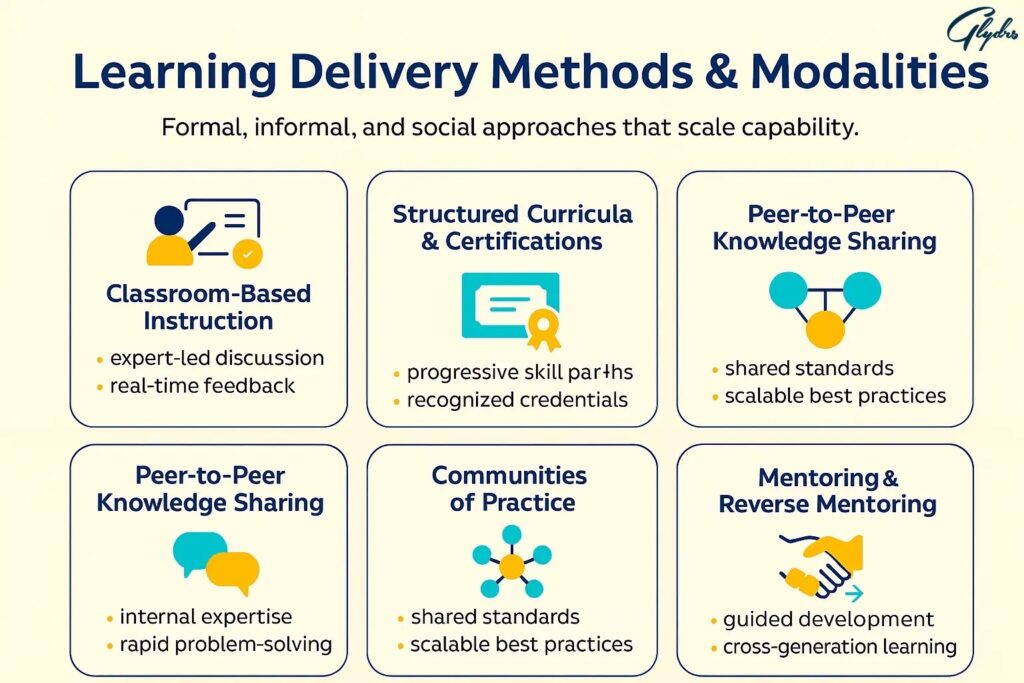
Classroom-based instruction continues to play an important role in comprehensive L&D programs, particularly for complex topics that benefit from interactive discussion and immediate feedback. You’re creating structured learning environments that facilitate deep understanding and skill development through expert instruction and peer interaction.
Structured curricula and certification programs provide systematic pathways for skill and knowledge development. You’re designing comprehensive learning journeys that build competency progressively while providing recognized credentials that validate achievement.
Academic partnerships and degree programs extend learning opportunities beyond what your organization can provide internally. You’re creating relationships with educational institutions that enable employees to pursue advanced education while maintaining their career progression.
Informal and Social Learning
Peer-to-peer knowledge sharing leverages the collective expertise within your organization to accelerate learning and problem-solving. You’re creating platforms and opportunities for employees to learn from each other’s experiences and insights.
Communities of practice bring together individuals with shared interests or responsibilities to exchange knowledge and develop best practices. You’re facilitating these communities and providing the resources they need to thrive and contribute to organizational learning.
Mentoring and reverse mentoring programs create structured relationships that facilitate knowledge transfer across generations, levels, and functional areas. You’re matching mentors and mentees strategically while providing the support and guidance needed for successful relationships.
Experiential and Action Learning
Job rotations and stretch assignments provide employees with hands-on learning opportunities that develop both skills and organizational understanding. You’re creating structured experiences that challenge individuals while providing the support needed for success.
Project-based learning initiatives allow employees to develop new capabilities while contributing to real organizational objectives. You’re designing projects that balance learning goals with business needs, creating win-win opportunities for growth and contribution.
Simulation and scenario-based training create safe environments for practicing high-stakes skills or dealing with challenging situations. You’re using technology and creative design to replicate real-world conditions where employees can learn from mistakes without real-world consequences.
Digital and Technology-Enhanced Learning
E-learning and microlearning modules provide flexible, accessible learning opportunities that fit into busy schedules and diverse learning preferences. You’re creating bite-sized learning experiences that deliver targeted knowledge and skills in formats that maximize retention and application.
Virtual and augmented reality training offers immersive learning experiences that would be impossible or impractical to create in traditional training environments. You’re leveraging cutting-edge technology to create compelling, memorable learning experiences that drive real behavior change.
Mobile learning and just-in-time resources ensure that learning support is available when and where employees need it most. You’re creating systems that deliver relevant information and guidance at the point of need, enabling immediate application and problem-solving.
Strategic Learning and Development Areas
Talent Development and Succession Planning
High-potential employee programs identify and develop individuals who show exceptional promise for leadership roles or specialized expertise. You’re creating accelerated development pathways that challenge these employees while preparing them for greater responsibilities.
Career pathing and development planning provide employees with a clear understanding of potential career trajectories and the steps needed to achieve their professional goals. You’re aligning individual aspirations with organizational needs while creating roadmaps for mutual success.
Talent pipeline management ensures that your organization has the right people with the right skills available when and where they’re needed. You’re creating systematic approaches to talent development that anticipate future needs and prepare accordingly.
Skills Gap Analysis and Future-Proofing
Workforce capability assessment provides a comprehensive understanding of your organization’s current skill and knowledge landscape. You’re conducting thorough analyses that identify strengths, gaps, and opportunities for development across all levels and functions.
Emerging skills identification keeps your organization ahead of industry trends by anticipating future capability requirements. You’re monitoring technological, market, and industry developments to identify skills that will become critical before they’re widely recognized as such.
Reskilling and upskilling strategies ensure that your workforce remains relevant and valuable as job requirements evolve. You’re creating comprehensive programs that help employees transition to new roles or enhance their capabilities in current positions.
Learning Strategy and Business Alignment
Strategic workforce planning integration ensures that your L&D initiatives directly support organizational objectives and business strategy. You’re creating clear connections between learning investments and business outcomes while demonstrating the value of learning and development to organizational success.
Business case development for learning initiatives requires you to articulate the rationale, expected outcomes, and return on investment for proposed programs. You’re building compelling arguments that secure necessary resources and support from organizational leadership.
ROI optimization and resource allocation involve making strategic decisions about where to invest L&D resources for maximum impact. You’re analyzing program effectiveness, cost-benefit ratios, and strategic importance to guide investment decisions.
Organizational Learning and Knowledge Management
Knowledge capture and transfer systems ensure that critical organizational knowledge doesn’t leave with departing employees or remain siloed in individual minds. You’re creating processes and technologies that systematically capture, organize, and share institutional knowledge.
Learning culture development fosters an environment where continuous learning and growth are valued, supported, and rewarded. You’re working to shift mindsets and create systems that encourage curiosity, experimentation, and knowledge sharing.
Institutional memory preservation protects valuable organizational knowledge and experience from being lost due to turnover or organizational changes. You’re creating systematic approaches to documenting and transferring critical knowledge and lessons learned.
Assessment, Measurement, and Analytics in L&D
Learning Effectiveness Measurement
Kirkpatrick and Phillips’ evaluation models provide systematic frameworks for assessing learning program effectiveness at multiple levels. You’re implementing evaluation strategies that measure not just participant satisfaction but also learning achievement, behavior change, and business impact.
Learning analytics and data interpretation enable you to make evidence-based decisions about program design, delivery, and improvement. You’re leveraging data to understand learning patterns, identify successful approaches, and optimize program effectiveness.
Pre and post-training assessments provide concrete evidence of knowledge and skill development resulting from your programs. You’re designing assessment strategies that accurately measure learning while providing valuable feedback to both participants and program designers.
Business Impact and ROI Analysis
Performance metrics and KPI tracking connect learning initiatives to measurable business outcomes. You’re identifying relevant metrics and creating systems that track the relationship between learning investments and organizational performance improvements.
Cost-benefit analysis methodologies help you evaluate the financial impact of learning programs and make informed decisions about resource allocation. You’re developing sophisticated approaches to calculating both the costs and benefits of learning initiatives.
Long-term impact assessment measures the sustained effects of learning programs over extended periods. You’re creating evaluation systems that track not just immediate outcomes but also lasting behavior change and continued application of learning.
Learning Technology and Data Management
Learning Management System (LMS) administration involves selecting, implementing, and optimizing the technology platforms that deliver and track learning experiences. You’re ensuring that technology supports rather than hinders learning while providing valuable data for program improvement.
Learning Experience Platform (LXP) utilization focuses on creating personalized, engaging learning experiences that adapt to individual needs and preferences. You’re leveraging advanced technology to create Netflix-like learning experiences that encourage exploration and discovery.
Data privacy and security considerations ensure that learning-related data is collected, stored, and used in compliance with relevant regulations and organizational policies. You’re balancing the need for learning analytics with respect for individual privacy and data protection requirements.
Emerging and Future-Focused L&D Areas
Artificial Intelligence and Personalized Learning
AI-driven content curation and delivery systems automatically identify and present relevant learning content based on individual needs, preferences, and performance. You’re implementing intelligent systems that make learning more efficient and effective by delivering the right content to the right person at the right time.
Personalized learning path optimization uses artificial intelligence to create customized learning journeys that adapt based on individual progress, learning style, and career goals. You’re moving beyond one-size-fits-all approaches to create truly individualized learning experiences.
Predictive analytics for learning needs anticipates future skill requirements and identifies learning opportunities before gaps become critical. You’re using advanced analytics to stay ahead of organizational learning needs and proactively address emerging requirements.
Remote and Hybrid Workforce Development
Virtual collaboration skills training prepares employees to work effectively in distributed teams using digital tools and technologies. You’re building capabilities that enable seamless collaboration regardless of physical location while maintaining team cohesion and productivity.
Remote leadership development addresses the unique challenges of leading teams that may never meet in person. You’re creating programs that help leaders build trust, maintain engagement, and drive performance across virtual teams.
Digital workplace proficiency ensures that all employees have the skills needed to navigate and excel in technology-rich work environments. You’re building foundational digital literacy while also addressing advanced technology skills that enable innovation and efficiency.
Wellness and Mental Health Support
Stress management and resilience training help employees develop the coping skills needed to thrive in demanding work environments. You’re creating programs that build mental and emotional resilience while providing practical tools for managing workplace stress.
Work-life balance education addresses the challenges of maintaining personal well-being while meeting professional demands. You’re helping employees develop boundaries and strategies that support both career success and personal fulfillment.
Mental health awareness and support create psychologically safe workplaces where employees feel comfortable seeking help and supporting colleagues who may be struggling. You’re building organizational capacity to recognize and respond appropriately to mental health challenges.
Sustainability and Corporate Responsibility
Environmental awareness training helps employees understand their role in organizational sustainability efforts while building personal environmental consciousness. You’re creating programs that connect individual actions to broader environmental impact and organizational responsibility.
Social responsibility education builds understanding of how organizations can contribute positively to society while achieving business objectives. You’re developing awareness of social issues and the skills needed to address them through business activities.
Ethical decision-making development provides frameworks and tools for navigating complex ethical situations in professional contexts. You’re building capabilities that help employees make principled decisions even when facing difficult choices or competing pressures.
Keep reading and uncover secrets that can change the way you work. HOW TO CHOOSE A LEARNING AND DEVELOPMENT COURSE
Implementation and Operational Considerations
L&D Program Design and Curriculum Development
Instructional design principles and methodologies ensure that your learning programs are built on solid pedagogical foundations. You’re applying evidence-based design principles that maximize learning effectiveness while creating engaging, memorable experiences.
Content creation and resource development involve producing high-quality learning materials that support program objectives and engage diverse learning styles. You’re balancing creativity with instructional effectiveness while managing resource constraints and timeline pressures.
Vendor management and external partnerships extend your organization’s learning capabilities by strategically leveraging external expertise and resources. You’re building relationships with learning providers while ensuring quality, consistency, and alignment with organizational objectives.
Budget Management and Resource Allocation
Cost-effective program delivery strategies help you maximize the impact of limited resources while maintaining program quality and effectiveness. You’re identifying opportunities for efficiency and scale while avoiding false economies that compromise learning outcomes.
Resource optimization across different L&D areas requires strategic thinking about where to invest limited resources for maximum organizational impact. You’re making difficult decisions about program priorities while ensuring that critical learning needs are met.
Stakeholder buy-in and funding justification involve building support for learning investments by demonstrating their value and necessity. You’re creating compelling business cases that secure the resources needed for effective learning and development programs.
Change Management for L&D Initiatives
Resistance management and adoption strategies address the natural human tendency to resist change, even positive change like new learning opportunities. You’re creating strategies that encourage participation while addressing concerns and barriers to engagement.
Communication and marketing of L&D programs ensure that employees understand the value and relevance of learning opportunities. You’re creating compelling narratives that motivate participation while setting appropriate expectations about outcomes and requirements.
Continuous improvement and iteration processes ensure that your programs evolve and improve over time based on feedback and results. You’re creating systematic approaches to program evaluation and enhancement that keep your offerings current and effective.
Keep reading and uncover secrets that can change the way you work. ENTERPRISE LMS: WHAT IS IT AND WHAT ARE THE BENEFITS?
Building Your L&D Area Expertise: From Understanding to Mastery
Identifying Strategic Priorities
Your journey in mastering the various areas of learning and development begins with understanding which areas align most closely with your organizational needs and personal career goals. You’ll need to assess your organization’s strategic priorities, current capability gaps, and future challenges to determine where to focus your initial efforts.
Consider conducting a comprehensive needs assessment that examines not just current skill gaps but also emerging requirements that will become critical in the coming years. This forward-looking approach will help you prioritize your development efforts in areas that will have the greatest long-term impact on both organizational success and your own career advancement.
Developing Multi-Domain Competency
Building expertise across multiple L&D areas requires a systematic approach to skill development. You’ll want to start with foundational competencies that apply across all areas—such as instructional design principles, adult learning theory, and program evaluation methods—before diving deeper into specialized domains.
The key to success in modern L&D is developing what might be called “T-shaped” expertise: broad knowledge across many areas with deep specialization in a few key domains that align with your interests and organizational needs.
Focus on developing both the technical skills specific to L&D work and the business acumen needed to align learning initiatives with organizational objectives. You’ll need to understand not just how to create effective learning experiences but also how to demonstrate their value and secure the resources needed for success.
Creating Integrated Approaches
The most effective L&D professionals understand how different areas work together to create comprehensive development experiences. You’ll need to think systemically about how onboarding connects to career development, how leadership development supports succession planning, and how performance improvement initiatives can be integrated with skills training.
This integrated thinking allows you to create learning ecosystems rather than isolated programs. You’ll be designing experiences that build on each other over time, creating cumulative value that exceeds the sum of individual parts.
Staying Current with Evolution
The field of learning and development continues to evolve rapidly, driven by technological advancement, changing workforce demographics, and shifting business requirements. You’ll need to commit to continuous learning and adaptation to remain effective in this dynamic environment.
Develop relationships with other L&D professionals, participate in professional associations, attend conferences, and engage with thought leaders in the field. Stay curious about emerging technologies, research findings, and innovative practices that could enhance your effectiveness.
Keep reading and uncover secrets that can change the way you work. THE FUTURE OF AI IN LEARNING AND DEVELOPMENT
Your Path Forward in Learning and Development
Understanding the full spectrum of learning and development areas is just the beginning of your journey in this dynamic and rewarding field. You now have a comprehensive map of the territory, from foundational areas like onboarding and skills training to emerging domains like AI-enhanced learning and remote workforce development.
The opportunities in this field are as diverse as they are meaningful. Whether you’re drawn to the strategic aspects of talent development and succession planning, the creative challenges of instructional design and content creation, or the analytical rigor of program evaluation and measurement, there’s a place for your unique talents and interests within the L&D ecosystem.
Remember that mastery in this field comes not from knowing everything about every area, but from understanding how different areas connect and complement each other to create comprehensive development experiences. Your role is to be a bridge-builder, connecting learning opportunities to business needs, individual aspirations to organizational objectives, and current capabilities to future requirements.
The field of learning and development will continue to evolve, driven by technological advancement, changing workforce expectations, and shifting business requirements. Your success will depend not just on your current knowledge but on your ability to adapt, learn, and grow along with the field itself. Embrace the continuous learning mindset that you’ll be fostering in others, and you’ll find yourself at the forefront of one of the most important and impactful professions of our time.
Turn your goals into real achievements with our tailored services – request the service now.
1- What are the most critical L&D areas for small organizations to focus on first?
Small organizations typically benefit from focusing initially on onboarding and orientation programs, basic skills training, and performance improvement initiatives. These areas provide immediate value by helping employees become productive quickly and addressing specific performance gaps that impact business results. As the organization grows, you can expand into more sophisticated areas like leadership development and strategic talent planning.
2- How do different L&D areas integrate in practice?
Integration happens through careful program design that recognizes the connections between different learning needs and career stages. For example, your onboarding programs can introduce career development concepts, while leadership development initiatives can incorporate coaching and mentoring components. The key is mapping the employee journey and identifying natural connection points where different L&D areas can reinforce each other.
3- What skills do L&D professionals need to work across multiple areas?
Core competencies include instructional design, program evaluation, project management, and business acumen. You’ll also need strong communication skills, analytical capabilities, and the ability to build relationships across the organization. Technology literacy is increasingly important, as is the ability to work with data and demonstrate program impact through metrics and analytics.
4- How is technology changing the landscape of L&D areas?
Technology is enabling more personalized, flexible, and data-driven approaches to learning and development. Artificial intelligence is making personalized learning paths possible, virtual reality is creating immersive training experiences, and analytics are providing unprecedented insights into learning effectiveness. Mobile technology is making learning accessible anywhere, anytime, while collaboration platforms are enabling new forms of social learning.
5- What are the emerging L&D areas that organizations should prepare for?
Key emerging areas include AI-enhanced learning, remote workforce development, mental health and wellness training, sustainability education, and digital literacy development. Organizations should also prepare for increased focus on agility and change management as the pace of business change continues to accelerate. The ability to rapidly reskill and upskill employees will become increasingly critical for organizational survival and success.
No Comments