

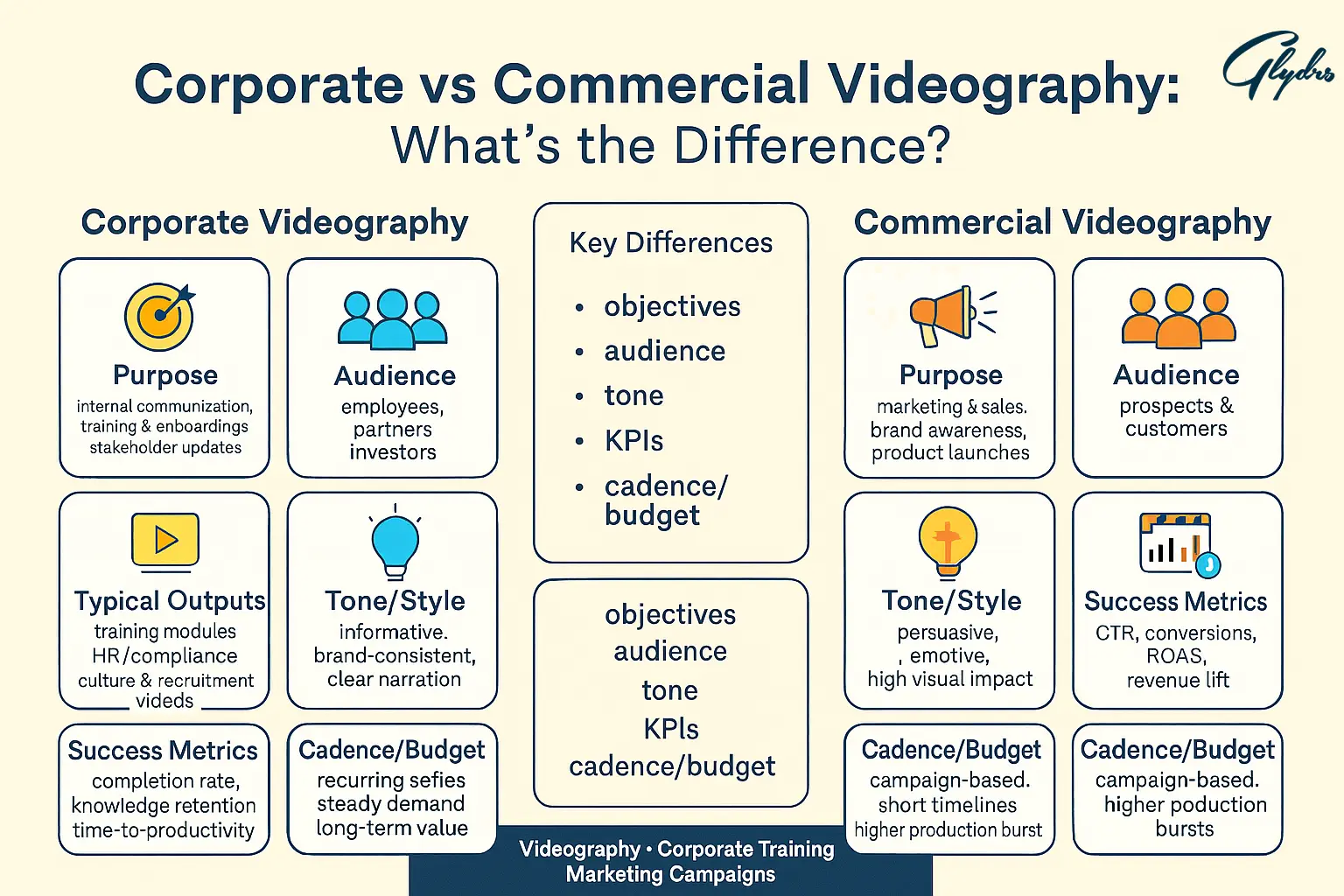
25 Nov What is the difference between corporate and commercial videography?
Commercial Videography: That Impacts Your Business Strategy
You’ve probably encountered countless videos throughout your business journey, but have you ever stopped to consider why some feel distinctly different from others? The video production landscape is vast and varied, with two primary categories that often get confused: corporate and commercial videography. Understanding these differences isn’t just academic—it’s crucial for your business success.
In today’s digital-first world, video content has become the backbone of effective business communication. Whether you’re looking to train your employees, attract new customers, or communicate with stakeholders, the type of video you choose can make or break your objectives. The confusion between corporate and commercial videography leads many businesses to invest in the wrong type of content, resulting in missed opportunities and wasted resources.
When you grasp the fundamental differences between these two approaches, you’ll be equipped to make informed decisions that align with your specific goals, audience, and budget. This comprehensive guide will walk you through everything you need to know about corporate versus commercial videography, helping you navigate the complexities and make strategic choices that drive real results for your business.
Defining Corporate Videography
Corporate videography serves as the internal and stakeholder-focused arm of your video strategy. When you create corporate videos, you’re primarily speaking to people who already have a relationship with your organization—your employees, investors, board members, and business partners. These videos function as sophisticated communication tools that build trust, convey important information, and strengthen relationships within your business ecosystem.
The primary purpose of corporate videography revolves around education, communication, and relationship building. You might use corporate videos to onboard new employees, explain complex processes to your team, or present quarterly results to investors. These videos prioritize substance over style, though they still maintain professional production standards.
“Corporate videos are the backbone of internal communication, serving as a bridge between leadership and stakeholders while maintaining the professional integrity that reflects your company’s values.”
Company culture videos represent one of the most popular corporate video formats. When you invest in these productions, you’re showcasing your workplace environment, values, and team dynamics to potential employees and partners. Training and educational content form another cornerstone of corporate videography, allowing you to standardize important information delivery across your organization.
Internal communications through video have revolutionized how you can reach distributed teams and remote workers. Executive messaging videos give your leadership team a powerful platform to address the entire organization with consistency and gravitas. Investor relations materials leverage the visual medium to present complex financial data and strategic visions in more digestible formats.
Understanding Commercial Videography
Commercial videography operates in an entirely different sphere, focused on capturing the attention of potential customers and driving specific actions. When you invest in commercial video production, you’re entering the competitive arena of marketing and advertising, where every second counts and every visual element must serve the ultimate goal of conversion.
The core objective of commercial videography centers on persuasion and action. Unlike corporate videos that inform and educate, commercial videos must entertain, engage, and convince viewers to take immediate action. Whether you’re launching a new product, building brand awareness, or driving direct sales, commercial videos serve as your frontline marketing weapons.
Television advertisements remain the most recognizable form of commercial video content, though the landscape has expanded dramatically. Social media promotional content now represents a massive segment of commercial videography, with platforms like Instagram, TikTok, and YouTube demanding unique approaches and formats. Product demonstrations through video allow you to showcase features and benefits in ways that static images simply cannot match.
Brand awareness campaigns leverage commercial videography to build emotional connections with your target audience. These videos often tell stories that resonate with viewers aspirations and values, creating lasting impressions that influence future purchasing decisions. Direct response marketing videos take a more immediate approach, incorporating clear calls-to-action and time-sensitive offers designed to generate immediate responses.
The Five Critical Differences Between Corporate and Commercial Videos
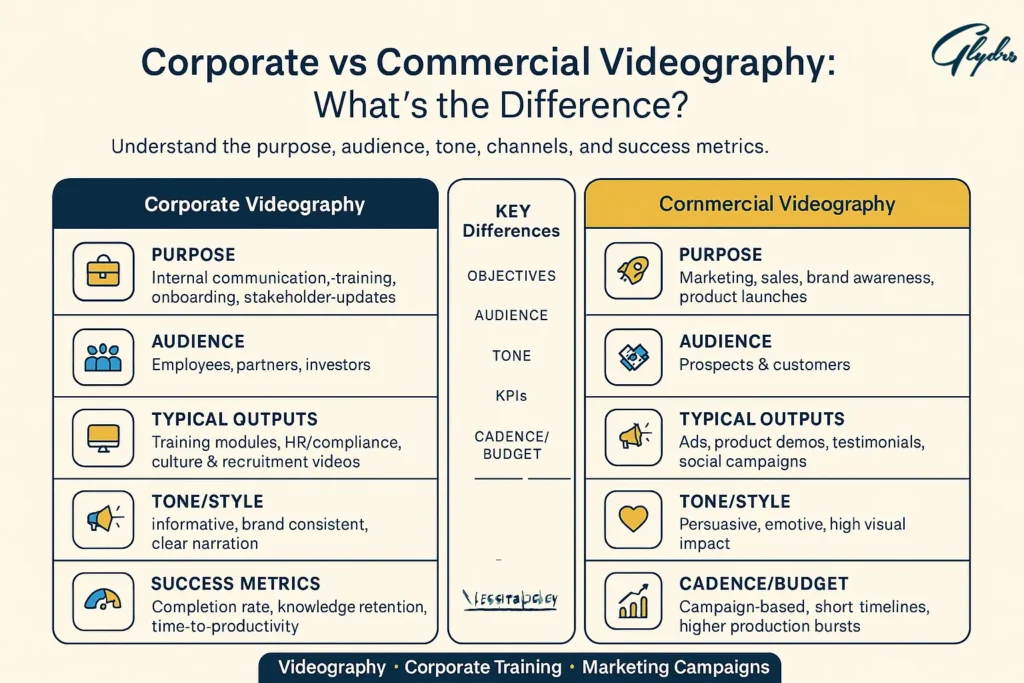
The distinction between corporate and commercial videos becomes clear when you examine five critical differences that define each category. Understanding these differences will help you make strategic decisions about which approach serves your specific objectives.
Purpose and intent represent the most fundamental difference between these video types. When you create corporate videos, your intent focuses on building relationships, conveying information, and maintaining stakeholder engagement. Commercial videos, however, exist solely to drive action—whether that’s making a purchase, signing up for a service, or increasing brand consideration.
Target audience variations create completely different production considerations. Your corporate videos speak to people who already know your company and have some level of investment in your success. Commercial videos must capture the attention of strangers who have no prior relationship with your brand and may be encountering your message amid dozens of competing alternatives.
| Aspect | Corporate Videos | Commercial Videos |
|---|---|---|
| Primary Intent | Inform and Build Relationships | Persuade and Drive Action |
| Audience Familiarity | High – Existing Stakeholders | Low – Potential Customers |
| Message Complexity | Can Be Detailed and Nuanced | Must Be Simple and Clear |
| Production Timeline | More Flexible | Often Time-Sensitive |
| Success Metrics | Engagement and Comprehension | Conversions and ROI |
Messaging approach and tone differ significantly between corporate and commercial productions. Corporate videos can afford to be more detailed, technical, and relationship-focused. You can assume your audience has time and interest in comprehensive information. Commercial videos must grab attention immediately and maintain engagement throughout shorter timeframes.
Distribution channels and platforms create different production requirements.
Corporate videos often live on internal platforms, company websites, or closed distribution networks where you control the viewing environment. Commercial videos compete for attention on public platforms where viewers have unlimited alternatives just one click away.
Success metrics and measurement criteria reflect the fundamental differences in objectives. Corporate video success might be measured through employee engagement scores, training completion rates, or stakeholder satisfaction surveys. Commercial video success demands more immediate and quantifiable metrics like click-through rates, conversion percentages, and return on advertising spend.
Audience Analysis: Who Are You Really Talking To?
Understanding your audience represents the cornerstone of effective video strategy, and the differences between corporate and commercial audiences are substantial. When you analyze these distinct groups, you’ll discover why one-size-fits-all video approaches rarely succeed.
Corporate video audiences bring existing knowledge and investment to the viewing experience. Your employees already understand company terminology, culture, and context. When you create training videos or internal communications, you can reference shared experiences and company-specific information without extensive explanation. This familiarity allows for more efficient communication and deeper, more nuanced messaging.
Investors and board members represent another key corporate audience segment. These viewers approach your content with analytical mindsets, seeking specific information to support decision-making processes. They expect professional presentation quality but prioritize substance over entertainment value. Your videos for this audience should demonstrate competence, transparency, and strategic thinking.
Business partners and vendors engage
With your corporate content to better understand working relationships and collaboration opportunities. These audiences appreciate detailed process explanations, quality standards, and partnership benefits. They’re invested in your success because it directly impacts their own business outcomes.
Commercial video audiences present entirely different challenges and opportunities. Potential customers and clients encounter your content with varying levels of interest and attention. You must assume zero prior knowledge while competing against countless alternatives for their attention. Every element of your commercial video must justify continued viewing.
The general public and market segments require broad appeal and universal understanding. Your commercial videos cannot rely on industry jargon or insider knowledge. Instead, they must communicate benefits in terms that resonate with diverse backgrounds and experience levels. This constraint demands creativity in simplifying complex value propositions.
Specific demographic targets allow for more focused commercial videography approaches. When you understand your ideal customer’s age, interests, challenges, and preferences, you can craft videos that speak directly to their needs and desires. This targeted approach often produces better results than broadly appealing content.
Production Approach: Style, Budget, and Timeline Considerations
The production approach for corporate and commercial videos reflects their different objectives and audiences. Understanding these distinctions helps you set appropriate expectations for style, budget, and timeline requirements.
Corporate video production emphasizes professionalism without necessarily requiring high-end creative flourishes. You need clear audio, steady shots, and professional lighting, but you don’t need Hollywood-level production values. The focus remains on clear communication and information delivery rather than artistic expression or emotional manipulation.
Longer format acceptance in corporate videos provides flexibility that commercial productions rarely enjoy. Your employees or stakeholders will watch a 15-minute training video if the content serves their needs. This extended timeframe allows for comprehensive coverage of complex topics without the extreme condensation required in commercial formats.
Information-focused content structure dominates corporate video production. You can organize content logically, spend time on detailed explanations, and assume viewers are motivated to understand the complete message. This approach supports more straightforward production techniques focused on clarity rather than entertainment.
Commercial videography demands significantly higher creative and visual standards. Every frame must justify its existence in capturing and maintaining the viewer’s attention. Production values directly impact credibility and effectiveness, and investing in professional cinematography, editing, and post-production is essential for success.
Shorter attention span considerations fundamentally shape commercial video production. You typically have seconds, not minutes, to capture interest and begin delivering value. This constraint requires careful planning, precise editing, and often higher production complexity to convey complete messages in compressed timeframes.
Entertainment value integration represents a crucial element of successful commercial videography. Your videos must compete with professionally produced entertainment content for viewer attention. This reality demands creative storytelling, engaging visuals, and often humor or emotional appeal to maintain engagement throughout the viewing experience.
Investment and ROI: What to Expect Financially
Financial considerations play a crucial role in choosing between corporate and commercial video approaches. Understanding typical investment ranges and expected returns helps you make informed decisions about resource allocation.
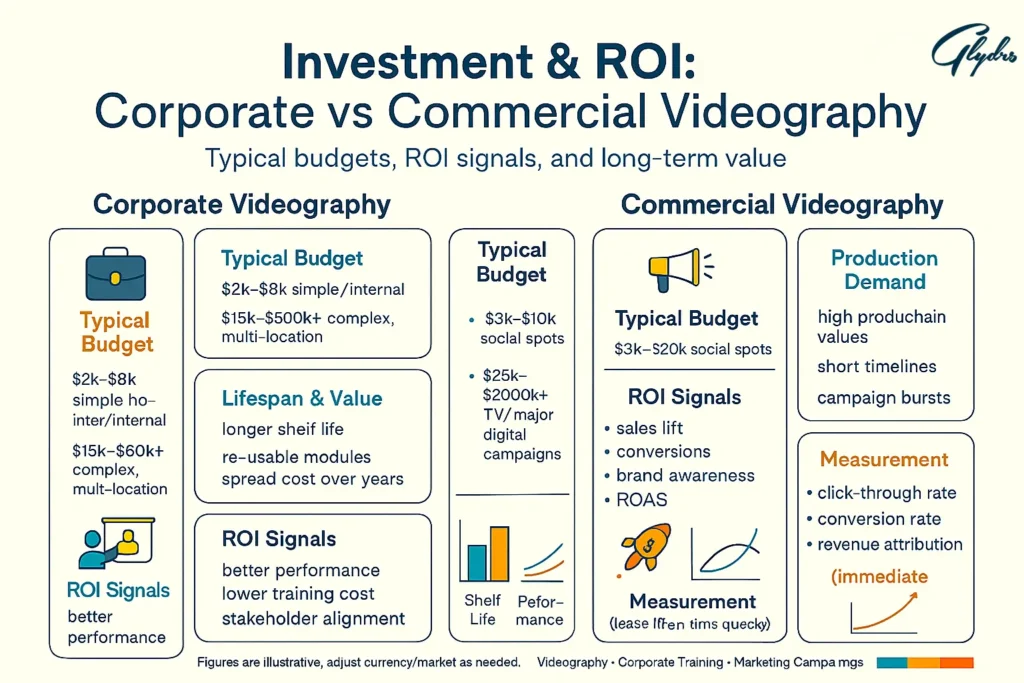
Corporate video budgets typically range from moderate to substantial, depending on production complexity and intended use. Simple training videos or internal communications might cost anywhere from $2,000 to $8,000 for professional production. More complex corporate productions featuring multiple locations, professional talent, or sophisticated post-production can reach $15,000 to $50,000 or more.
The longer lifespan of corporate videos often justifies higher initial investments. Training materials might remain current for years, and company overview videos can serve stakeholders for extended periods. This longevity spreads costs over time and provides ongoing value that pure advertising content cannot match.
Commercial videography represents a different investment paradigm entirely.
Simple social media commercials might start around $3,000 to $10,000, but high-end commercial videography for television or major digital campaigns often requires investments of $25,000 to $200,000 or more. The competition for consumer attention demands production values that can compete with major brand advertising.
Return on investment measurement differs significantly between corporate and commercial videos. Corporate video ROI often appears in improved employee performance, reduced training costs, enhanced stakeholder relations, and more efficient communication. These benefits, while substantial, can be difficult to quantify precisely.
Commercial video ROI typically shows up in more measurable metrics like increased sales, higher conversion rates, improved brand awareness scores, and direct revenue attribution. The immediate nature of commercial video objectives makes ROI tracking more straightforward but also places greater pressure on performance.
Long-term value considerations favor corporate videos in many scenarios. While commercial videos may become outdated quickly due to changing market conditions or seasonal relevance, corporate videos often provide value for extended periods. This durability makes them attractive investments for businesses seeking sustainable returns on video production expenditures.
Making the Right Choice: When to Use Corporate vs Commercial Videos
Choosing between corporate and commercial video approaches depends on your specific objectives, audience, and business context. Understanding when each approach excels helps you allocate resources effectively and achieve desired outcomes.
Corporate videography scenarios typically involve internal audiences or stakeholder communications. When you need to train employees on new procedures, communicate policy changes, or present company performance to investors, corporate video approaches provide the depth and professionalism required. These situations benefit from the informational focus and relationship-building strengths of corporate production.
Employee onboarding represents an ideal corporate video application. New hires need comprehensive information about company culture, procedures, and expectations. Corporate videos can deliver this content consistently while allowing new employees to review materials at their own pace. The investment pays dividends through reduced training time and improved employee integration.
Investor relations communications leverage corporate video strengths in conveying complex information to sophisticated audiences. Quarterly reports, strategic announcements, and company updates benefit from the professional credibility and detailed information delivery that corporate videos provide.
Commercial videography excels when you need to attract new customers.
Launch products, or build brand awareness among target markets. These scenarios require the persuasive power and attention-grabbing capabilities that commercial productions provide. The entertainment value and emotional engagement of commercial videography serve these objectives better than corporate approaches.
Product launches demand the excitement and persuasive power that commercial videography delivers. You need to generate interest among people who may never have heard of your product while communicating key benefits and motivating immediate action. The creative freedom and marketing focus of commercial production align perfectly with launch objectives.
Brand awareness campaigns benefit from the storytelling and emotional connection capabilities of commercial videography. Building recognition and positive associations among target audiences requires the creativity and broad appeal that commercial approaches provide.
Hybrid approaches sometimes offer optimal solutions for complex business needs. Some videos serve both internal and external audiences, requiring elements of both corporate and commercial production. These situations might involve product training for sales teams that also serves as customer education content.
Keep reading and uncover secrets that can change the way you work. TYPES OF VIDEOGRAPHY SERVICES FOR STARTING YOUR OWN BUSINESS
Working with Video Production Professionals
Selecting the right production partner significantly impacts your video project’s success, and different types of productions require different expertise and capabilities. Understanding what to look for in production professionals helps ensure you get the results you need.
Corporate video production teams should demonstrate experience with business communications and stakeholder-focused content. Look for portfolios that include training videos, company profiles, and professional presentations. These producers understand the balance between professional quality and information delivery that corporate videos require.
Technical competence in corporate video production includes reliable audio capture, professional lighting for interview situations, and editing skills that prioritize clarity over artistic flair. Your production team should understand business environments and be comfortable working with executives and employees who may not have on-camera experience.
Communication skills become particularly important in corporate video production.
Producers must understand complex business concepts and translate them into visual content that serves your objectives. They should ask probing questions about your goals and audience to ensure the final product meets your needs.
Commercial videography expertise demands different skills and experience. Look for production teams with marketing and advertising experience who understand the competitive landscape and consumer psychology. Their portfolios should demonstrate creative problem-solving and the ability to communicate compelling messages in short timeframes.
Creative capabilities in commercial videography include storytelling abilities, visual creativity, and understanding of current trends and techniques. Your production team should bring ideas and suggestions that enhance your message rather than simply executing your existing concepts.
Marketing knowledge distinguishes excellent commercial video producers from technically competent filmmakers. The best commercial videography professionals understand target audience psychology, conversion optimization, and the role of video in broader marketing strategies.
Questions to ask potential production partners should explore their experience with your specific type of project, their creative process, and their approach to measuring success. Ask to see relevant work samples and speak with previous clients who had similar objectives.
Timeline and budget management capabilities vary significantly among production professionals. Establish clear expectations about deliverables, revision processes, and project milestones before beginning work. Professional producers should provide detailed proposals that outline all aspects of the production process.
Keep reading and uncover secrets that can change the way you work. A STEP-BY-STEP GUIDE TO CREATING AMAZING VIDEO FILMING
Maximizing Your Video Investment Strategy
Strategic thinking about video content helps you maximize returns on production investments while building sustainable content marketing capabilities. The most successful businesses develop comprehensive approaches that leverage both corporate and commercial video strengths.
Integration with the overall marketing strategy ensures your video content supports broader business objectives rather than operating in isolation. Corporate videos should reinforce brand messages and company positioning, while commercial videos should align with sales and marketing campaigns. This coordination amplifies the impact of individual video projects.
Content planning across multiple video types allows for efficient resource utilization and consistent messaging. You might create corporate videos that establish credibility and expertise while developing commercial videos that drive immediate action. This combination provides both short-term and long-term marketing benefits.
Repurposing content between corporate and commercial applications can extend the value of production investments. Training content might be adapted for customer education, while commercial content could be modified for internal team inspiration. Creative repurposing multiplies the return on original production costs.
Measuring success across different video types requires distinct metrics and evaluation methods. Corporate video success might focus on completion rates, comprehension testing, and stakeholder satisfaction. Commercial video measurement emphasizes conversion rates, cost per acquisition, and revenue attribution.
Platform optimization ensures your videos perform well across different distribution channels. Corporate videos might prioritize functionality on internal platforms and professional networks, while commercial videos must perform across social media, advertising platforms, and mobile devices.
Long-term planning helps you build video content libraries that provide ongoing value. Corporate videos with evergreen content serve as permanent assets, while commercial videos require regular updates to maintain relevance and effectiveness.
Keep reading and uncover secrets that can change the way you work. THE BENEFITS OF MULTIMEDIA PRODUCTION IN VIDEO
Your Path Forward: Turning Video Knowledge Into Business Success
Understanding the differences between corporate and commercial videography provides you with a powerful foundation for making strategic video content decisions. The knowledge you’ve gained about audience distinctions, production approaches, and investment considerations positions you to allocate resources effectively and achieve meaningful results from your video initiatives.
Your immediate next step involves honestly assessing your current video needs and objectives. Are you primarily trying to communicate with existing stakeholders or attract new customers? Do you need to educate your team or persuade your market? The answers to these questions will guide you toward corporate or commercial approaches.
Begin by auditing your existing video content to identify gaps and opportunities. Look for areas where the wrong video type might be undermining your objectives or where strategic video investments could solve current business challenges. This analysis will help you prioritize future video projects based on potential impact and resource requirements.
Research potential production partners who specialize in the needed video type. Don’t assume that all video producers can deliver equally effective corporate and commercial videography. Look for demonstrated experience, relevant portfolios, and understanding of your specific industry and objectives.
Start planning your video production strategy with realistic timelines and budgets. Factor in the different production requirements and success metrics for corporate versus commercial videos. Remember that quality video content requires adequate investment in professional production capabilities.
The video landscape will continue evolving, but the fundamental differences between corporate and commercial approaches will remain relevant. By mastering these distinctions and applying them strategically, you’re positioning your business to leverage video content effectively for both internal success and market growth.
Turn your goals into real achievements with our tailored services – request the service now.
Frequently Asked Questions
1- Can one video serve both corporate and commercial purposes?
While it’s possible to create dual-purpose content, the different objectives and audiences of corporate and commercial videos usually make specialized content more effective. Corporate videos prioritize information delivery to stakeholder audiences, while commercial videos focus on persuading potential customers. Attempting to serve both purposes often results in content that doesn’t excel at either objective. However, some content, like company culture videos, can work for both recruitment (commercial) and internal morale building (corporate) with slight modifications.
2- How long should corporate vs commercial videos be?
Corporate videos enjoy more flexibility in length since their audiences typically have a higher motivation to consume complete content. Training videos might run 10–20 minutes, while executive communications could be 3–5 minutes. Commercial videos face stricter attention span constraints, with social media commercials often performing best under 30 seconds and longer-form commercial content rarely exceeding 2–3 minutes. The key is matching length to platform requirements and audience expectations.
3- What’s the biggest mistake businesses make when choosing video types?
The most common error is using corporate video approaches for commercial objectives or vice versa. Many businesses create informational videos when they need persuasive content or attempt to use sales-focused videos for internal communications. This mismatch between content approach and intended outcome wastes resources and fails to achieve desired results. Understanding your primary objective should always drive the choice between corporate and commercial approaches.
4- Do I need different production teams for corporate and commercial videos?
While some production companies excel at both types, the skill sets and experience required for corporate and commercial videography differ significantly. Corporate video producers need business communication skills and professional presentation capabilities. Commercial video producers require marketing knowledge, creative storytelling abilities, and an understanding of consumer psychology. Evaluate potential partners based on their relevant experience rather than assuming all video producers can handle both types equally well.
5- How often should I update my corporate and commercial videos?
Corporate videos typically have longer lifespans since they focus on relatively stable information like company values, training procedures, and organizational structure. These might need updates every 2–3 years or when significant changes occur. Commercial videos require more frequent updates to maintain relevance and effectiveness, especially those tied to specific products, offers, or seasonal campaigns. Social media commercial content might need refreshing every few months to maintain audience engagement and platform algorithm performance.
No Comments