

23 Dec How to product a video production to Rocket your Business?
Product Video Production Matters in the Fast-Paced US Market
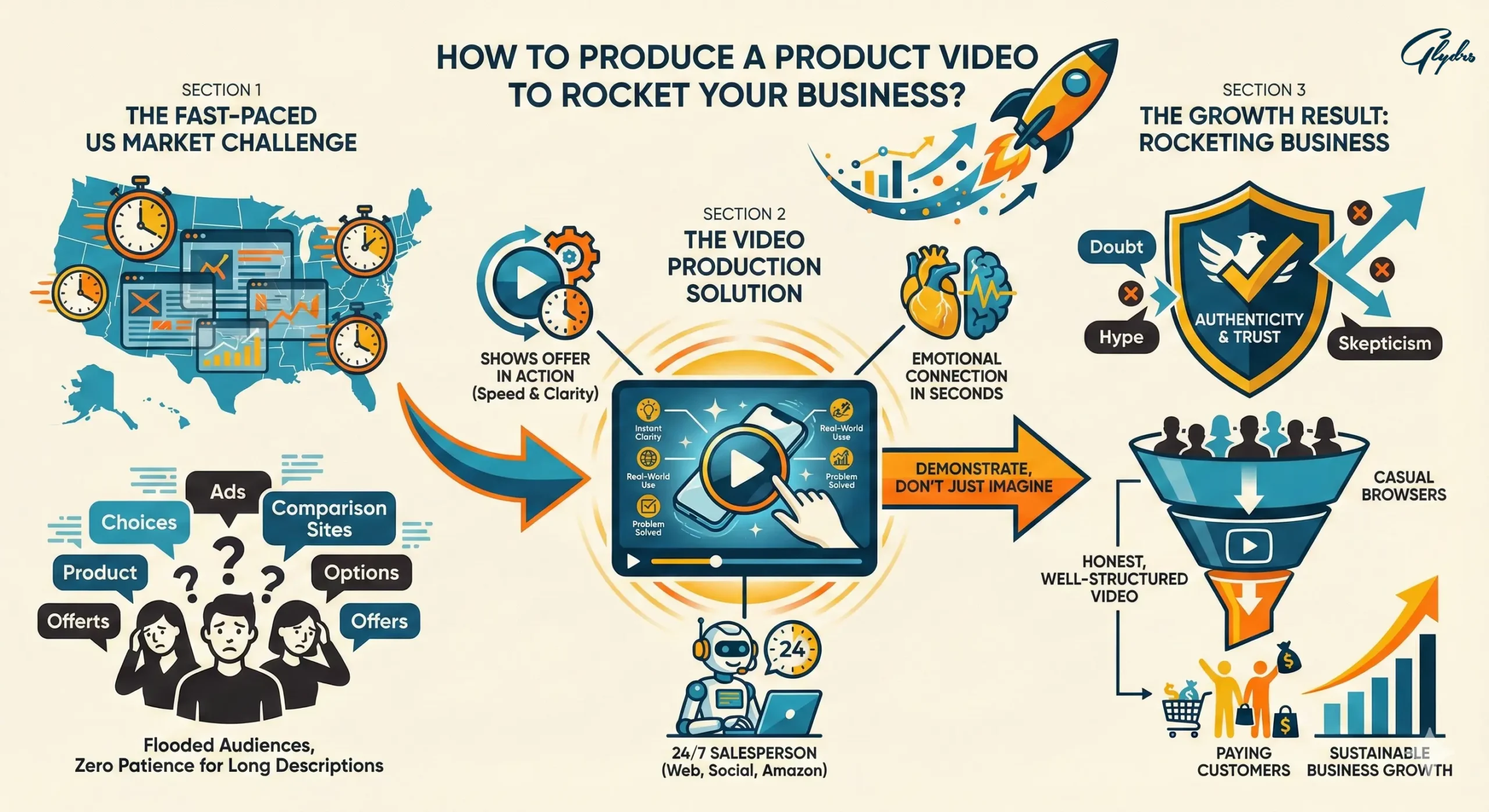
In the fast-paced U.S. market, product video production has become one of the most effective ways to rocket your business growth. American customers are flooded with choices, comparison sites, and ads on every screen, so they rarely have time—or patience—to read long product descriptions. A strong product video changes that. It shows your offer in action, explains the benefits quickly, and creates an emotional connection in a matter of seconds.
Instead of asking prospects to imagine how your product works, you demonstrate it clearly: how it looks, how it’s used, and how it solves a real problem in their daily life. Whether you sell software, physical products, or services, a well-produced video helps people “get it” instantly. It becomes a salesperson that works 24/7 on your website, social media, Amazon listing, or landing pages. For American audiences who expect clarity, speed, and authenticity, this is critical.
They want to see proof, not hype. When your product video feels honest, well-structured, and visually appealing, it builds trust and reduces doubt. That trust is what encourages visitors to stay longer, click deeper, and move closer to buying. Over time, smart product video production turns casual browsers into engaged viewers—and engaged viewers into paying customers.
Defining Your Target Audience and a Clear Goal Before You Hit Record
Before you hit record, the first step in effective product video production is to define your audience and your goal in a very specific way. Many U.S. businesses make the mistake of trying to talk to “everyone,” which makes the video feel generic and weak. Instead, ask yourself: who exactly am I speaking to, and what do I want them to do after watching? Are you targeting busy American parents shopping on their phone, B2B decision-makers comparing software, fitness lovers looking for gear, or creative professionals searching for better tools?
Each group cares about different benefits—speed, savings, simplicity, prestige, safety, or performance. Your main goal might be to get them to add to cart, book a demo, start a free trial, or visit a store. Once this is clear, you can shape your script, visuals, and call to action around that one objective. This focus keeps your video tight and powerful.
Instead of listing every feature, you highlight the few that matter most to that specific viewer. In the U.S. market, where attention is short and competition is intense, this kind of targeted approach is the difference between “just another video” and a product video that actually drives results.
Crafting a Simple, Persuasive Story for Your Product Video
Once you know who you’re targeting and what you want them to do, the next step in product video production is crafting a simple, persuasive story. A good product video isn’t just a list of features; it follows a structure that feels natural to U.S. buyers. Start with a strong hook in the first few seconds—show the problem your audience faces or a bold promise that speaks directly to their pain point. Then introduce your product as the clear solution, focusing on benefits first and features second.
For example, instead of saying “this blender has 1200 watts,” show how quickly it makes a smooth breakfast for a busy American family. Use plain, friendly language that sounds like real people, not technical manuals. Break the story into clear beats: problem, solution, how it works, social proof, and a call to action. If you’re selling software, show the screen and walk through a key workflow; if it’s a physical product, show close-ups, real-life use, and “before and after” moments.
Keep the script tight and focused—most high-performing product videos for social ads in the U.S. are 15–60 seconds, while website demos might run 1–3 minutes. At every stage, ask: does this line help my viewer understand or feel something that makes buying easier? If not, cut it. When your product video production is built around a clear, simple story, viewers stay engaged long enough to hear your message and take the next step.
Visual and Production Choices That Build Trust and Professionalism
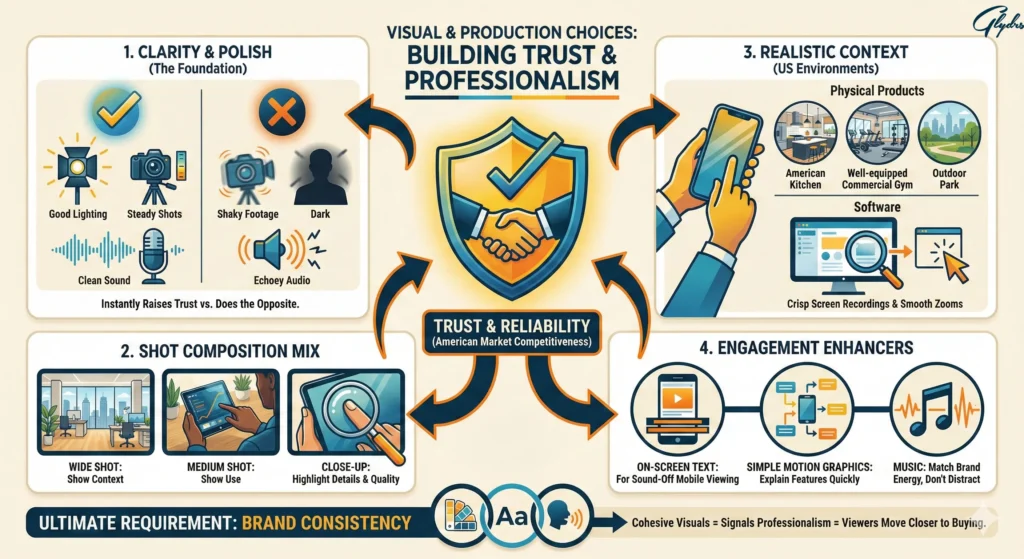
With your story in place, the visuals and production choices are what make your product video production look professional enough to compete in the American market. You don’t always need a Hollywood budget, but you do need clarity and polish. Good lighting, steady shots, and clean sound instantly raise trust—shaky, dark, or echoey footage does the opposite. Use a mix of wide shots to show context, medium shots to show how the product is used, and close-ups to highlight details and quality.
For e-commerce items, show the product from multiple angles, in real hands, and in realistic U.S. environments—kitchens, gyms, offices, cars, or outdoor spaces. For software, use crisp screen recordings with smooth zooms and highlights so viewers can follow along easily. Add on-screen text to emphasize key benefits, knowing many Americans watch with the sound off on mobile. Music should match the brand’s energy but never distract from the message.
Simple motion graphics—icons, arrows, callouts—can help explain features quickly. Above all, keep the visual style consistent with your brand: colors, fonts, and tone should match your website and social channels. When your product video production looks cohesive and intentional, it signals professionalism and reliability, making it much easier for viewers to trust your offer and move closer to buying.
Distributing Your Product Video Across Website, Social, and Ads
Once your video is ready, smart distribution is what turns product video production into real business results in the U.S. market. Think of your video as a flexible asset, not a one-time post. Start with your website: place the main product video above the fold on your product page or landing page so visitors see it immediately. Add shorter versions to your homepage, FAQ pages, or pricing page to reinforce key messages. Then move to social media. Create vertical cuts for Instagram Reels, TikTok, and YouTube Shorts, and slightly longer horizontal versions for YouTube, Facebook, and LinkedIn.
Each platform has its own culture, so adjust your captions, hashtags, and hooks to match—more playful and fast-paced on TikTok, more professional and benefit-focused on LinkedIn. In email marketing, use an eye-catching thumbnail or GIF that links to your video, inviting subscribers to “watch how it works in under 30 seconds.” For paid ads, test different versions of your product video production as top-of-funnel creatives to attract cold audiences and as remarketing assets for people who have already visited your site.
U.S. buyers often need multiple touchpoints before they buy, so seeing your product video across several channels—always telling the same clear story—builds familiarity and trust. By planning distribution from the start, you make sure your video works hard everywhere your ideal customer spends time online.
Using Data and A/B Testing to Improve Product Videos Continuously
To truly rocket your growth, treat product video production as an ongoing, data-driven process instead of a one-time project. American digital platforms give you powerful analytics that show exactly how your videos perform: view-through rates, watch time, click-through rates, add-to-cart behavior, and conversions. Use this data to refine your creative. If many viewers drop off in the first five seconds, your hook needs to be stronger or shorter. If lots of people watch but don’t click, your call to action might not be clear or compelling enough.
Create A/B tests where you change only one element at a time—opening shot. Headline, overlay text, or offer—and see which version wins. Over time, you’ll discover patterns: what kind of storytelling, length, pacing, and visuals work best for your U.S. audience. You can then apply those insights to future product video production, making each new video more effective than the last. This continuous improvement approach turns your content library into a long-term growth engine.
Instead of guessing what might work. You build a proven system where every product video is informed by real customer behavior. Helping you lower acquisition costs, increase conversions, and scale with confidence.
Building Social Proof with Testimonial and User-Generated Product Videos
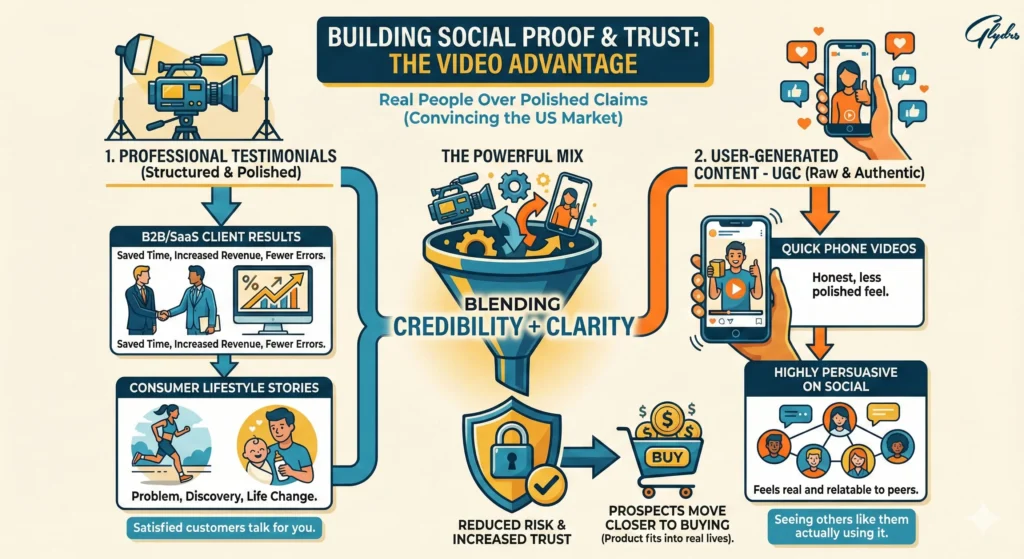
Another powerful way product video production can rocket your business in America is by building social proof and trust through real people, not just polished visuals. U.S. customers are used to big claims. What convinces them is seeing others like them actually using and loving your product. That’s where testimonial and user-focused product videos come in. Instead of you talking about how great your offer is, satisfied customers do it for you.
You can film short interviews, day-in-the-life clips, or simple reactions where people talk about the problem they had. How they discovered your product, and what changed after they started using it. For SaaS or B2B products, this might be a client walking through the results they achieved—saved time, increased revenue, fewer errors. For consumer brands, it could be lifestyle stories. A runner showing their gear, a parent showing a baby product, or a creator showing the tools they rely on.
You can also encourage user-generated content (UGC), where American customers film their own quick product videos on their phones. These clips may be less polished, but they feel honest and relatable, which is highly persuasive on social platforms. When you blend professional product video production with authentic customer voices, you create a powerful mix of credibility and clarity. Prospects don’t just see what the product does. They see how it fits into real lives—and that makes buying feel far less risky.
Keep reading and uncover secrets that can change the way you work. How Multimedia Companies Bring Ideas to Life in America
Using Product Video Production for Training, Sales, and Partnerships
Beyond direct sales, product video production can also strengthen your brand’s internal operations and partnerships in the U.S. market. For internal teams, product videos become a training tool. New hires can watch clear demos to understand features, benefits, and positioning much faster than reading manuals. Sales reps can use video snippets in presentations, pitches. And follow-up emails to reinforce key points without repeating the same explanation over and over.
Channel partners, distributors, and retailers can embed your official product videos on their own sites. Ensuring that your message stays consistent even when someone else sells your product. This is especially useful if you sell nationwide through e-commerce platforms, marketplaces. Or physical stores. Clear, high-quality videos help store associates and online support teams answer questions more accurately. Which leads to fewer returns and happier customers.
For investors and strategic partners. A sharp product video can quickly communicate your value proposition in meetings or pitch decks—making it easier to win support and funding. In all these cases, product video production multiplies the impact of your product knowledge. Turning it into an asset that educates, persuades, and aligns people inside and outside your company.
Keep reading and uncover secrets that can change the way you work. How can promotional video production help your business?
Positioning Your Brand Higher with Premium Product Video Content
In a crowded American marketplace. Product video production also helps you position your brand at a higher level, even if you’re a small or mid-sized business. Many U.S. consumers and B2B buyers judge quality based on what they see in the first seconds of contact. If your competitors rely on blurry photos, stiff copy, or generic stock images. A clean, well-thought-out product video instantly sets you apart. It communicates that you care about the details, that you invest in your customer’s experience. And that you believe in your product enough to show it up close.
This perception is especially important when you’re selling online without a physical showroom. A strong video becomes your digital shelf. It allows people to “touch” the product visually—see textures, colors, size, and features—before they buy. You can also tailor product video production to different segments of the U.S. market by creating variations that speak to specific industries, lifestyles. Or regions, all while keeping the same core brand identity.
Over time, this level of intentionality doesn’t just drive individual sales. It shapes how people talk about your brand, recommend you to others. And remember you when they’re ready to purchase again.
Keep reading and uncover secrets that can change the way you work. How to Do E-Learning Video Production Right (2025)
Turning Product Video Production into a Long-Term Growth Engine for Your Business
Ultimately, what makes product video production so powerful for rocketing your business in America is the way it ties everything together. Clarity of message, emotional impact, proof, and performance data. A great product video forces you to focus on what truly matters to your customer. Then delivers that message in a format they actually enjoy consuming. It works across your website, social media, ads, email, sales presentations, and partner channels. Giving you one asset that can support dozens of touchpoints.
When you treat video as a strategic system—not just a one-time creative project. You can test, refine, and scale what works. Reducing your cost per acquisition while increasing conversions and lifetime value. In a digital landscape where attention is the most valuable currency, investing in thoughtful. Targeted product video production is one of the smartest moves you can make.
It helps strangers become interested, helps prospects feel confident. And helps customers feel proud of what they’ve chosen. Creating a growth engine that keeps pushing your business forward long after the first upload.
Turn your goals into real achievements with our tailored services – request the service now.
FAQ- Product Video Production
1- How can product video production help my business grow in the U.S. market?
Product video production helps American customers quickly understand what your product does and why it matters. By showing the product in action and solving a real problem in seconds, you build trust, reduce doubt, and turn casual browsers into buyers across your website, social media, and online marketplaces.
2- Why is defining a clear target audience and goal important before creating a product video?
Because trying to speak to “everyone” usually convinces no one. When you know exactly who you’re talking to and what single action you want—add to cart, book a demo, start a free trial—you can focus the script and visuals on the few benefits that matter most to that specific American buyer.
3- What makes a product video story persuasive for U.S. customers?
A persuasive product video starts with a strong hook that shows a real problem, then clearly presents your product as the solution, focusing on benefits over technical details. Short, simple, real-life scenarios, social proof, and a clear call to action match how U.S. audiences make fast, emotional, and research-driven decisions.
4- Where should I use my product videos to get the best results in the U.S. market?
Use your main product video above the fold on key product or landing pages, then repurpose shorter versions for Instagram Reels, TikTok, YouTube Shorts, Facebook, LinkedIn, and email campaigns. Combine this with paid ads and remarketing so U.S. buyers see a consistent message across multiple touchpoints before they decide to buy.
5- How can I improve my product videos over time and turn them into a growth engine?
Track performance data like watch time, click-through rate, and conversions on each platform, then A/B test different hooks, lengths, overlays, and calls to action. By using real behavior from U.S. viewers to refine each new video, you build a proven system where every product video performs better, lowers acquisition costs, and drives long-term growth.
No Comments