

30 Dec What is Industrial Video Production?
What Industrial Video Production Means for American Industry
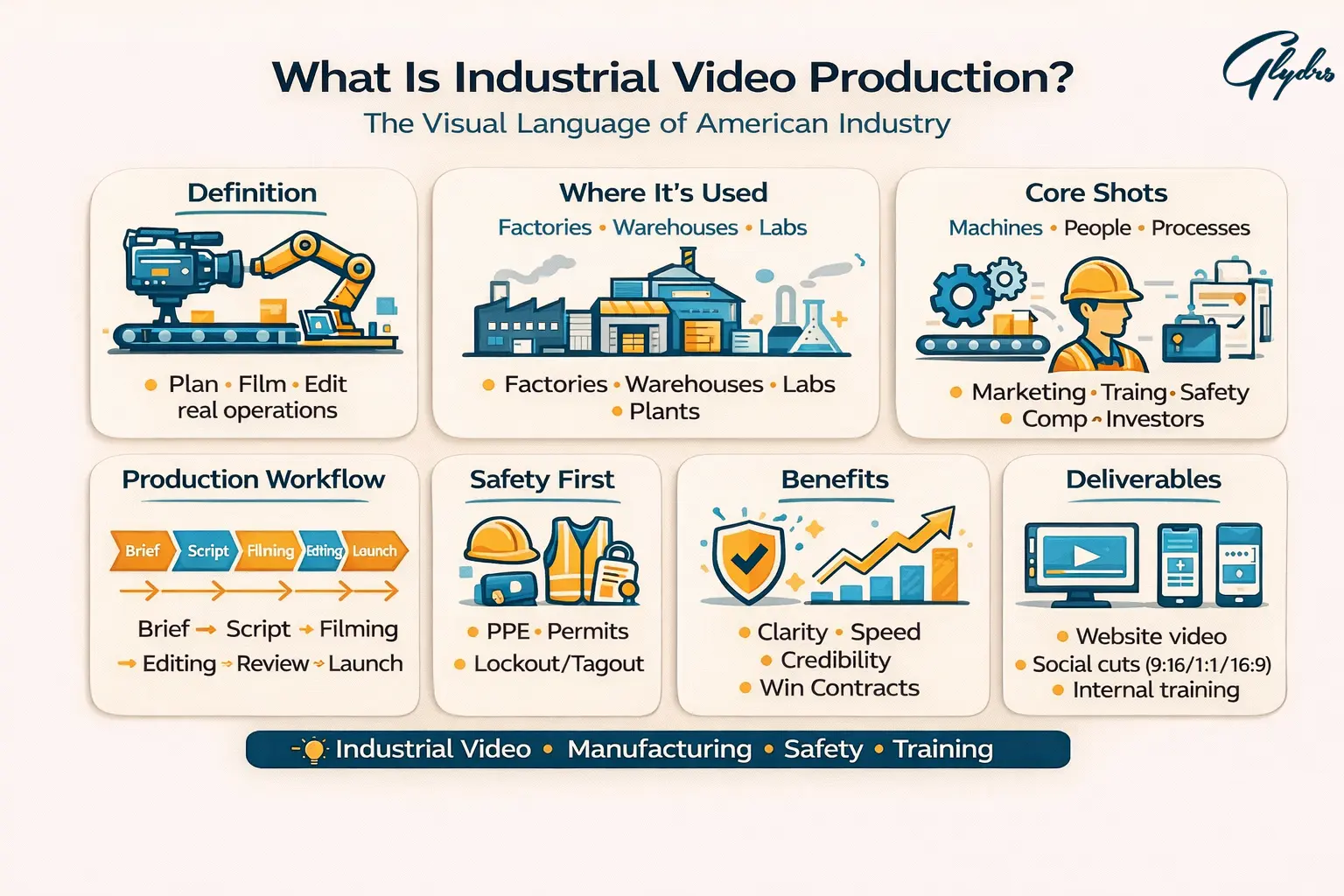
In a country built on making, building, and moving things, Industrial Video Production has become the visual language of American industry. At its core, industrial video production is the process of planning, filming, and editing videos that showcase how things are designed, manufactured, assembled, inspected, or maintained. Unlike glossy consumer ads, these videos focus on real machines, real people, and real processes inside factories, warehouses, labs, and industrial facilities.
They help explain complex operations that are difficult to describe with text or still photos—such as how a production line works, how a heavy machine is installed, or how a safety procedure must be followed step by step. For manufacturers, logistics companies, energy providers, and engineering firms across the U.S., industrial video production turns invisible expertise into clear, shareable content. It’s used for marketing, training, safety, compliance, recruitment, and investor relations.
Whether you’re a small fabrication shop in Ohio or a multi-site manufacturer across Texas and California, industrial video gives you a powerful way to show what you do best: precision, reliability, scale, and innovation. When done well, these videos don’t just look impressive—they help you win contracts, train people faster, and build long-term trust with customers and partners.
Key Types of Industrial Videos Used by US Companies
To really understand Industrial Video Production, it helps to look at the main types of videos industrial companies in the U.S. create. One common format is the facility or plant tour: a guided walkthrough that highlights your production floor, automation, quality checks, and safety culture. Another is the process or manufacturing video, which zooms in on how a product is made from raw material to finished goods—ideal for customers who care about quality and traceability.
Product demonstration videos show machines or components in action, often explaining technical features in language that buyers can easily understand. Then there are training and safety videos used internally to teach employees how to operate equipment, follow SOPs, and avoid hazards. Case study and testimonial videos let real clients talk about results, while recruitment videos show American workers what it’s like to be part of your team.
All of these fall under industrial video production, and together they form a toolkit that supports your entire business lifecycle—from first contact with a prospect to onboarding a new hire on the factory floor.
Planning and Pre-Production Inside Complex Industrial Environments
Before any camera comes out, effective Industrial Video Production in the U.S. starts with detailed planning and pre-production. Industrial environments are complex—there are safety rules, restricted areas, noisy machines, and time-sensitive operations to respect—so a professional crew never just “shows up and shoots.” Instead, they begin with discovery: learning about your company’s goals, target audience, key messages, and the specific processes or equipment that need to be filmed.
Together with your team, they decide which lines, machines, or steps best represent your capabilities and what story the video should tell. Site visits or virtual walk-throughs are used to identify camera positions, lighting challenges, and safety requirements. Scripting and shot lists are then created to outline every scene: which operator will demonstrate a task, which angles will show important details, and which on-screen graphics or text will clarify technical points.
Because American facilities must comply with OSHA and internal safety protocols, production teams coordinate with EHS managers to ensure everyone on set has the right PPE and follows all rules. This careful pre-production phase is what allows Industrial Video Production to run smoothly on the day of the shoot—minimizing disruption to your operation while capturing footage that is accurate, safe, and visually compelling.
Filming on the Factory Floor: Turning Operations into Clear Visuals
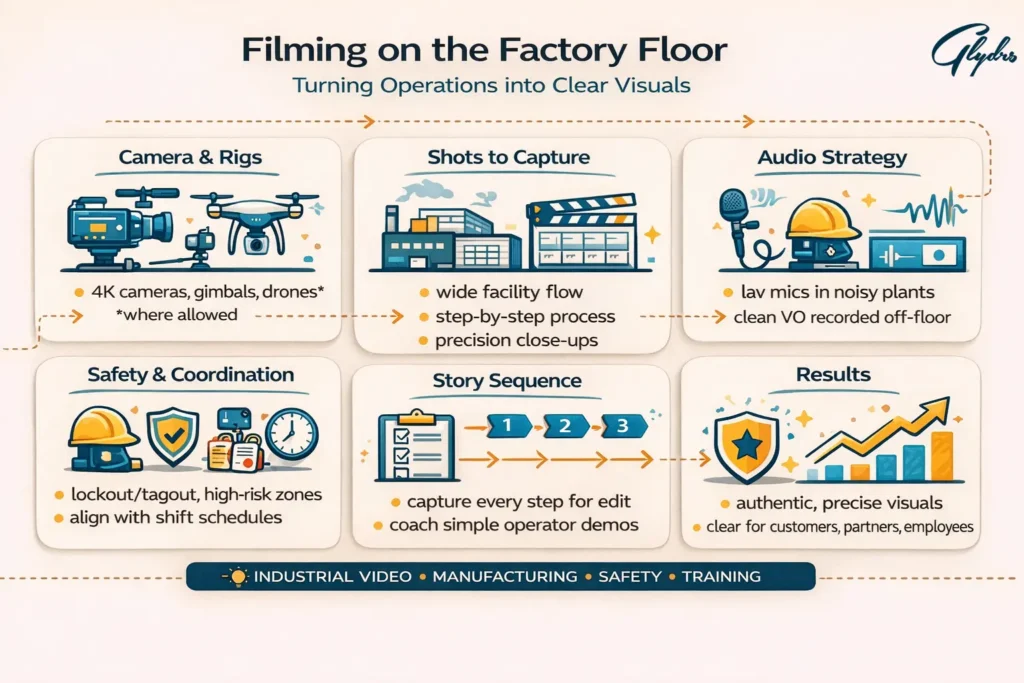
On shoot day, Industrial Video Production turns your operations into clear, powerful visuals that non-experts can understand. Crews may use a mix of tools—4K cameras, gimbals, drones (where allowed), macro lenses, and time-lapse setups—to capture both the scale and the fine detail of your process. Wide shots show the size of your facility and the flow of work across the production line, while close-ups highlight precision machining, automated robotics, or careful manual craftsmanship.
In noisy American plants, audio is handled carefully: interview subjects are miked properly, and voice-overs are often recorded in controlled environments for clarity. Safety remains a priority, with crews coordinating closely around shift schedules, lockout/tagout procedures, and high-risk zones. Footage is captured with editing in mind, making sure each step in the process can be shown in a logical sequence later.
When needed, operators or engineers are coached on simple, camera-friendly actions—pressing controls, inspecting parts, or demonstrating quality checks—so the video clearly communicates what matters. This blend of technical respect for your operation and visual storytelling is what makes Industrial Video Production so effective in the U.S.: it reveals the real work behind your products in a way that feels authentic, precise, and easy for customers, partners, and employees to follow.
Post-Production: Turning Raw Footage into a Clear Industrial Story
Once filming is complete, the heart of Industrial Video Production shifts into post-production, where raw footage is transformed into a clear, polished story. Editors organize the clips, remove anything redundant, and assemble sequences that follow the real workflow of your American facility—from incoming materials to finished product. They balance technical accuracy with simplicity, so non-engineers can still follow what’s happening.
Color correction helps machines, safety markings, and brand colors look clean and consistent, while audio editing removes background noise and ensures voices are easy to understand. Voiceover scripts are often written to translate complex processes into everyday language, and recorded by narrators whose tone matches your brand—professional, friendly, or authoritative. On-screen text and diagrams can highlight key specs, certifications, or safety steps without overwhelming viewers.
Motion graphics and 2D/3D animations are sometimes added to show internal mechanisms or flow paths that cameras can’t see. In the American market, where buyers expect a high standard of visual communication, this post-production stage is essential. It’s where Industrial Video Production turns messy reality into a concise, accurate, and visually engaging explanation of what makes your operation valuable and reliable.
Using Industrial Videos Across Marketing, Sales, and Training
Once the final videos are ready. Industrial Video Production becomes a powerful tool across your marketing, sales. And training channels in the U.S., A facility tour or manufacturing video can live on your website’s homepage or “About” page, helping prospects quickly understand your capabilities without reading long text. Product and process videos can be embedded on service pages, used in sales presentations, or shared during online demos with American buyers who may never visit your plant in person.
For trade shows. Looping industrial videos on large screens attracts foot traffic and gives your sales team a visual way to start conversations. On LinkedIn and email campaigns, short clips from your industrial video production can position your company as modern. Transparent and technically strong. Internally, the same content—or extended versions. Can be used to onboard new employees, standardize training across multiple U.S. sites, and reinforce safety culture visually.
Because industrial videos show real facilities, people, and processes. They create a level of trust that brochures and static photos can’t match. Prospects see your scale, your quality checks, and your attention to detail. This can be a deciding factor when American companies choose a manufacturing or industrial partner.
Standing Out with Proof: Industrial Video for Trust and Compliance
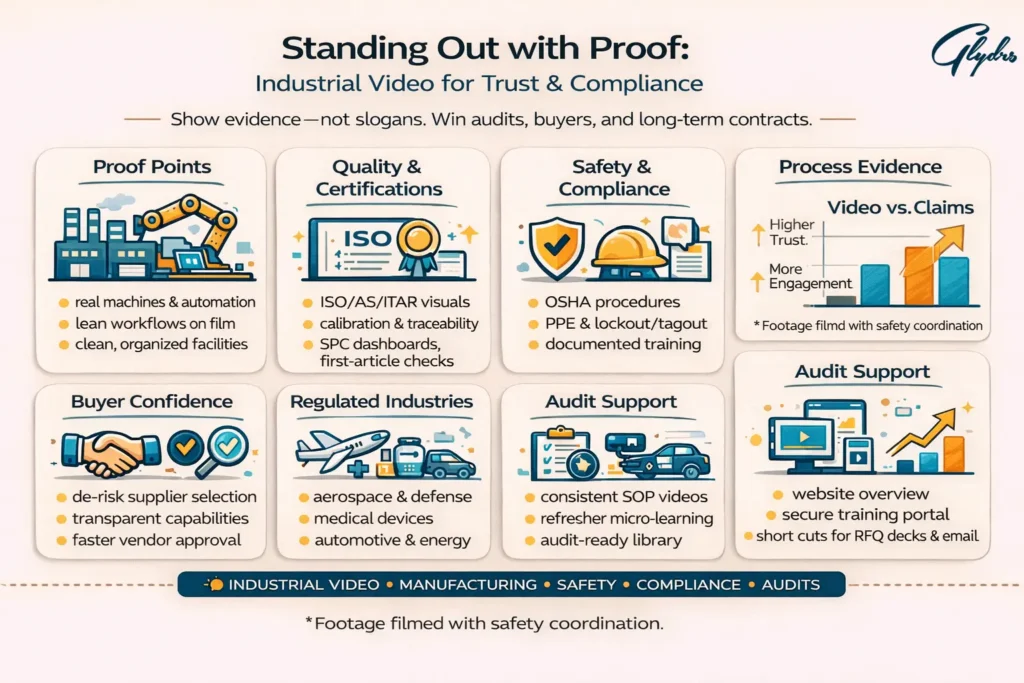
Beyond immediate sales and marketing benefits. Industrial Video Production also helps American companies differentiate themselves in crowded, price-sensitive markets. When buyers compare multiple suppliers, they often see similar claims: “high quality,” “on-time delivery,” “ISO-certified.” Industrial videos cut through that sameness by showing proof instead of slogans. A well-crafted video can highlight your advanced machinery, automation, and lean workflows. And a clean environment. And safety culture in a way that written proposals never can.
For buyers in aerospace, automotive, and medical devices. And other regulated U.S. industries, this visual proof reduces perceived risk. They can see that you follow procedures, maintain standards, and treat quality seriously. Industrial video production also supports compliance and audits. Safety and training videos document that you have clear, consistent processes in place. This can be useful when demonstrating OSHA compliance or industry-specific standards.
In addition, these videos help communicate complex technical ideas to non-technical stakeholders—such as executives. Procurement teams, or investors, who need to understand your capabilities without deep engineering knowledge. By making your strengths visible and understandable. Industrial Video Production becomes a strategic asset in winning long-term contracts and building strong partnerships across the American industrial landscape.
Keep reading and uncover secrets that can change the way you work. How can promotional video production help your business?
Attracting Talent and Training Teams with Industrial Video Production
Another key value of Industrial Video Production in the U.S. is its impact on workforce development and company culture. Manufacturing and industrial sectors face ongoing challenges in attracting and retaining skilled workers. Especially younger generations who may not initially consider industrial careers. Recruitment-focused industrial videos can change perceptions by showing modern equipment, clean facilities, collaborative teams, and real career paths.
Job candidates get a realistic sense of what it’s like to work at your plant. This helps attract people who are genuinely interested and reduces mismatched expectations. Once hired, employees benefit from video-based training that explains tasks visually, step by step. Instead of relying only on manuals or shadowing. Operators can rewatch clear demonstrations whenever they need a refresher. This reduces errors, speeds up onboarding. And supports consistent performance across shifts and locations.
Industrial Video Production also reinforces pride in work. When employees see their skills and contributions featured in professional videos shared publicly. It builds recognition and engagement. In a sector where experience and know-how are critical. Using video to capture and share that knowledge helps American industrial companies protect against skill loss. Support continuous improvement, and create a stronger, more informed workforce at every level.
Keep reading and uncover secrets that can change the way you work. How to product a video production to Rocket your Business?
Measuring Performance and Innovating with Advanced Industrial Video
In a digital-first American economy, successful Industrial Video Production also means measuring performance and using insights to improve over time. Instead of treating each video as a one-off project. Leading U.S. manufacturers and industrial brands see them as long-term assets that should deliver clear returns. Analytics from your website, YouTube, and LinkedIn. And email platforms can show how many people watch your industrial videos. How long they stay engaged, and what they do next—visit a contact page. Download a spec sheet or request a quote.
Sales teams can track which videos are most effective in moving prospects from initial interest to serious discussion. Training managers can monitor completion rates and quiz scores for safety or SOP videos. All of this data helps you refine your Industrial Video Production strategy. Which topics resonate most? Which processes need more explanation? And which formats (live-action, animation, drone footage, time-lapse) work best for your U.S. audience?
Emerging technologies—like 360° video, AR, VR, and interactive hotspots. We are creating even more ways to immerse buyers and trainees in complex environments without leaving their desks. By combining clear objectives, professional production, and data-driven iteration. Industrial companies across America can turn video into a continuous improvement loop that supports growth, efficiency, and innovation year after year.
Keep reading and uncover secrets that can change the way you work. How to Do E-Learning Video Production Right (2025)
Why Industrial Video Production Is a Strategic Asset for US Manufacturers
Ultimately, Industrial Video Production is about making the invisible visible and the complex understandable. It answers a simple but important question for your American stakeholders. “What exactly do you do, and why should we trust you to do it well?”. Instead of asking prospects, employees, or partners to imagine your capabilities. You show them—carefully, accurately, and in a format they naturally consume every day.
From plant tours and process breakdowns to safety training, recruiting, and customer case studies. Industrial video sits at the intersection of storytelling and hard reality. It respects the technical precision of manufacturing while speaking in a visual language anyone can grasp. For U.S. companies that build, move, or maintain the physical world, that combination is incredibly powerful. It helps you win more informed customers, onboard safer and more confident employees. And differentiate your brand in a sector where true quality often hides behind factory walls.
When you invest in thoughtful. Well-planned Industrial Video Production, you’re not just creating content. You’re building a permanent, scalable window into the heart of your operation. One that can support your business strategy for years to come.
Turn your goals into real achievements with our tailored services – request the service now.
FAQ- Industrial Video Production
1- What is industrial video production in the context of American industry?
Industrial video production is the planning, filming, and editing of videos that show real machines, people, and processes inside factories, warehouses, labs, and industrial facilities. It explains how things are designed, made, inspected, or maintained in a clear, visual way.
2- What types of industrial videos do U.S. companies use most?
Common types include facility/plant tours, process and manufacturing videos, product demos, safety and training videos, case studies, and recruitment videos. Together, they support marketing, sales, onboarding, safety, and employer branding.
3- Why is planning and pre-production so important in U.S. industrial environments?
Because factories and plants have strict safety rules, noise, restricted areas, and tight schedules. Good pre-production aligns on goals, story, key processes to film, safety requirements, and shot lists—so the crew captures the right footage without disrupting operations.
4- How do industrial videos help U.S. manufacturers win trust and business?
They show proof, not just claims. Buyers can see your machinery, quality checks, cleanliness, and safety culture. This visual evidence reduces perceived risk, supports compliance, and can be the deciding factor when American companies choose a supplier or partner.
5- How can U.S. industrial companies use and improve their videos over time?
They can deploy videos on websites, LinkedIn, trade shows, sales calls, and internal training, then track views, watch time, conversions, and training completion. Using this data, they refine topics, formats, and styles—turning industrial video production into a long-term strategic asset, not a one-off project.

No Comments