

07 Jan Event Videos That Drive Buzz, Shares, and Sales in USA: Your Guide 2026
Why Event Videos Are Essential for US Brands in 2026
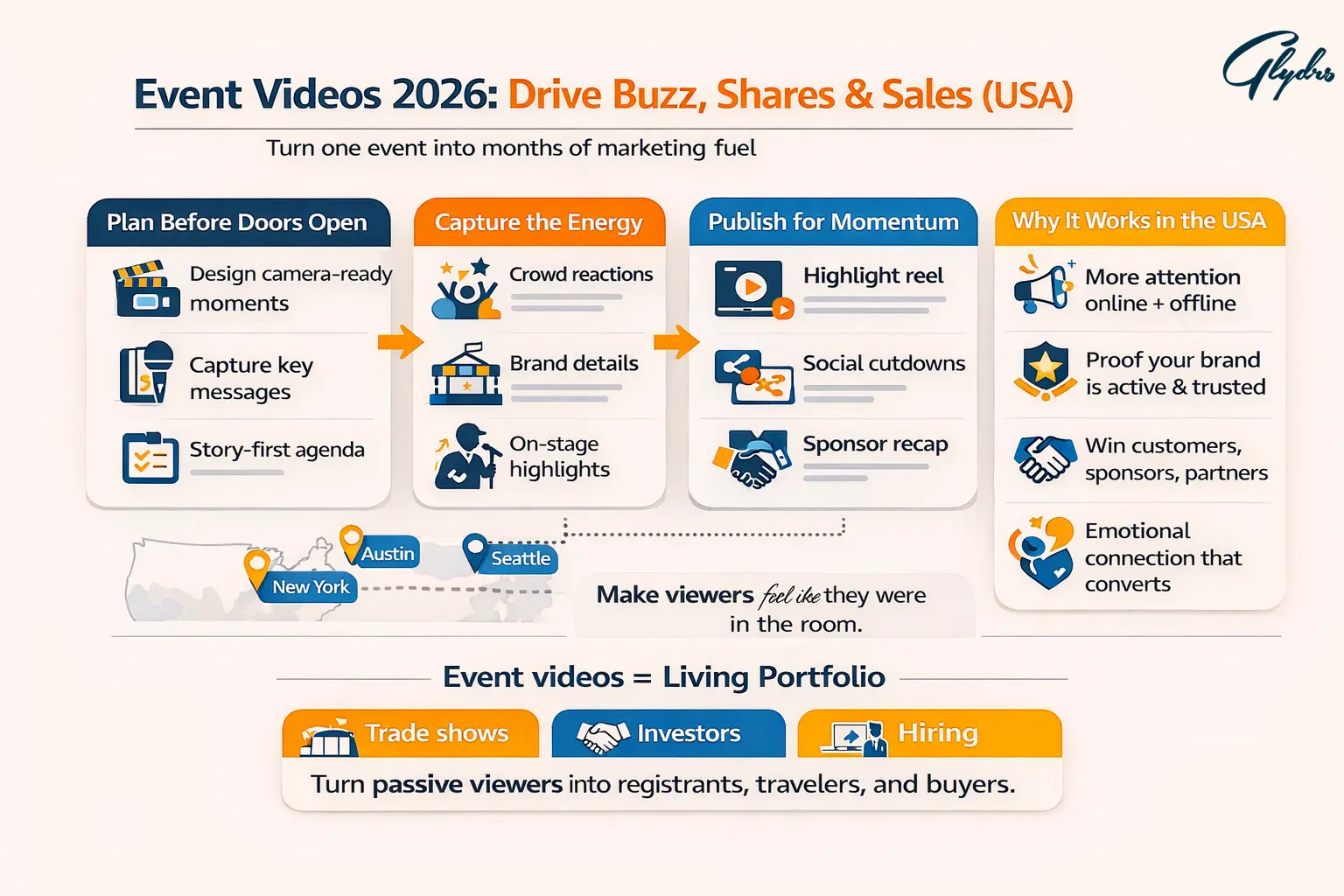
In the crowded American marketplace, where brands fight for attention online and offline, event videos have become one of the most powerful ways to turn a single occasion into months of marketing fuel. A great conference, trade show, product launch, or company retreat might only last a few hours or days, but the right footage can keep driving buzz, shares, and sales long after the lights go down. Instead of relying on a few smartphone clips and random social posts, smart businesses now treat event videos as a core part of their growth strategy.
They plan for video before the doors even open, designing moments that look great on camera, encouraging interactions that tell a story, and making sure their most important messages are captured clearly. When someone in New York, Austin, or Seattle watches your highlight reel, they should feel like they were actually in the room—seeing the energy, hearing the reactions, and understanding why your brand matters. Done well, event videos become proof that your company is active, trusted, and in demand, helping you win new customers, sponsors, and partners who never even attended the event.
For U.S. organizations that need to stand out at trade shows, attract investors, or impress potential hires, these videos act like a living portfolio, showing not just what you do but how it feels to interact with your brand. That emotional connection is what turns passive viewers into people who register, travel, and buy the next time you launch something new.
Turning One Event into a Full Funnel of Event Video Content
To get those results, you need to think of event videos as more than just a recap. In 2026, the most successful brands in the USA are using event videos to support every stage of the customer journey, not only to prove that something happened. Before the event, teaser clips introduce the theme, show behind-the-scenes prep, and highlight speakers or experiences that build anticipation weeks in advance. During the event, real-time social edits—short vertical clips for Reels, TikTok, and YouTube Shorts—keep attendees engaged and trigger FOMO for everyone watching from home or the office.
After the event, polished highlight films, speaker cutdowns, testimonial montages, and sponsor spotlights continue to work for you for months in your ads, email campaigns, and sales decks. Each piece can be tailored for a different platform or audience segment while maintaining a consistent message and visual identity. A B2B conference in Chicago might prioritize thought-leadership edits for LinkedIn, while a music or cultural festival in Miami leans into fast-paced, colorful recap videos for Instagram.
By approaching event videos as a reusable content system instead of a one-off deliverable, you turn every conference, gala, or activation into a content engine that keeps your brand visible, relevant, and shareable across the American digital landscape long after the chairs are stacked and the venue is empty.
Building a Clear Story and Goal for Every Event Video
One of the biggest reasons event videos work so well in the US is that they let you show, not just tell, the story behind your brand. But a powerful video doesn’t start with cameras—it starts with a clear narrative and goal. Before the event, decide exactly what you want viewers to feel and do after watching. Do you want them to register for next year, book a call with your sales team, become a sponsor, or apply to work for you? Each goal leads to a different storyline.
For example, if your focus is ticket sales for future events, your event videos should emphasize energy: full rooms, engaged audiences, networking, and “you had to be there” moments. If your focus is B2B sales, you’ll highlight keynote soundbites, product demos, and real client conversations that show authority and results. Think of your event like a movie and your attendees as the cast: speakers, hosts, sponsors, and guests are all characters with roles to play.
Plan key “hero moments” in advance—product reveals, live demos, awards, crowd reactions—so your video team knows when to be ready. When you structure event videos around a clear narrative arc (build-up → peak moments → emotional close), you get a final edit that feels like a story, not just random clips. That story is what makes people in the US share, comment, and say, “I’m definitely going next time.”
Planning the Shoot to Capture High-Impact Moments On Site
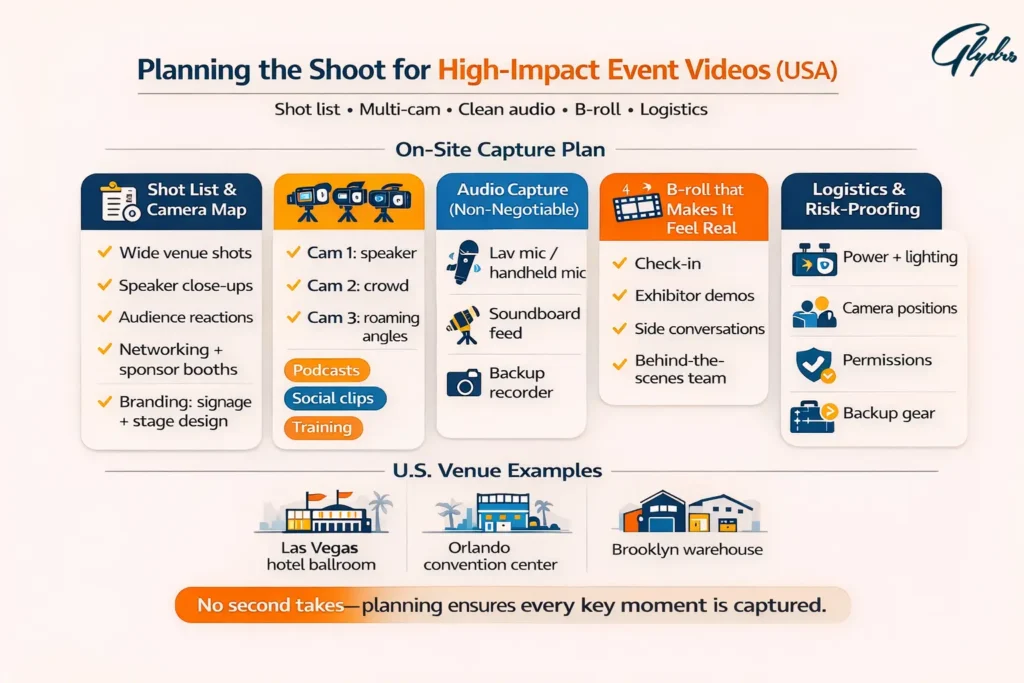
Once your story and goals are clear, the next step is to design the capture plan, so your event videos actually look and sound as impressive as the experience felt in the room. In a busy US venue—whether it’s a hotel ballroom in Las Vegas, a convention center in Orlando, or a warehouse in Brooklyn—there are no second takes on key moments. That’s why professional crews build detailed shot lists and camera plans in advance. They map out wide shots of the venue, close-ups of speakers, audience reactions, networking, sponsor booths, and branding elements like signage and stage design.
Multiple cameras might be used for main sessions: one on the speaker, one on the crowd, and one roaming for dynamic angles. Audio is just as important as video—clean sound from microphones and soundboards ensures your event videos are usable for podcasts, social clips, and training later. B-roll (those in-between moments) is essential too: people checking in, exhibitors explaining products, side conversations, hands-on demos, and behind-the-scenes footage of your team at work.
These details make the final video feel real and immersive to American viewers who weren’t there. By planning logistics—power, lighting, camera positions, backup gear, and permissions—your crew can move smoothly and capture everything you need to tell a complete, high-impact story when the edit begins.
Editing Event Videos into Highlights, Clips, and Social-Ready Assets
After the cameras stop rolling, the real magic of event videos happens in the edit. This is where raw footage from your US conference, expo, or brand activation is shaped into assets that actually drive buzz, shares, and sales. Editors start by organizing clips around your goals: highlight reels for future promotion, speaker cutdowns for thought leadership, testimonials for sales, and short vertical edits for social media. Music, pacing, and color all influence how American viewers feel as they watch.
Faster cuts and upbeat tracks work well for energetic public events; slower pacing and clean sound design suit executive roundtables or high-end B2B gatherings. On-screen titles and motion graphics can emphasize key quotes, stats, or calls to action—“Register Now,” “Book a Demo,” “Join Us in 2027.” Captions are non-negotiable: many US viewers watch with the sound off on mobile, so burned-in subtitles ensure your message still lands. Branded elements—logos, color palettes, lower thirds—keep your look consistent with your website and social channels.
Smart editing also means thinking in “modules,” not just one long video. A single keynote might yield a 90-second highlight, five short clips, a teaser, and a looping background for booths or lobbies. When your post-production is planned this way, each event becomes a content goldmine instead of a single recap that gets posted once and forgotten.
Plugging Event Videos into Your US Marketing and Sales Funnel
The real business power of event videos appears when you plug those finished edits into your broader US marketing and sales ecosystem. On your event or company website, a hero recap video instantly shows visitors what your experience feels like, reducing hesitation around travel, ticket prices, or time away from work. On landing pages for the next edition, you can embed highlight reels and speaker clips to boost registrations and justify premium pricing.
Sales teams can drop tailored event videos into outreach emails or follow-ups—“Here’s a two-minute recap of our last healthcare summit in Boston”—making cold outreach warmer and more credible. Sponsors and partners in the US love reusable proof of their involvement: branded cuts featuring their logo, booth, or session help you deliver more value and make renewal conversations easier. Social media becomes a long tail: over weeks and months, you drip out short event videos as thought-leadership posts, behind-the-scenes stories, and throwback content that keeps your brand visible between events.
You can even turn full-length recordings into gated on-demand sessions, generating leads long after the in-person experience ends. In short, when you integrate event videos into every part of your funnel, your event stops being a one-day spike and becomes a long-term engine for awareness, authority, and revenue across the American market.
Using Event Videos to Build Community, Culture, and Brand Credibility
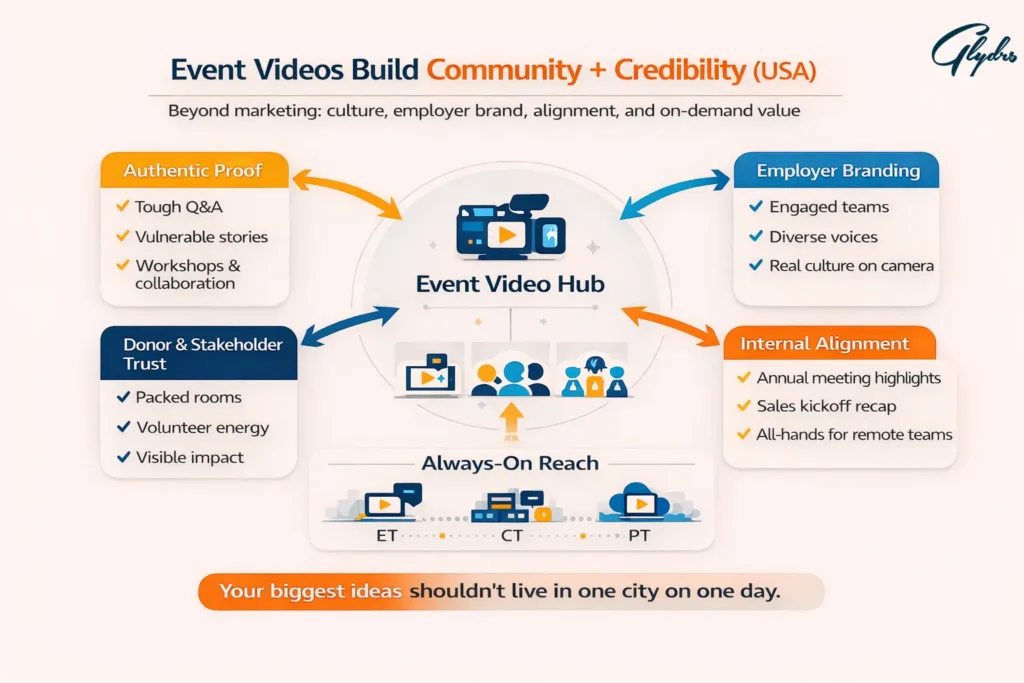
Beyond marketing and sales, smart event videos can also strengthen community, culture, and credibility for US brands long after guests go home. When you capture authentic moments—participants asking tough questions, speakers sharing vulnerable stories, teams collaborating in workshops—you’re documenting proof that your event is more than just a stage and a logo. Those clips become powerful assets for employer branding in America’s competitive talent market. A short video showing engaged teams, diverse voices, and real collaboration can attract candidates far better than a long job description.
Internally, you can use event videos to align distributed teams: highlight reels from an annual meeting, sales kickoff, or all-hands can be shared with employees who couldn’t travel, so they still feel part of the story. For associations and nonprofits, event videos validate impact to donors and stakeholders—seeing packed rooms, engaged volunteers, and real beneficiaries is far more persuasive than reading a report. And because 2026 continues to blur lines between in-person, virtual, and hybrid formats, event videos play an important bridging role.
Key sessions can be recorded and repurposed as on-demand webinars, mini-courses, or member-only content libraries. That means your biggest ideas don’t just live in one city on one day—they remain accessible to American audiences in every time zone, adding ongoing value to memberships, partnerships, and programs.
Keep reading and uncover secrets that can change the way you work. How to product a video production to Rocket your Business?
Repurposing Live Sessions into Evergreen On-Demand Event Content
To truly get results from event videos in the USA. You also need to measure what’s working and refine your approach over time. Instead of simply posting a recap and hoping for views, treat each video like a campaign asset with clear KPIs. Impressions, watch time, shares, clicks, registrations, demo requests, or sponsor inquiries. Use UTM links and landing pages tied directly to specific event videos so you can see which edits drive the most sign-ups or sales.
A/B test different thumbnails, hooks, and captions on platforms like LinkedIn, YouTube, Instagram, and TikTok. Sometimes a new opening line or shorter cut makes a huge difference for US viewers with limited time. Ask registrants and attendees how they heard about you and track how often they mention video. For future planning, analyze which moments performed best. Was it crowd energy, a big announcement, a product demo, or a specific speaker quote?. Use those insights to design your next event with video in mind—building in more “moments worth capturing” that you know your American audience will respond to.
Over a few event cycles, this data-driven approach turns event videos from a nice-to-have into a predictable growth lever. You know what kinds of stories, formats, and platforms consistently generate buzz, shares. And sales in your market, and you can invest with confidence.
Keep reading and uncover secrets that can change the way you work. What is Industrial Video Production?
Helping Small and Mid-Sized US Businesses Compete with Event Videos
For small and mid-sized organizations across the USA, event videos are one of the most cost-effective ways to compete with bigger brands. You might not have a national ad budget or a huge in-house creative team. But a single well-planned event can generate a rich library of content that works all year long. A local business summit in Atlanta, a customer appreciation event in Denver. Or a hybrid workshop streaming from Seattle can all be transformed into assets that reach far beyond the room.
The key is to think “content first” when you design the event. Build interactive moments, Q&A sessions, live demos, and networking activities that are naturally visual. Then work with a video partner or internal team who understands how to capture those moments and turn them into multiple formats—horizontal recaps, vertical social clips, speaker reels, and testimonial edits. Even if your budget is modest, you can prioritize a shorter highlight reel plus a few high-impact clips that speak directly to your ideal American audience.
Over time, these event videos position your organization as active, credible, and community-focused, even if your team is small. They also make it easier to secure sponsors, partners, and speakers. Because you can show them the exposure and quality they’ll receive. In 2026, audiences are increasingly skeptical of generic stock footage and AI-generated visuals. Real human moments filmed at your events become a powerful differentiator. They prove that your brand actually shows up, brings people together. And delivers value in real life—not just in your marketing copy.
Keep reading and uncover secrets that can change the way you work. How to Do E-Learning Video Production Right (2025)
Making Event Videos a Long-Term Growth Engine for Your Brand in 2026
By 2026, the US brands that win with event videos will be the ones that see them not as a “nice-to-have.” But as a core part of their growth engine. Every conference, product launch, roadshow, or internal kickoff becomes more than an isolated experience. It becomes a content-production day with a clear strategy, shot list, and distribution plan. Event videos give you something most marketing channels struggle to deliver: real proof.
They show real people choosing to spend their time with your brand. Real reactions to your ideas, and real energy in the room. That proof builds trust with prospects, sponsors, partners, and future employees who are deciding where to invest their money, time, and careers. When you combine that emotional credibility with smart, data-driven distribution—SEO-optimized YouTube uploads. Paid campaigns, email nurturing, and social storytelling—you turn each event into months of measurable impact. Instead of starting from zero every quarter. You build a reusable library of clips that keep telling your story in different ways to different segments of the American market.
The big shift is mindset: treat event videos as strategic assets, not just documentation. Plan them early, capture them professionally, and edit them into multiple versions. And track what works so you can improve with every event. If you do, your brand won’t just host events—it will own the narrative around them online. And in a noisy 2026 attention economy. That ability to control and amplify your story through event videos may be one of the most important advantages your business has.
Turn your goals into real achievements with our tailored services – request the service now.
FAQ- Event Videos
1- Why are event videos so important for U.S. brands in 2026?
Because they turn a single conference, launch, or show into months of reusable content that proves your brand is active, trusted, and in demand—helping you attract customers, sponsors, partners, and talent who never attended the event.
2- How can one event become a full funnel of video content in the U.S. market?
By planning video for every stage: teasers before the event, real-time vertical clips during it, and highlight reels, speaker edits, testimonials, and sponsor spotlights afterward—each adapted for platforms like LinkedIn, Instagram, TikTok, YouTube, and your email campaigns.
3- What makes an event video storyline effective for American audiences?
A clear goal and narrative: know whether you want more ticket sales, sponsorships, leads, or hires, then build a story arc (build-up → hero moments → emotional close) that shows energy, authority, and real human interactions your U.S. audience can relate to.
4- How should U.S. companies plug event videos into their marketing and sales funnels?
Use recap and highlight videos on event pages, registration pages, and homepages; give sales teams tailored clips for outreach; provide branded edits to sponsors; and drip short social clips over weeks to keep your brand visible between events.
5- How can small and mid-sized U.S. businesses compete using event videos?
By treating each local summit, workshop, or customer event as a content-production day—capturing a few high-quality highlights and social clips that showcase real people and real moments, then reusing them all year to build credibility, community, and sponsor appeal.
No Comments