

22 Jan How Corporate Filmmaking Can Transform Your Business Strategy
Why Corporate Filmmaking Is More Than Just a Company Video
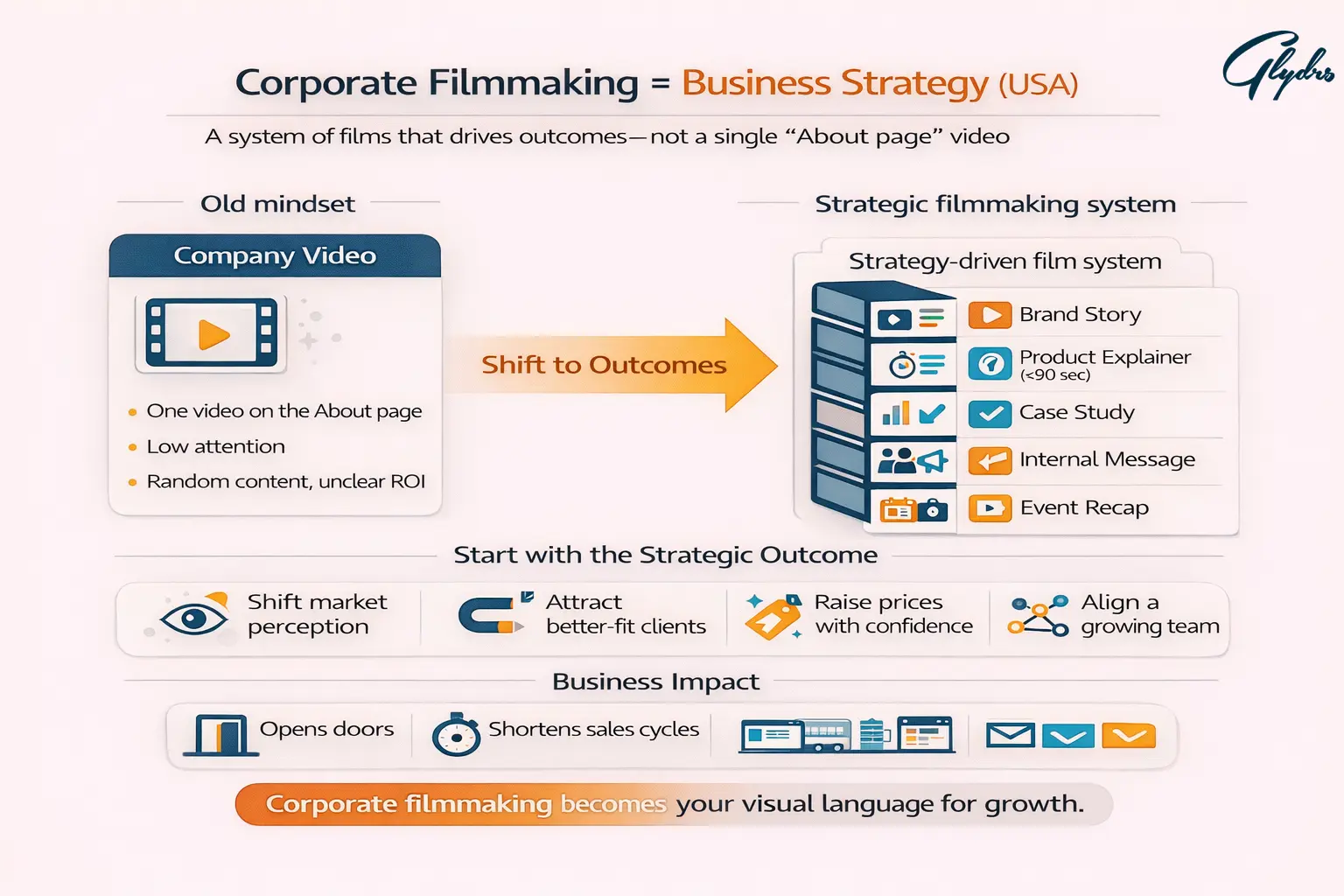
When most people hear the phrase Corporate Filmmaking, they think of a simple “company video” that lives on the About page and rarely gets watched. In the modern US market, that mindset is leaving serious money and opportunity on the table. Corporate filmmaking today is about designing a strategic system of films—brand stories, product explainers, case studies, internal messages, event recaps—that all work together to support your business goals.
Instead of starting with “we need a video,” leading American companies start with “what strategic outcome are we trying to drive?” Do you want to shift how the market sees you, attract better-fit clients, raise prices with confidence, or align a growing team around a new direction? Corporate filmmaking becomes the visual language that brings those decisions to life. A well-crafted brand film can reframe your company from “one more vendor” to a trusted, mission-driven partner.
A concise explainer can turn a complex solution into something a busy US decision-maker understands in under 90 seconds. When you treat corporate filmmaking as part of strategy—not just marketing decoration—you create assets that open doors, shorten sales cycles, and make every other touchpoint (website, sales deck, trade show, email) more effective.
How Corporate Filmmaking Builds Trust with Buyers and Teams
The real power of Corporate Filmmaking is that it connects the inside of your business to the outside world in a way that feels human, consistent, and repeatable. US buyers, investors, and potential hires are all asking the same questions: Who are you really? Why should I trust you? What makes you different from the next tab in my browser? Film can answer those questions faster and more convincingly than text alone.
A series of customer story films can prove your impact in real industries and real cities across the USA. Behind-the-scenes process films can show the quality, care, and expertise that justify your pricing. Culture and recruiting films can help American candidates self-select—attracting people who align with your values and repelling those who don’t.
Internally, corporate filmmaking supports strategy by making vision and priorities tangible: when leaders share a new direction through film, with clear visuals and examples, teams across states and time zones understand where the company is going and what their role is. Over time, this creates a feedback loop: strategy shapes the films you make, and those films shape how the market and your people respond—giving you real-world data to refine your strategy again.
Mapping Corporate Films to Clear Business Goals and Outcomes
To use Corporate Filmmaking as a real strategic tool, you have to start with structure, not just creativity. That means building a content map that lines up your key business goals with specific types of films. For brand positioning, you might invest in a flagship brand film that tells your origin story. Your mission, and the transformation you create for clients in the US market. For sales enablement, you plan a set of short product or service explainers that walk buyers through the “what,” “how,” and “why now” in clear, simple language. For trust-building.
You line up case study films and testimonial videos that show real American clients talking about measurable results. For recruiting and retention. You create culture films and “day in the life” pieces that show what it really feels like to work in your company—not just staged shots, but genuine interactions. Once this map is clear, corporate filmmaking stops being random and starts being intentional. Every piece has a job: attract, educate, convince, reassure, or align.
You can then plan production days in a way that maximizes ROI—filming multiple films and formats in one shoot, capturing extra B-roll, and gathering interviews that can be repurposed. This strategic planning is what separates leading US brands from those who treat video as an occasional expense instead of a long-term asset.
The Corporate Filmmaking Process: Pre-Production That Supports Strategy
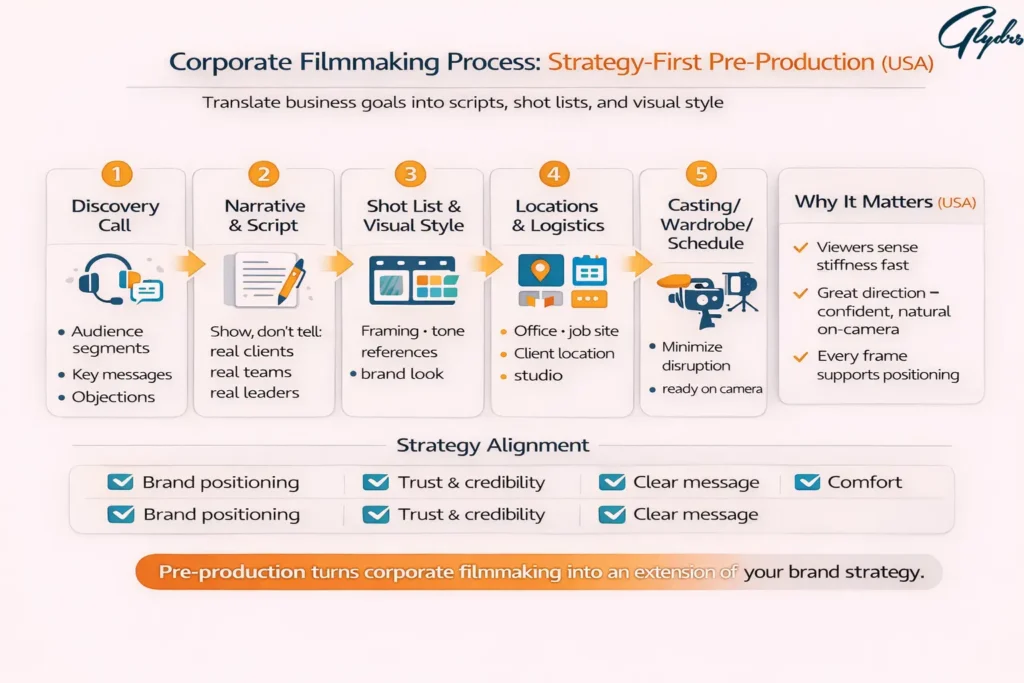
Of course, the process of Corporate Filmmaking itself also needs to be professional and aligned with your strategy—not rushed and chaotic. The best results in the US market come from a clear pre-production phase where your team and your production partner translate business goals into scripts, shot lists, and visual styles. Discovery calls identify your audience segments, key messages, objections, and differentiators. From there, writers and directors craft narratives that show, not just tell, those points: real clients using your solution, real teams solving complex problems, real leaders explaining the “why” behind your choices.
Locations are chosen to support the story—offices, job sites, client locations, or studios—while wardrobe, casting (if needed), and schedule are organized to minimize disruption to your workday. On shoot days, a professional crew handles lighting, sound, framing, and direction so your leaders and clients feel comfortable on camera. That matters in the US, where viewers can instantly sense when someone is stiff, over-rehearsed, or insincere.
Thoughtful direction brings out natural, confident performances that reflect how you actually show up with customers. When pre-production and production are handled this way, corporate filmmaking becomes an extension of your brand strategy: every frame, quote, and cut supports the positioning you want in the American market, instead of fighting against it.
Post-Production as a Content System, Not a One-Off Edit
Once the cameras stop rolling, Corporate Filmmaking really starts to earn its strategic value in post-production. This is where raw interviews, B-roll, product shots, and behind-the-scenes moments are shaped into assets that work across your entire US customer journey. Editors don’t just create one “full version” and call it a day—instead, they build a powerful toolkit: a flagship film for your homepage, shorter cuts for LinkedIn, vertical clips for Instagram Reels and TikTok, and silent-friendly edits with captions for trade shows and in-store displays.
Music, pacing, and graphics are chosen to match your brand positioning, whether you’re a serious B2B partner in the financial sector or an innovative SaaS company in Silicon Valley. On-screen titles highlight key proof points—metrics, case study names, client logos—so busy American viewers can grasp your value even if they only watch for a few seconds. Thoughtful post-production also means planning for repurposing from the start: one CEO interview can yield a brand film, several short thought-leadership clips, and internal messages for your team.
A single client shoot can become a detailed case study plus multiple quote snippets for social campaigns. By thinking “film system,” not “one-off video,” you turn each corporate filmmaking project into months of content that keeps your story consistent and visible across the US market, while getting far more ROI from every shoot day.
Using Corporate Filmmaking to Shorten Sales Cycles and Boost Conversions
Used well, Corporate Filmmaking can completely reshape how your sales process feels—for both your team and your American buyers. Instead of starting every conversation from zero, your reps can send a curated sequence of films that educate and build trust before the first serious call. A prospect might see a brand film on your homepage, a product explainer in a follow-up email, and a customer story film in a proposal—each piece answering a different question in their decision journey.
Complex offers that are hard to explain in a slide deck suddenly become clear when prospects can see your solution in action with real US clients and real outcomes. For account-based selling, you can even develop tailored cuts that highlight specific industries or use cases—healthcare, logistics, fintech, manufacturing—so each stakeholder feels like the film was made for them. This doesn’t replace your sales team; it equips them.
Reps spend less time repeating basic explanations and more time digging into real needs and next steps. Decision-makers who might ignore a long PDF are far more likely to watch a 90-second film on their phone between meetings. Over time, companies that integrate corporate filmmaking into their sales playbooks see shorter sales cycles, better conversion rates, and stronger inbound leads—because buyers arrive already informed, emotionally engaged, and partially convinced before the first serious conversation even begins.
Aligning Remote and Multi-Location Teams Through Strategy Films
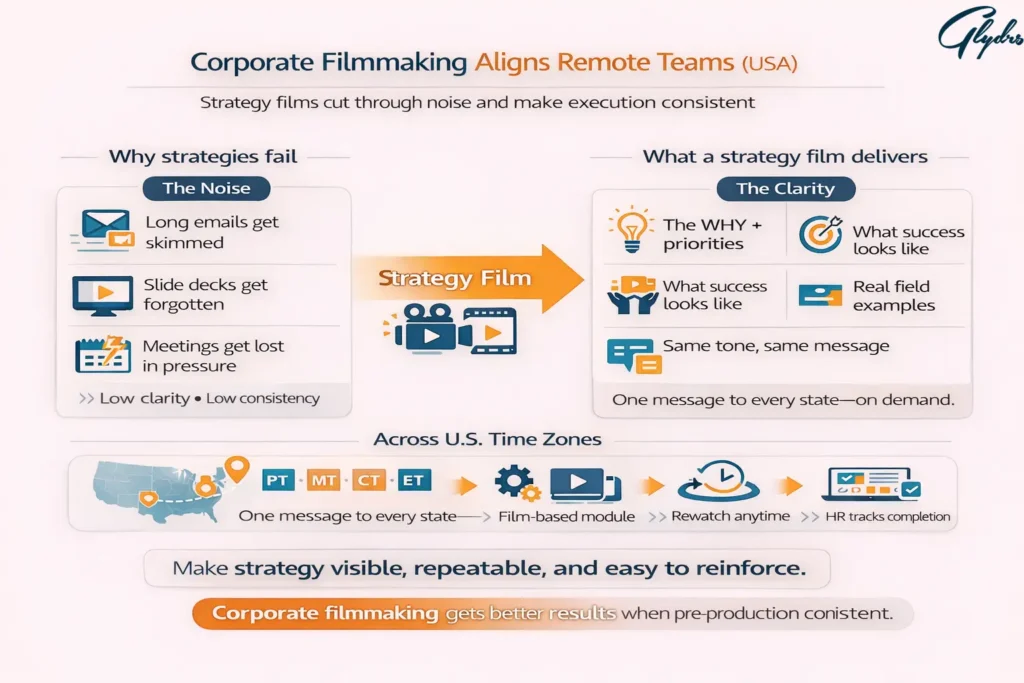
Beyond marketing and sales. Corporate Filmmaking can transform internal strategy execution—especially for US companies with remote, hybrid. Or multi-location teams. One of the biggest reasons strategies fail is not because leaders choose the wrong direction. But the direction isn’t communicated in a way people truly understand. Long emails get skimmed. Slide decks get forgotten. Meetings get lost in daily pressure. Film cuts through that noise. A short strategy film from leadership can show the “why,” the priorities, and what success looks like with clarity and emotion.
You can combine executive messages with real examples from the field—teams serving customers. Operations running smoothly, product updates in progress—so employees don’t just hear what matters, they see it. This is especially powerful in American organizations operating across time zones. Not everyone can attend live town halls. Corporate filmmaking allows you to deliver the same message. With the same tone, to every employee in every state.
It also supports training and change management. When new tools, processes, or policies roll out, film-based modules can show step-by-step workflows. Common mistakes and best practices far more effectively than written documentation. Employees can rewatch anytime, managers can assign specific videos to close gaps, and HR can track completion. Over time, this makes execution more consistent, reduces confusion, and strengthens culture—because your strategy becomes visible. Repeatable and easy to reinforce.
Keep reading and uncover secrets that can change the way you work. What is Industrial Video Production?
Winning Talent in the US with Employer Branding and Culture Films
In 2026, Corporate Filmmaking is also becoming a strategic advantage for employer branding and talent acquisition in the US market. Top candidates don’t just want a paycheck—they want purpose, clarity. And a workplace that fits their values. They research companies before applying. Watch videos on LinkedIn, and judge culture by what they can observe, not what’s promised. Corporate filmmaking gives you a way to show the real people behind your brand. How leaders communicate, how teams collaborate, what inclusion looks like in meetings. How customers are treated, and how work is celebrated.
A strong recruiting film can reduce hiring friction by helping candidates self-select—attracting those who align and filtering out those who don’t. That saves time and improves retention. For industries struggling with talent shortages, manufacturing. Healthcare, logistics, skilled trades—films that show modern environments, safety culture, training support. And career growth can change perceptions and bring more applicants into the pipeline. Internally, celebration films and team spotlights increase pride and connection. Which is critical for distributed teams.
When people see their work honored in high-quality films shared across the company. It reinforces the behaviors you want and makes the culture feel real. In a competitive American labor market. That emotional connection—built through corporate filmmaking. Can be the difference between being “just another employer”. And becoming a company that people actively want to join and stay with.
Keep reading and uncover secrets that can change the way you work. Event Videos That Drive Buzz, Shares, and Sales in USA: Your Guide 2026
Distributing and Measuring Corporate Films to Prove ROI
To maximize the strategic return of Corporate Filmmaking. Top US companies treat distribution and measurement as part of the plan—not an afterthought. A great film that no one sees can’t transform strategy. That’s why high-performing teams build a clear rollout system. Where each film lives, how it’s promoted, and which KPI it supports. Brand films often anchor the homepage and key landing pages. While shorter cuts run on LinkedIn, YouTube, and paid campaigns.
Sales teams get a “video playbook” with specific films for each stage. Intro, explainer, proof, proposal—so every rep knows what to send and when. Internally, leadership films and training videos are hosted in a central hub. Assigned in onboarding paths and referenced in quarterly planning. Then comes measurement. In the US market, you can track watch time. Click-through rates and conversion events tied to specific video placements. For recruitment, you can measure applicant quality and time-to-hire changes after launching culture films.
For sales. You can compare close rates and cycle length for prospects who watched key films versus those who didn’t. For training. You can track completion and performance improvements by team. This data helps you refine messaging and tighten edits. And invest more in formats that deliver results. Over time, corporate filmmaking becomes a continuous improvement loop. Create → distribute → measure → optimize—aligning content more tightly with business strategy every quarter.
Keep reading and uncover secrets that can change the way you work. How to Do E-Learning Video Production Right (2025)
Corporate Filmmaking as a Long-Term Strategic Growth Engine
Ultimately, Corporate Filmmaking transforms business strategy because it makes your direction, value, and credibility visible at scale. Strategy is often trapped in documents, meetings, and internal language that doesn’t translate well to customers, candidates, or even employees. Film turns that strategy into a story people can understand and believe—fast. It aligns your market positioning, supports sales conversations, builds trust with proof, and strengthens culture by showing what the company stands for in action.
In a 2026 US landscape where attention is scarce, trust is earned through transparency. Video is one of the few media that can combine clarity, emotion, and evidence in one package. When you build a system of corporate films, rather than a single “company video”. You create assets that work every day across your website. Ads, sales pipeline, recruiting, training, and internal communication. The result is not just better marketing. It’s a better execution. Your teams move with more alignment, your buyers move with more confidence. And your brand moves with more authority.
That’s the real power of corporate filmmaking. It doesn’t just tell people what you do—it shows them why it matters. And it helps your entire organization act in a way that supports the strategy you want to win with.
Turn your goals into real achievements with our tailored services – request the service now.
1- How is modern corporate filmmaking different from a traditional “company video”?
Corporate filmmaking today is a strategic system of films—brand stories, explainers, case studies, internal messages, and event recaps—designed to drive clear business outcomes like better positioning, faster sales cycles, and stronger team alignment in the U.S. market.
2- How does corporate filmmaking build trust with American buyers and teams?
It shows real clients, real processes, and real culture on screen—helping U.S. buyers, investors, and candidates quickly see who you are, why you’re credible, and how you deliver results, while also making strategy and priorities clearer for internal teams.
3- How can U.S. companies map corporate films to specific business goals?
They create a content map: brand films for positioning, explainers for clarity, case study films for proof, culture films for recruiting, and internal strategy films for alignment—so every video has a defined job in the customer and employee journey.
4- In what ways can corporate filmmaking shorten sales cycles in the U.S. market?
Prospects can watch brand films, explainers, and customer stories before or between calls, so they arrive already educated and emotionally engaged—reducing confusion, answering objections early, and helping reps move faster to serious, high-value conversations.
5- Why is corporate filmmaking a long-term strategic growth engine for U.S. brands?
Because it turns abstract strategy into visible stories that can be reused across websites, ads, sales outreach, recruiting, and training—creating a consistent, high-trust presence that supports growth, talent attraction, and execution year after year.

hitclub88
Posted at 21:27h, 30 MarchHitclub88? Sounds like a good time haha! If you’re feeling lucky, might be worth checking out. Remember to play responsibly though! My link for convenience: hitclub88
llyygameapk
Posted at 21:27h, 30 MarchLooking for some new games on your phone? Llyygameapk may be your jam. Downloadable apps, nice! Always vet where you’re downloading from first, yeah? Go here at your own risk: llyygameapk
jugabetmexico
Posted at 21:28h, 30 MarchJugabetmexico, mi gente! La verdad es que me he pasado buenos ratos aquí. Tienen un montón de juegos y las promos son buenas. A veces gano, a veces pierdo, pero siempre me divierto. Échenle un ojo! jugabetmexico
hitclubvips
Posted at 19:36h, 01 AprilTrying to find some new games to play? I reckon hitclubvips might be your jam. Find new and exciting things here hitclubvips.
tải vn123
Posted at 19:36h, 01 AprilLooking for how to tải vn123? You can find what you need here. Check it out here tải vn123.
yo88vina
Posted at 19:37h, 01 AprilYo88vina eh! Heard some buzz about this place. Seems legit for some casual gaming fun. Gonna check it out and maybe win some beer money! Give yo88vina a whirl if you’re bored.