

23 Jan Learning and Development: The Ultimate Guide to Getting Started
What Learning and Development Means in the US Workplace
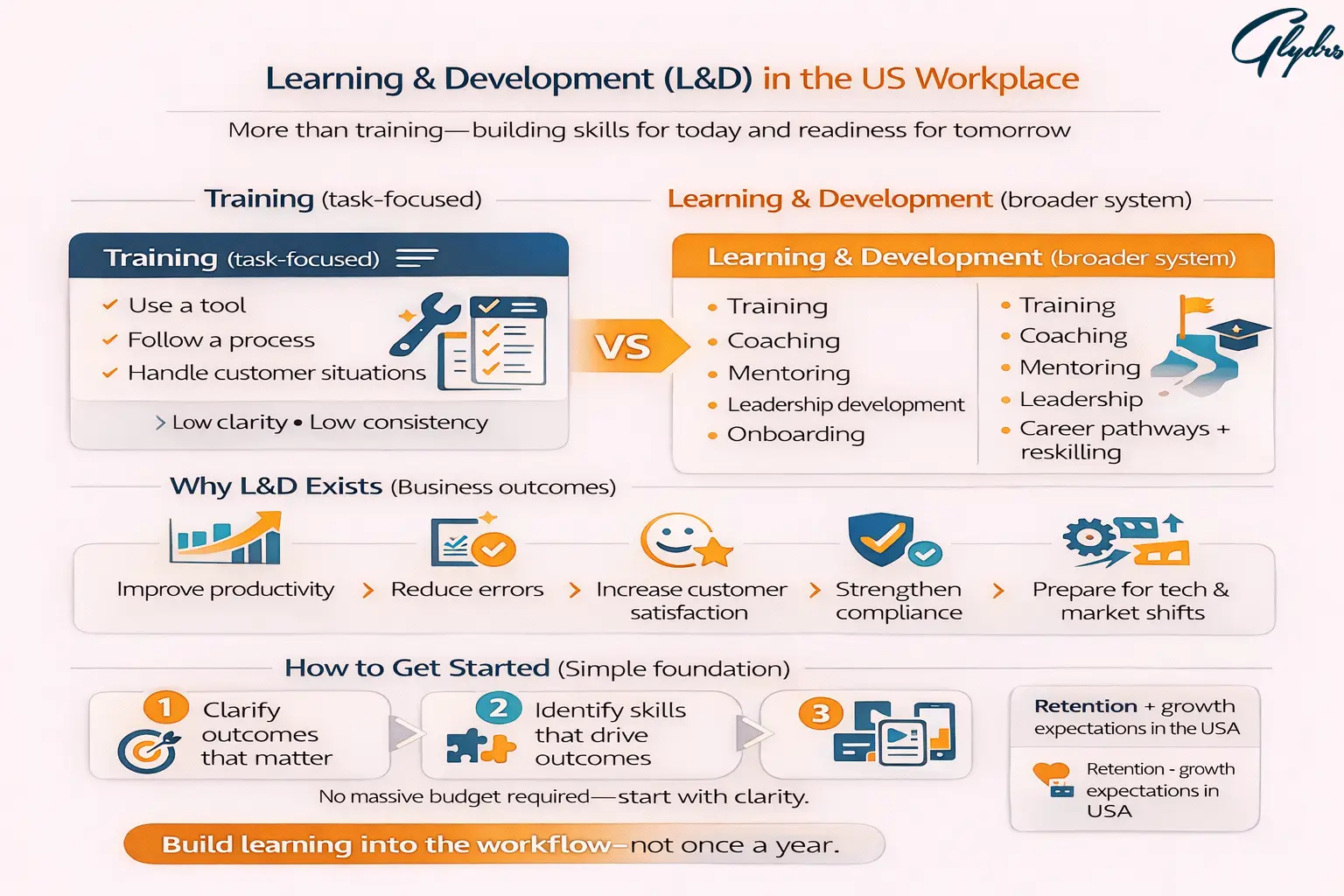
In the US workplace, Learning and Development (L&D) is the function that helps employees build the skills, knowledge, and behaviors they need to perform today—and stay ready for tomorrow. It’s broader than “training.” Training usually focuses on a specific task (how to use a tool, follow a process, handle a customer situation). Learning and Development includes training, but also coaching, mentoring, leadership development, onboarding, career pathways, and reskilling initiatives that support long-term growth.
In practical terms, L&D exists to solve business problems through people: improving productivity, reducing errors, increasing customer satisfaction, strengthening compliance, and preparing teams for new technology or market shifts. That’s why top US companies treat L&D as a strategic partner rather than a “nice-to-have.” When done well, Learning and Development creates a culture where performance improves because learning is built into the workflow—not something employees do once a year. It also supports retention, because American employees increasingly expect clear growth opportunities, not just job stability.
If your company can offer visible career progression and skill-building support, you’ll attract better candidates and keep strong performers longer. And if you’re just getting started, the good news is you don’t need a massive budget or a complex platform to begin. You need clarity: what outcomes matter most, what skills drive those outcomes, and what learning methods your people will actually use. This guide will help you start with the fundamentals, avoid common mistakes, and build an L&D foundation that fits your size, industry, and US workforce realities.
How L&D Connects Directly to Performance and Retention
A strong Learning and Development approach starts by understanding what L&D should not be: random workshops, long courses nobody finishes, or “training for training’s sake.” In the US, time is expensive and teams are busy—so your L&D efforts must be relevant, measurable, and tied to real performance. The simplest way to do that is to connect every learning initiative to a business goal. For example, if customer complaints are rising, your L&D priority might be service recovery modules, call simulations, and coaching for frontline leads.
If sales cycles are too long, you might build product messaging training, objection handling practice, and a library of short enablement videos your reps can use on demand. If turnover is high, you may need stronger onboarding, manager training, and internal career paths that show employees a future inside the company. L&D also works best when it respects how adults learn: short, focused lessons; real scenarios; practice and feedback; and resources people can access in the moment of need. That’s why modern Learning and Development often uses blended formats—microlearning, peer learning, short videos, job aids, live sessions for discussion, and coaching for reinforcement.
Think of L&D as a system, not a single event. When you build that system deliberately, you create something powerful: a repeatable way to upgrade skills across roles, locations, and experience levels—without pulling people away from work for hours at a time.
Running a Simple Needs Assessment to Find Real Skill Gaps
The fastest way to start Learning and Development without wasting time or budget is to run a simple needs assessment that focuses on performance, not opinions. In many US companies, leaders jump straight into buying courses or launching workshops because “training sounds like a good idea.” But if you don’t identify the real gap, you may train the wrong thing. Start by asking: what outcome is currently underperforming, and what behaviors or skills drive that outcome? Look at hard signals first—customer satisfaction scores, quality issues, production errors, safety incidents, missed deadlines, churn, close rates, and turnover.
Then validate with people closest to the work: frontline managers, high performers, and customer-facing teams. Ask practical questions like: Where do people get stuck? What mistakes happen repeatedly? What knowledge does a top performer have that others don’t? You can also review internal documentation, support tickets, call recordings, or QA reports to spot patterns. In the US workplace, the most common training gaps usually fall into a few buckets: onboarding and role clarity, tool and process adoption, communication and collaboration, manager effectiveness, and compliance or safety.
Once you identify the gap, define it in plain language. “Customer refunds are rising because reps don’t follow the policy and don’t know how to de-escalate.” That sentence is the foundation for training design. It keeps L&D focused on the real problem and helps leadership see why the program matters.
Choosing the Right Training Format for the Right Problem
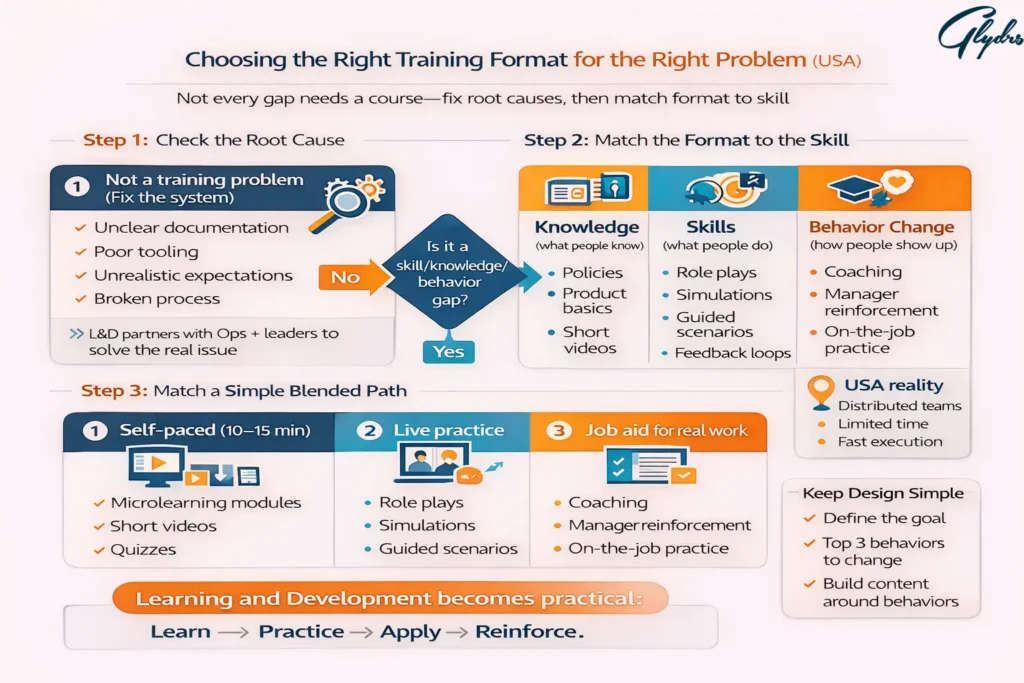
Once you know the gap, the next step in Learning and Development is choosing the right learning solution—not every problem needs a course. Sometimes the issue is unclear documentation, poor tooling, unrealistic expectations, or a process that doesn’t match reality. L&D should partner with operations and leadership to fix root causes, not just push content. When training is the right answer, match the format to the skill. For knowledge (policies, product basics). Microlearning modules, short videos, and quizzes work well. For skills (selling, coaching, handling conflict). Practice-based learning is essential: role plays, simulations, guided scenarios, and feedback loops.
For behavior change (culture, leadership habits). Coaching and manager reinforcement matter more than content. In the US, where teams are often distributed and time is limited, blended learning is usually the best approach: a short self-paced module to introduce concepts, a live session to discuss and practice, and a job aid to support real work afterward. Keep the design simple: define the goal, list the top three behaviors learners must do differently, then build content around those behaviors.
Every L&D program should include reinforcement—follow-up prompts, manager check-ins, and quick refreshers—because most people forget what they don’t use. With this structure, Learning and Development becomes practical, not theoretical: employees learn what they need, practice it, apply it at work, and get supported until it sticks.
Building a Practical L&D Operating Model That Scales
To make Learning and Development work in the real world, you need a basic operating model—who owns L&D, how requests are handled, and how programs are delivered and improved. In many US companies, L&D starts informally: HR runs onboarding, managers train their teams, and subject-matter experts share knowledge when they have time. That can work at a small scale, but it breaks as you grow because training becomes inconsistent and tribal knowledge spreads.
A simple structure solves this. First, define ownership: even if you don’t have an L&D department, appoint an L&D lead (HR, ops, or a hybrid role) who can coordinate priorities and keep standards consistent. Next, establish a lightweight intake process: a simple form or conversation framework that captures the business problem, audience, urgency, and desired outcome. Then create repeatable content standards—templates for modules, slide decks, job aids, and assessments—so training feels consistent across teams. For delivery, start with what your people will actually use.
In the US, mobile-friendly microlearning and short videos are often more successful than long courses because employees can fit them into busy schedules. If you use a learning platform (LMS/LXP), keep it organized by role and pathway, not a messy library of random courses. Finally, build maintenance into your model. Processes change, products update, and policies evolve—so Learning and Development must be treated like a living system, with periodic reviews and updates rather than “set it and forget it.”
Measuring L&D Impact Beyond Completions and Attendance
Once your L&D system exists, you have to measure what matters—or Learning and Development becomes “activity” instead of impact. Many organizations stop at vanity metrics: attendance, completion, or smile-sheet feedback. Those are useful, but they don’t prove business value. A simple measurement approach used by many US companies is to track four layers.
(1) participation (did people complete it?).
(2) learning (did knowledge improve? quiz or assessment results).
(3) behavior (are people doing the new behaviors on the job?).
and (4) outcomes (did the business metric improve?). You don’t need complicated analytics to start. For behavior, managers can use short observation checklists, QA reviews, or call scoring. For outcomes, choose one or two clear metrics per program—like fewer safety incidents, faster onboarding time, higher first-call resolution, improved close rate, or reduced rework.
Tie your training to those metrics from day one. Then run small pilots before scaling. Start with one team, measure baseline performance, deliver the program, and measure again after a few weeks. If results improve, expand. If not, refine. This test-and-improve mindset turns Learning and Development into a strategic function leaders trust—because it consistently demonstrates that learning is not just “nice,” it drives measurable performance in the US workplace.
Modern Learning Trends in 2026: Skills, Microlearning, and AI
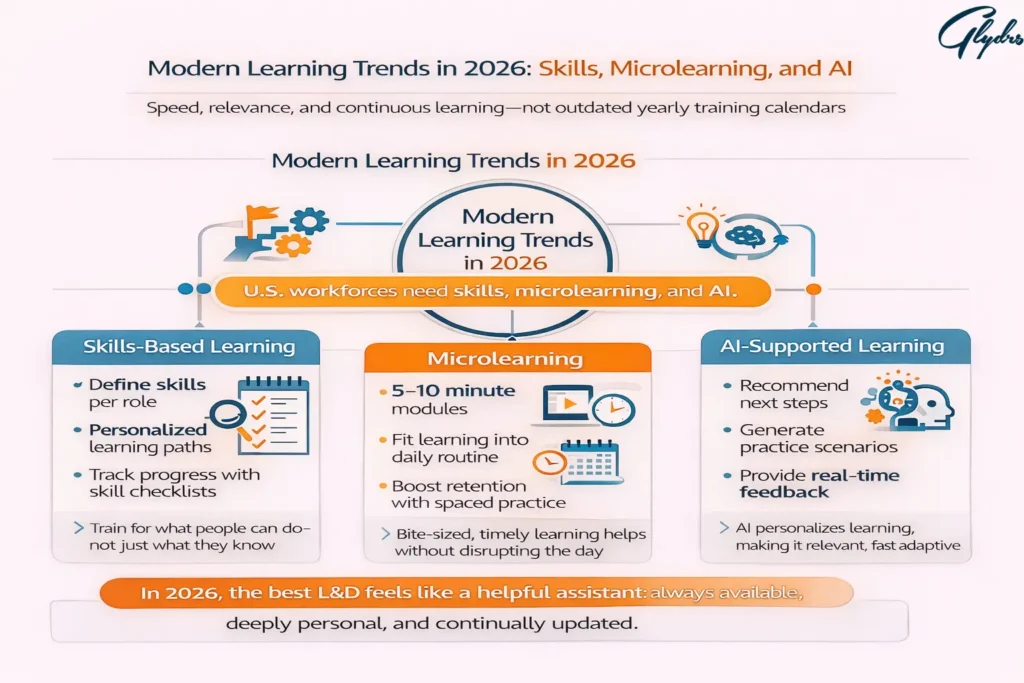
In 2026, the most effective Learning and Development programs in the US are built around speed, relevance, and continuous change—not yearly training calendars that fall behind reality. Technology evolves quickly, roles shift, and employees expect learning to feel personalized. That’s why many organizations are adopting modern L&D approaches like skills-based learning, microlearning, and AI-supported training experiences.
Skills-based learning focuses on what people can do, not just what they know. Instead of enrolling everyone in the same courses, you define the skills required for each role and build learning paths that close specific gaps. Microlearning delivers content in short bursts—five to ten minutes—so employees can learn without losing momentum in their day. AI-supported tools can recommend modules, generate practice scenarios, and give learners instant feedback, helping scale personalization across large US workforces.
But the goal isn’t technology for technology’s sake. The goal is to make learning easier to access and harder to ignore. When L&D feels like a helpful assistant—available in the moment of need—employees use it more. Managers support it more, and performance improves faster. If you’re getting started, you can adopt these principles without buying complex tools. Break content into smaller modules, and organize learning by role. Build simple skill checklists and create a habit of continuous updates instead of annual rebuilds.
Keep reading and uncover secrets that can change the way you work. How AI in Training Can Help You Develop Your Employees?
Why Manager Reinforcement Makes Learning Stick
A strong Learning and Development program also depends on manager involvement—because managers are the bridge between learning and real performance. In the US, employees often decide whether training “matters” based on how their direct manager treats it. If managers ignore it, training becomes optional. If managers reinforce it, training becomes behavior. That’s why many top companies invest in manager enablement as part of L&D: teaching managers how to coach, give feedback, assign learning, and follow up with clear expectations.
The best approach is simple and repeatable. Before training, managers set the context. Why this matters and what will change after it. During training, managers check in briefly and encourage practice. After training, managers reinforce behaviors through quick reminders and role plays. Or observations—five minutes in a team meeting can make a huge difference. L&D should make this easy by providing manager toolkits. Discussion prompts, observation checklists, and short follow-up exercises.
This reduces the burden on managers while increasing the chance that new skills stick. When Learning and Development includes manager reinforcement. It stops being a separate “HR activity” and becomes part of how your company runs. That’s when you begin to see lasting change. Better communication, stronger execution. Improved customer experiences. And a workforce that grows continuously—because learning is supported at the team level. Not just pushed from the top.
Keep reading and uncover secrets that can change the way you work. Why Top Companies Use Custom Training Modules to Upskill Teams
Creating Clear Learning Pathways That Support Career Growth
As your Learning and Development efforts mature. One of the smartest moves you can make is to create clear learning pathways that connect training to career growth. In the US, employees don’t just want “courses”—they want progress. They want to see how skills lead to better roles, more responsibility, and higher pay. Learning pathways make that visible. Start by identifying the roles that matter most to your business (and are hardest to hire for). Then map the skills required at each level—entry. Intermediate and advanced.
Build a pathway using modular learning. Onboarding essentials, role-specific tools and processes, core soft skills, and role-based performance scenarios. Add checkpoints like short assessments, manager sign-offs, and real-world projects that prove skill application. For example, a customer support pathway might include product knowledge modules and de-escalation practice. QA scoring targets, and a mentor shadowing phase. A frontline manager pathway could include coaching skills. Feedback conversations, performance planning, and team communication habits.
These pathways make Learning and Development feel fair and structured. People know what “good” looks like and what they must do to advance. They also protect your business by building internal pipelines. Instead of scrambling to hire externally every time you need a supervisor or team lead. You can promote from within based on demonstrated skills. That lowers turnover, boosts morale, and strengthens culture. Because employees see that growth is real, not just promised.
Keep reading and uncover secrets that can change the way you work. How to Choose a Learning and Development Course
Turning Learning and Development into a Long-Term Business Advantage
To wrap it up, Learning and Development is one of the most practical ways to build a stronger organization. More adaptable company—especially in the US market. Where change is constant, and competition is intense. Getting started doesn’t require perfect systems. It requires clarity and consistency. Identify the business outcomes that matter most. Find the skill gaps behind those outcomes, choose learning methods that fit real workflows. And measure impact beyond completion rates.
Build simple infrastructure. Ownership, intake, content standards, and maintenance. Then scale what works through modular programs and manager reinforcement. And career pathways that turn training into real growth. Over time, Learning and Development becomes more than an HR function. It becomes a strategic advantage. It helps you onboard faster, improve performance, and retain talent. And respond to new tools and market shifts without panic. Most importantly, it sends a message to employees that resonates in the American workplace. We are investing in you, and we have a plan for your growth here.
When that message is backed by useful training, real coaching, and visible career progress. Employees become more capable, more confident, and more committed. That’s how L&D evolves from “getting started” to becoming a long-term engine for performance and resilience—one that keeps your teams ready. Your business is competitive, and your people are moving forward year after year.
Turn your goals into real achievements with our tailored services – request the service now.
1- What does Learning and Development (L&D) mean in the US workplace?
Learning and Development is the function that helps employees build the skills, knowledge, and behaviors needed to perform today and stay ready for tomorrow—covering training, onboarding, coaching, leadership development, and reskilling to solve real business problems in the U.S. market.
2- How does L&D directly impact performance and retention in American companies?
When every learning initiative is tied to clear business goals—like reducing errors, improving customer satisfaction, or shortening sales cycles—employees see real results in their work, feel supported in their growth, and are more likely to stay with the company instead of looking elsewhere.
3- Why is a needs assessment so important before launching training in the US?
A simple needs assessment helps U.S. organizations identify real skill gaps behind issues like low CSAT, high churn, or frequent errors, so they design targeted learning instead of wasting time and budget on generic courses that don’t change performance.
4- What training formats work best for busy, distributed US teams?
For American employees with limited time, blended L&D works best: short microlearning for knowledge, live or virtual sessions for discussion and practice, plus job aids and coaching for on-the-job reinforcement, all designed to fit into real daily workflows.
5- How can Learning and Development become a long-term advantage for US businesses?
By building clear ownership, simple processes, measurable outcomes, manager reinforcement, and role-based learning pathways, L&D evolves from “one-off training” into a strategic system that supports faster onboarding, better performance, stronger retention, and long-term adaptability in the U.S. market.
No Comments