

28 Jan E-learning content development: A Step-by-Step Guide
E-learning Content Development Means in the US Workplace
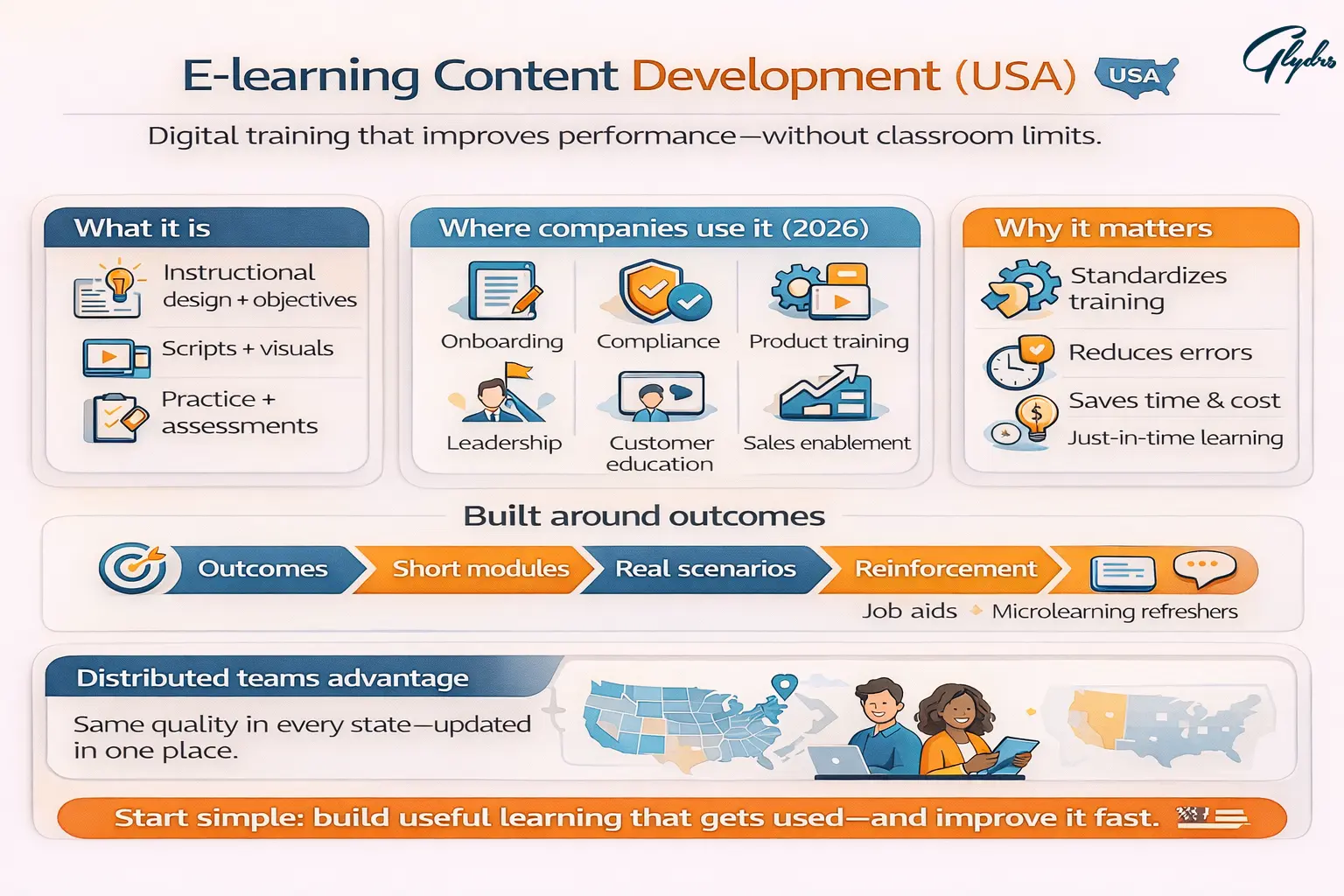
In the US market, E-learning content development is the process of designing and building digital learning experiences that help people gain skills, change behaviors, and perform better at work—without the limits of classroom schedules. It’s more than uploading slides to an LMS. Real e-learning content development combines instructional design, clear learning objectives, strong scripts, engaging visuals, interactive practice, and measurable assessments. Companies use it for onboarding, compliance, product training, leadership development, customer education, and sales enablement—especially across distributed teams in different states and time zones.
The reason it matters so much in 2026 is simple: American organizations are moving fast, roles are changing, and employees expect learning that feels relevant, short, and practical. When e-learning content development is done well, it saves time and reduces costs by standardizing training, minimizing errors, and giving learners just-in-time resources they can use in the moment of need. It also supports consistency: a new hire in Dallas and another in Boston can receive the same high-quality guidance, updated in one place, without depending on tribal knowledge.
The most successful programs are built around outcomes—what people must do differently on the job—and then translated into short modules, realistic scenarios, and reinforcement tools like job aids and microlearning refreshers. If you’re getting started, don’t overcomplicate it. The goal is not to create “perfect” content on day one. The goal is to create useful learning that gets used, improves performance, and can be updated quickly as your business evolves.
Step-by-Step E-learning Content Development From Goals to Launch
A practical E-learning content development process starts with clarity, not software. Step one is defining the business goal and the audience. What problem are you solving—high error rates, inconsistent service, slow onboarding, missed compliance steps, weak manager coaching? Who needs the learning—new hires, frontline staff, leaders, partners, customers? Step two is writing measurable learning objectives that describe observable behaviors (not vague statements like “understand safety”). For example: “Identify three lockout/tagout steps,” or “Handle a pricing objection using the approved framework.”
Step three is content discovery: gather the source materials, interview subject-matter experts, and capture real examples—screenshots, SOPs, call recordings, workflows, common mistakes, and best practices from top performers. Step four is designing the learning experience: choose the right format for the skill. Knowledge may need microlearning, video, and quick checks. Skills require scenario-based practice, branching decisions, role-play prompts, and feedback. Step five is scripting and storyboarding: write the narration, scene flow, on-screen text, and interactions before building anything.
Step six is production and build: create graphics, record voiceover, develop animations or screen captures, and build modules in your authoring tool. And step seven is review and QA: test for accuracy, accessibility, mobile responsiveness, and clear navigation. Step eight is launch and measurement: track completions, quiz results, and job performance indicators. Then iterate—because the best e-learning content development is a living system, not a one-time project.
Building a Repeatable Blueprint for Every E-learning Module
Step-by-step E-learning content development becomes much easier when you break the work into a repeatable blueprint for each module. Start with module length: in the US workplace, five to ten minutes per micro-module is often ideal for busy teams, while larger topics can be split into a short series rather than one long course. Then follow a proven structure: hook → context → concept → practice → feedback → summary → next step. The hook answers “why should I care?” in the first 10–20 seconds, using a real workplace scenario or consequence (lost revenue, safety risk, customer churn).
Context sets expectations: what learners will do by the end. The concept section teaches only what’s necessary—three to five key points, not ten. Practice is the core of effective learning: decision-making scenarios, drag-and-drop steps, mini-simulations, or quick knowledge checks that force retrieval. Feedback explains not only what is correct but why—because adults learn faster when they understand the reasoning.
The summary reinforces key actions, and the next step links learning to real work: a checklist, a job aid, a manager prompt, or a short “apply it today” task. This blueprint keeps e-learning content development efficient, consistent, and easier to scale across departments. It also improves learner experience because people know what to expect, progress is clear, and content feels practical instead of academic.

Choosing the Right Media and Interactivity Without Overproducing
Once your module blueprint is set, the next step in E-learning content development is choosing the right media and interactivity levels for your goals and budget. Not every lesson needs animation or complex simulations. In fact, many high-impact US corporate programs use simple, clean media: short videos, screen recordings, still graphics, and scenario interactions. The rule is: match media to the skill and the audience. If you’re teaching a tool workflow, a clear screen capture with callouts is often better than a flashy video.
If you’re teaching customer conversations, role-play scenarios. And branching dialogue can outperform long lectures. If you’re teaching safety procedures, step-by-step visuals and quick checkpoints are critical. And sometimes short on-site video is the fastest way to build confidence. Accessibility should be built in from the start: captions, readable fonts, color contrast, keyboard navigation, and mobile responsiveness—especially important for US teams in the field using phones or tablets. Also consider tone: learners engage more when content feels human, not robotic.
Use plain language, real examples, and friendly microcopy that guides people without sounding like a compliance memo. By designing smartly, you can create e-learning content development projects that feel premium without overproducing—saving time, controlling cost, and still delivering training that employees actually complete and remember.
Managing SMEs and Reviews to Avoid Costly Rework
A crucial part of successful E-learning content development is building a smooth workflow between subject-matter experts (SMEs), instructional designers, and reviewers—because most delays and budget waste happen during review cycles. In many US organizations, SMEs are busy, and feedback arrives late, scattered, or contradictory. To avoid that, set review rules before you start: who approves what, by when, and in what format. Use a single source of truth for feedback (one document or one review tool), and require consolidated comments rather than multiple email threads.
It also helps to define what is “in scope” for SME review: accuracy of content, realism of examples, and alignment with policy—not preferences about fonts or minor wording. Instructional designers should translate SME knowledge into clear, learner-friendly language while keeping the module focused on behaviors that matter. For efficiency, build a prototype first: one finished sample module that shows the visual style, interactivity level, tone, and structure.
Once approved, the rest of your e-learning content development can follow that template quickly. This prototype approach reduces rework and makes stakeholders confident in the direction. It also makes scaling easier: you can train internal teams or external vendors to follow the same standards, creating a consistent learning library across your US workforce.
Measuring Results and Reinforcing Learning for Real Behavior Change
Another step that top US companies prioritize in E-learning content development is measurement and reinforcement—because completion alone doesn’t guarantee performance change. Start by defining what success looks like beyond “finished the course.” If the goal is faster onboarding, track time-to-competence and early performance scores. If the goal is fewer errors, track quality metrics. Incident reports, or rework rates. If the goal is a better customer experience, track CSAT and first-call resolution. Or complaint trends. Build lightweight assessments that test real decisions, not trivia.
Then add reinforcement: short follow-up quizzes, micro-reminders, manager discussion prompts, and job aids that appear when employees need them. For example, a quick checklist for handling returns, a one-page guide for safety steps, or a 60-second refresher video embedded in your internal wiki. In distributed US teams, reinforcement is what prevents “learn and forget.” It turns e-learning from a one-time event into a support system.
Modern platforms can automate nudges, recommend refresher modules, and surface content based on role or performance signals. Even without advanced tools, you can schedule follow-ups and embed learning into meetings. When measurement and reinforcement are baked into your e-learning content development plan, you get something leaders care about: not just training delivered, but performance improved.
Modern 2026 Approach: Modular Design and Rapid Updates
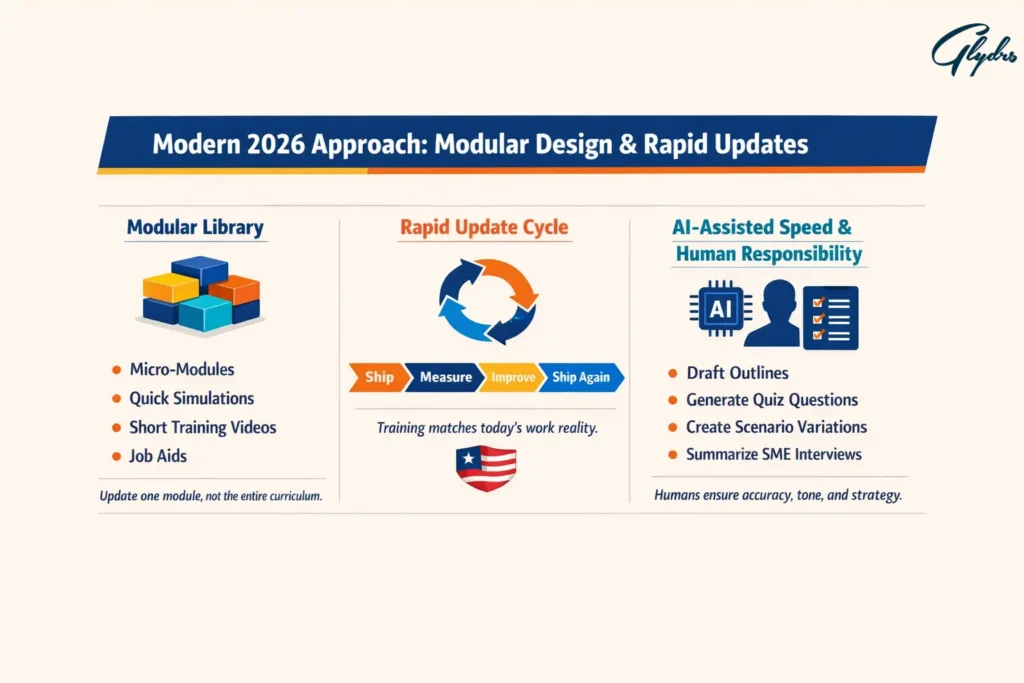
In 2026, modern E-learning content development in the US is increasingly shaped by speed and adaptability—because products, tools, and policies change constantly. That’s why many organizations are moving toward modular design and rapid update cycles. Instead of building one massive course that becomes outdated quickly, they create a library of smaller learning objects: micro-modules, quick simulations, short videos, and job aids that can be swapped or updated independently.
If a process changes, you update one module, not an entire curriculum. This approach also makes localization and role-based personalization easier: you can assemble different learning paths for sales, support, operations, and managers using the same core building blocks. AI-assisted tools are also accelerating content development by helping teams draft outlines, generate quiz questions, create scenario variations, and summarize SME interviews into usable scripts—while humans remain responsible for accuracy, tone, and strategy.
For US audiences, this speed matters: employees expect training to match the reality of their work today, not a version from last quarter. The companies that win with e-learning content development are the ones that treat it like a living product: they ship, measure, improve, and ship again—rather than waiting months for a “perfect” release.
Keep reading and uncover secrets that can change the way you work. Why Top Companies Use Custom Training Modules to Upskill Teams
Designing a Smooth Learner Experience That Drives Completion
At the same time, high-quality E-learning content development depends on learner experience—because engagement drives completion, and completion drives results. A few design choices can dramatically increase usability for American learners. First, reduce cognitive load. Use clean layouts, short sentences, and one main idea per screen. Second, make navigation predictable and friction-free, especially on mobile.
Third, use storytelling and realism: include scenarios that mirror real US workplace situations—customer calls, team meetings, safety checks, CRM workflows. So learners immediately recognize the value. Fourth, design for inclusivity and accessibility. Captions, readable contrast, screen-reader-friendly structure, and examples that reflect diverse audiences. Fifth, respect the learner’s time. Show progress clearly, let people pause and resume, and avoid unnecessary “click to continue” screens.
Finally, make the learning actionable. End each module with a quick “apply it now” prompt or a downloadable job aid. When e-learning feels smooth, relevant, and respectful. Employees don’t treat it as a compliance chore. They treat it as support. That shift in perception is one of the biggest hidden levers in e-learning content development. If learners trust the content, they return to it, share it, and actually use it during real work.
Keep reading and uncover secrets that can change the way you work. Learning and Development: The Ultimate Guide to Getting Started
Planning Costs, Resources, and Scalable Production Systems
One of the final steps in a scalable E-learning content development strategy is cost and resource planning—because the best learning design still needs a realistic production model. In the US, e-learning budgets vary widely depending on complexity, media choices, compliance needs, and how much SME time is required. A helpful way to plan is to separate costs into three buckets: (1) people, (2) production, and (3) platform/operations.
People costs include instructional design, project management, SME time, review cycles, and QA. Production costs depend on what you create: simple slide-based modules and screen recordings are usually faster and cheaper than animation-heavy or live-action video-based courses. Interactivity also affects time: a straightforward micro-module with quizzes takes less effort than branching scenarios or software simulations. Platform and operations include your LMS/LXP, hosting, reporting, and ongoing maintenance.
To keep costs under control, top US organizations standardize templates. Build a reusable asset library (icons, layouts, interaction styles). And prioritize the modules that move the biggest metrics first. They often start with a pilot—one role, one process, one high-impact gap. Then scale after proving results. This approach reduces risk and helps leadership see the ROI before committing to a larger library. Remember: e-learning content development is not just a creative project. It’s a production system. When you treat it like a system. You can deliver high-quality learning faster, more consistently, and at a predictable cost.
Keep reading and uncover secrets that can change the way you work. How to Choose a Learning and Development Course
Turning E-learning Content Development into a Long-Term Advantage
To wrap up, E-learning content development works best when it is structured and modular. And focused on real performance outcomes. Especially for US companies with distributed teams and fast-changing demands. Start with the business goal and a clear understanding of your learners. Define measurable objectives, gather real examples. And design modules that teach only what matters. Then require practice and feedback. Build with a repeatable blueprint. Choose media that fits the skill and budget, and manage SME reviews with a clear process to avoid endless rework.
Launch with measurement in mind and reinforce learning with job aids, micro-refreshers. And manager support so that behaviors actually change on the job. Finally, plan for iteration. Update modules quickly, keep your library current, and use data to improve what isn’t working. When you follow this step-by-step approach. E-learning becomes more than “online training.”
It becomes a reliable engine for onboarding, upskilling, compliance, and continuous improvement. Helping your people perform better today while staying ready for what’s next. In the 2026 US workplace, where time is tight and change is constant. A strong e-learning content development system can be one of the most valuable investments you make in your workforce and your business.
Turn your goals into real achievements with our tailored services – request the service now.
FAQ- E-learning Content Development
1- What does E-learning content development mean in the US workplace?
E-learning content development is the process of designing digital training—videos, modules, scenarios, and assessments—that help US employees gain skills, change behaviors, and perform better at work without needing a live classroom.
2- What are the key steps in an effective E-learning content development process?
Key steps include defining the business goal, identifying the target audience, writing measurable learning objectives, gathering real examples, storyboarding, building the module, testing for quality and accessibility, then launching and tracking results.
3- Why do US companies prefer short, modular E-learning content?
Because American teams are busy and often distributed, short 5–10 minute modules are easier to complete, update, and reuse, making it simpler to keep training relevant and consistent across locations and time zones.
4- How should US organizations choose media and interactivity for E-learning?
They should match media to the skill: screen recordings for tools, scenarios for conversations, simple videos for procedures—focusing on clarity, mobile access, and accessibility rather than overproduced animations that add cost without impact.
5- How do US businesses measure the success of E-learning content development?
They look beyond completion rates and track business metrics like faster onboarding, fewer errors, better customer satisfaction, or higher compliance—using quizzes, behavior checks, and performance data to decide what to improve or update next.

vn88 rezence việt nam
Posted at 19:35h, 01 AprilOkay, if you’re looking for something a bit more specific, give vn88 rezence việt nam a try. I’ve been browsing through what they’ve got cooking and it might be right for you. Dive in vn88 rezence việt nam.
123win69
Posted at 19:36h, 01 April123win69? Yeah, I’ve heard of them. They seem like a pretty popular choice. Why not check them out and see what you think? Go here 123win69.
g666ios
Posted at 19:36h, 01 AprilAlright iOS users, g666ios looks interesting. Seems like they’re catering specifically to you guys. Might be worth checking out. Here is the link g666ios.