

31 Dec How AI in Training Can Help You Develop Your Employees?
AI in Training Is a Competitive Advantage for US Companies
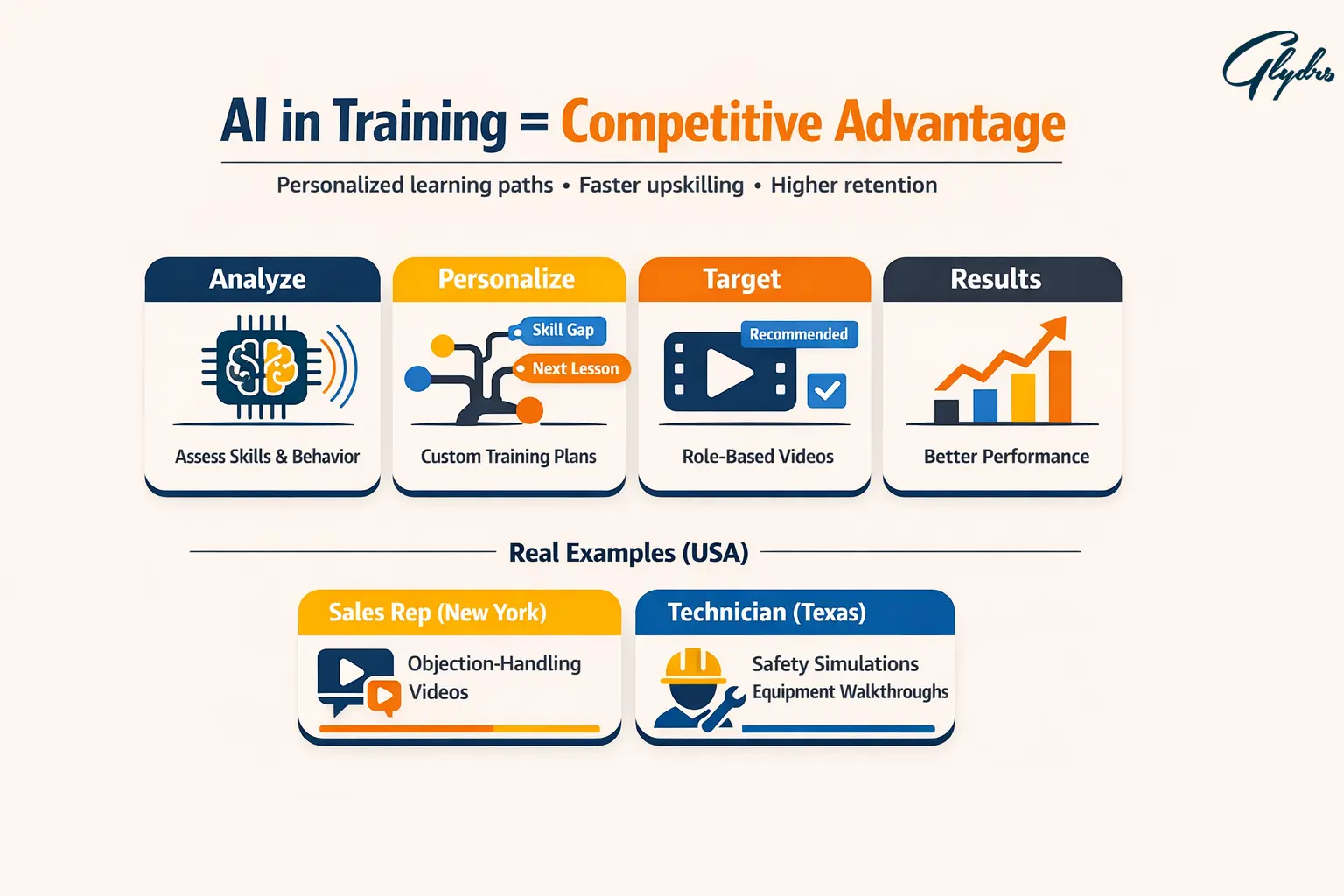
In today’s fast-moving American workplace, companies are under pressure to reskill and upskill employees faster than ever—and this is exactly where AI in training becomes a real competitive advantage. Instead of relying only on one-size-fits-all workshops or static e-learning modules, AI-powered tools analyze how each employee learns, what skills they already have, and where they struggle. That means your people don’t all see the same boring course.
They get personalized learning paths: shorter lessons if they’re experienced, more examples and practice if they’re new, and targeted recommendations based on their role and performance. For a sales rep in New York, AI might suggest quick scenario-based videos on objection handling; for a technician in Texas, it might prioritize safety simulations and equipment walk-throughs. This level of personalization is almost impossible to manage manually at scale, but AI makes it realistic for U.S. businesses of all sizes.
The result is more relevant training, less wasted time, and employees who feel that development is designed “for me,” not just “for everyone.” In a market where talent can easily move to another employer, that sense of support and tailored growth is a big reason people stay, grow, and contribute at a higher level.
Faster Content Creation and Smarter Delivery with AI in Training
Beyond personalization, AI in training also transforms how learning content is created, updated, and delivered inside American organizations. Traditionally, building a new course or video series could take weeks or months, with multiple rounds of scripting, reviews, and design. AI tools can dramatically speed this up by helping L&D and HR teams draft course outlines, generate practice questions, create microlearning modules, or even produce simple training videos from text scripts.
This doesn’t replace human expertise; it amplifies it. Your subject-matter experts still define what employees need to learn, but AI handles much of the heavy lifting, so you can respond quickly when products change, regulations update, or new skills are needed. For a U.S. company operating across multiple states and time zones, AI-driven platforms can deliver content on any device, at any time—allowing employees to learn in small, flexible moments instead of blocking calendar time for long sessions.
AI in training also tracks how people interact with content: which modules they finish, where they get stuck, and which activities lead to better on-the-job performance. These insights help you continuously improve your programs, focusing budget and effort on what actually moves the needle for your workforce and your business.
Turning Passive Learning into Interactive, Real-World Practice
Another big advantage of using AI in training is the way it turns learning from something passive into something interactive and practical. Instead of employees just watching a long webinar or clicking “next” on a slideshow, AI-powered platforms can simulate real-world situations and respond dynamically to each learner’s choices. Customer service reps in the U.S., for example, can practice handling tough calls in AI-driven role plays that adapt to their tone and responses.
Sales teams can rehearse pitches with virtual “customers” who ask realistic questions and objections. Leaders can practice giving feedback or managing conflict in branching scenarios where each decision changes the outcome. Behind the scenes, AI analyzes patterns: which responses lead to good results, where people hesitate, and what kinds of mistakes are common. The system can then offer targeted tips, additional practice, or short micro-lessons where each person needs the most help.
This makes AI in training extremely efficient—employees spend more time practicing what matters and less time reviewing what they already know. For American companies that want to see real behavior change, not just course completions, these adaptive simulations offer a safer, lower-risk way for people to build skills before they face real customers, teams, or high-stakes situations on the job.

Using AI in Training to Build Clear, Data-Driven Skills Profiles
AI in training also gives managers and HR leaders a clearer, data-driven picture of their workforce skills—something that’s increasingly critical in the U.S. market. Instead of guessing who is “good” at what or relying only on annual reviews, AI systems can aggregate data from assessments, practice scenarios, course completion, and on-the-job performance. This creates up-to-date skills profiles for each employee and for entire teams. Leaders can see where they have strong capabilities, where gaps exist, and which roles are at risk if technology or customer expectations change.
For example, a U.S. manufacturer might discover through AI-driven analytics that many technicians need reinforcement in digital controls, or a retail chain might see that store managers are strong in operations but weaker in coaching and feedback. With this insight, companies can design targeted development plans instead of generic programs that fail to resonate.
They can also identify high-potential employees who are quietly excelling in AI in training scenarios and are ready for stretch assignments or promotions. Over time, this skills intelligence helps American businesses make smarter decisions about hiring, succession planning, and reskilling—staying ahead of competitors who still treat training as a checkbox instead of a strategic lever.
Making Learning Feel Personal, Flexible, and “Built for Me”
AI in training also has a powerful effect on how employees feel about learning, which is especially important in the American workplace, where engagement and retention are big challenges. Traditional training often feels like a chore—long sessions, generic content, and little connection to real daily work. AI flips that experience by making learning more personalized, timely, and convenient. Employees can get short, targeted lessons exactly when they need them: a quick refresher before a client call, a step-by-step guide while using new software, or a micro-course during a commute.
AI-powered platforms can recommend content based on role, interests, and previous activity—similar to how streaming services suggest shows you might like. This creates a sense of “Netflix for learning,” where development feels more like a helpful resource than an obligation. In the U.S., where people juggle work, family, and side projects, this flexibility matters. Employees can learn in five- or ten-minute bursts instead of blocking an hour on their calendar.
AI can also adapt difficulty: offering easier explanations if someone is stuck. Or advanced challenges if they’re progressing quickly. Over time, this adaptive approach reduces frustration, builds confidence, and encourages a growth mindset. When employees notice that training actually helps them perform better and move toward their career goals. They’re far more likely to log back in, complete programs, and recommend them to colleagues. Turning AI in training into a real driver of learning culture, not just another tool.
Smoother Onboarding and Stronger Support for Remote & Hybrid Employees
At the same time, AI in training can dramatically improve onboarding and support for remote and hybrid employees across the U.S. For new hires. The first weeks are critical. They need to understand the company, tools, processes, and expectations quickly. Without feeling overwhelmed. AI-powered onboarding paths can automatically adjust based on role, location. And prior experience—giving a salesperson in Chicago different content than a developer in Austin. While still reinforcing shared values and culture.
Virtual AI assistants and chatbots can answer common questions 24/7 (“How do I request time off?” “Where is the latest sales deck?” “What’s our refund policy?”). Reducing pressure on HR and managers. For remote workers. AI in training makes it easier to feel connected and supported. They can join interactive simulations, receive instant feedback on practice tasks. And access curated resources whenever they run into a problem.
This is especially valuable in U.S. companies spread across multiple states and time zones. Where live training sessions can’t cover every need. Instead of waiting for the next workshop. Employees get “in the flow” support powered by AI—guides, checklists. And short explainer videos triggered by what they’re doing in real time. The result is a smoother, more consistent employee experience. Whether someone is sitting in headquarters or working from a home office thousands of miles away.
How AI in Training Transforms the Daily Work of L&D and HR
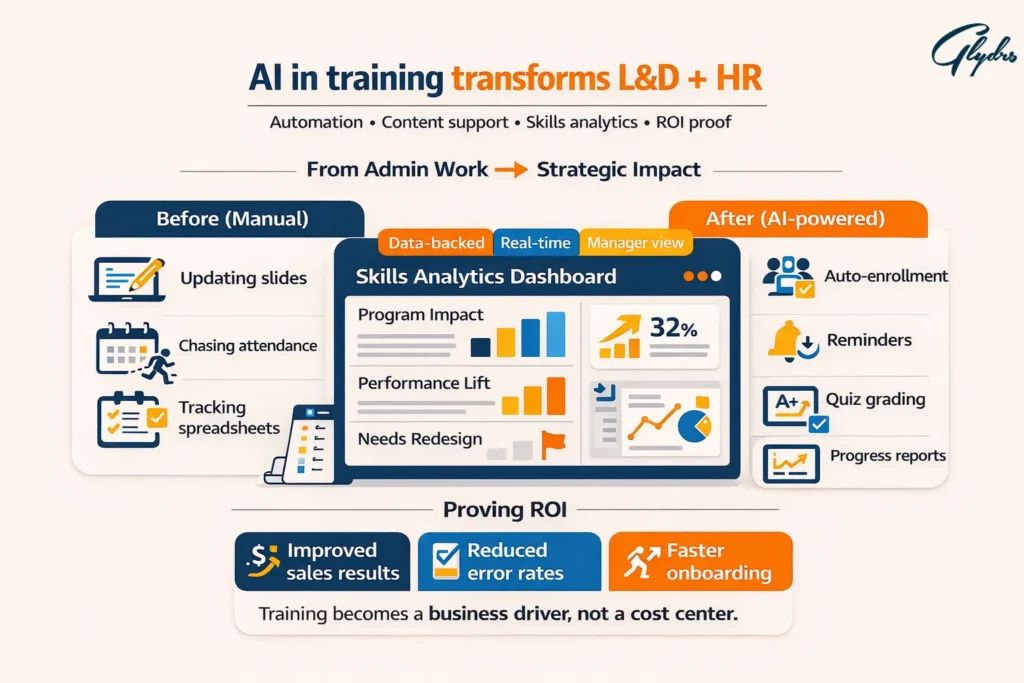
AI in training doesn’t just help employees—it also transforms the daily work of L&D and HR teams across the U.S. Instead of spending most of their time updating slides. Chasing attendance and manually tracking spreadsheets. Learning leaders can shift their focus to strategy and impact. AI tools can automatically handle many repetitive tasks. Enrolling people in the right courses, sending reminders, and grading quizzes. And generating progress reports for managers.
Content generation features can help draft lesson outlines, scenario ideas. Or quiz questions that instructional designers can refine instead of creating from scratch. Skills analytics dashboards show, at a glance. Which programs drive measurable performance improvements, and which need to be redesigned? This allows American L&D teams to make data-backed decisions—doubling down on what works and cutting what doesn’t.
At the same time, AI in training makes it easier to prove ROI to senior leadership. When you can show that a specific AI-supported program improved sales results. Reduced error rates or shortened onboarding time. Training is no longer just a cost center. It becomes a visible contributor to business outcomes. That credibility helps secure budget, influence, and long-term support for learning initiatives.
Keep reading and uncover secrets that can change the way you work. How to Create a Training Program: Simple Steps
Ethics, Transparency, and Trust in AI-Powered Training Programs
Of course, using AI in training effectively also means addressing important questions about ethics. Fairness, and data privacy—especially in the U.S. Where employees are increasingly aware of how their data is used. Responsible companies are transparent about what information AI systems collect (such as course completions, quiz scores, and simulation performance). And how it will be used (for development, not punishment). They set clear boundaries. AI recommendations support managers but don’t replace human judgment. And learning data is not a shortcut for unfair evaluations.
Diverse testing helps reduce bias in AI-powered content and assessments, ensuring that questions, scenarios. And feedback is inclusive and respectful of different backgrounds. Security measures protect sensitive data. Employees are given visibility into their own skills profiles and growth paths. When L&D and HR teams combine the power of AI in training with strong governance and open communication, they build trust instead of anxiety.
The result is a modern learning ecosystem where employees feel both supported and respected—benefiting from smart. Personalized development while knowing that people, not algorithms, remain in charge of their careers.
Keep reading and uncover secrets that can change the way you work. The Value of Training Development Certification of an Employee
Staying Future-Ready: Using AI in Training to Anticipate New Skill Needs
Looking ahead, one of the most exciting strengths of AI in training is how it helps American companies stay ready for whatever comes next. Technology, regulations, and customer expectations are shifting so quickly that job roles are constantly evolving. Skills that were “nice to have” yesterday can become essential tomorrow. AI-powered learning platforms can continuously scan trends in skills demand. Inside your own organization and across the broader U.S. market—and recommend new learning paths that keep your workforce current.
For example, if data literacy, cybersecurity awareness are required. Or AI literacy itself becomes critical in your industry. AI systems can quickly surface relevant modules and build campaigns around them. They can also identify which teams are most affected by these changes and prioritize them for training. This turns AI in training into a kind of early-warning and response system for talent. You see where you might fall behind, and you can act before the gap becomes painful.
Combined with leadership foresight and strategic workforce planning. AI-powered learning allows companies to move from reactive “emergency training” to proactive. Ongoing capability building. In a U.S. economy where disruption is normal. That agility can be the difference between thriving and struggling.
Keep reading and uncover secrets that can change the way you work. How to Choose a Learning and Development Course
Why AI in Training Is a Strategic Investment in Your People and Your Future
Ultimately, AI in training helps you develop your employees by doing what humans alone can’t do at scale. Personalize learning, deliver support in the moment of need. Analyze complex skill data and adapt quickly as your business changes. But the real magic happens when AI and people work together. Subject-matter experts, managers, and learning leaders define the vision, values, and priorities. AI tools amplify their impact by making high-quality development available to every employee. In every location, at the right time.
For your workforce, this means clearer growth paths, more relevant training. And faster skill-building that actually shows up in daily performance. For your business, it means stronger teams, shorter time-to-competence, and better retention. And a culture where learning feels practical—not theoretical. In the American market, talent is one of your most important assets. Investing in responsible, well-designed AI in training is not just a tech upgrade.
It’s a strategic decision about the future of your company. Done thoughtfully, it builds an organization where people and machines learn together—creating a smarter organization. More resilient business ready for whatever the next decade brings.
Turn your goals into real achievements with our tailored services – request the service now.
FAQ- AI in Training
1- How does AI in training give U.S. companies a competitive advantage?
AI in training personalizes learning for each employee—based on their role, skills, and performance—rather than pushing one generic course to everyone. That means faster upskilling, less wasted time, and employees who feel development is built “for me,” which boosts performance and retention in a competitive U.S. talent market.
2- How can AI make learning content creation and delivery more efficient?
AI helps L&D and HR teams draft outlines, questions, microlearning, and simple videos much faster, then delivers them on any device, at any time. This lets American companies respond quickly to product changes, new regulations, and skill gaps without waiting weeks for traditional course development.
3- How does AI in training turn passive learning into real-world practice?
AI-powered platforms create interactive simulations and role plays—like virtual customers or conflict scenarios—that adjust to each learner’s choices. U.S. employees can safely practice sales, service, leadership, or technical skills, get instant feedback, and build real confidence before facing high-stakes situations on the job.
4- What kind of workforce insights can AI-powered training give U.S. leaders?
AI aggregates data from assessments, simulations, completions, and performance to build live skills profiles for individuals and teams. Leaders can see where strengths and gaps are, design targeted development plans, spot high-potential employees, and make smarter decisions about hiring, reskilling, and succession planning.
5- Why is investing in AI in training a strategic move for the future of an American company?
AI in training helps organizations anticipate new skill needs, personalize development at scale, and keep employees future-ready as roles evolve. Combined with human leadership and strong ethics, it builds stronger teams, faster time-to-competence, better retention, and a learning culture that makes the business more resilient in a changing U.S. economy.

No Comments