



Production Scene Take Location Date
Global Corporate L&D Scale 200+ Modules MENA — 25°N, 45°E Jul 23,2026
The era of relying on static PDF manuals and monotone PowerPoint presentations for global corporate training is entirely obsolete. Fortune 500 HR Directors and EdTech VPs already know that video is the superior medium for knowledge transfer.
When an enterprise needs to produce, localize, and standardize 200+ e-learning modules across multiple languages and borders, traditional agency models break down. Scaling enterprise training requires a bulletproof production infrastructure, seamless Learning Management System (LMS) integration, and on-the-ground execution capabilities. This guide breaks down the exact frameworks global brands use to scale their e-learning video production without sacrificing cinematic quality, and why the MENA region (Middle East and North Africa) has become the premier hub for executing high-volume corporate training.
This guide breaks down the exact frameworks global brands use to scale their e-learning video production without sacrificing cinematic quality, and why the MENA region (Middle East and North Africa) has become the premier hub for executing high-volume corporate training.
Why scalable video infrastructure is a revenue asset — not an HR expense
Employees retain the vast majority of training content delivered via video, vs. roughly 10% from text alone.
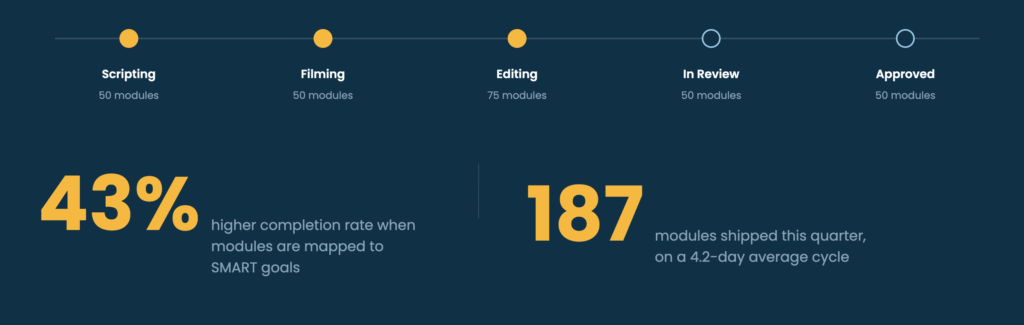
Organizations leveraging video training report significantly faster completion rates across the workforce.
Companies investing in high-quality training video outperform those relying on outdated, text-heavy methods.
Every module moves through the same five gates before it ships
Human brains process visual information 60,000 times faster than text, activating multiple neural pathways simultaneously.
However, even the highest-quality cinematic production cannot overcome cognitive overload.
The golden rule of scalable e-learning is modularity.
The most effective training videos run between 3 to 7 minutes for focused topics. Analytics consistently show that engagement rates drop significantly after the 6-minute mark.
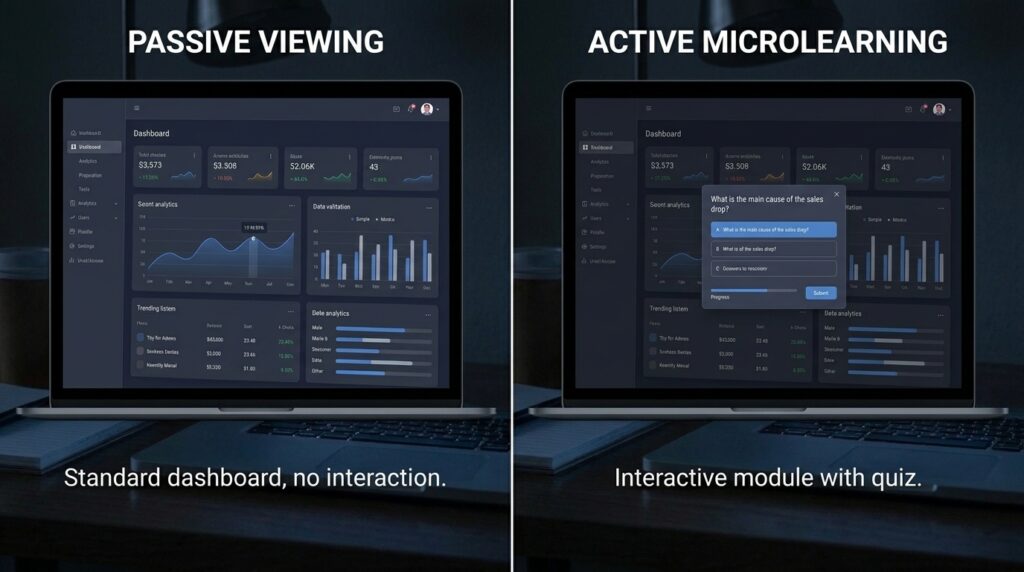
Instead of creating hour-long monolithic lectures, enterprise curriculums must be broken down into hyper-focused microlearning modules.
This approach supports spaced repetition and allows employees to access “just-in-time” learning precisely when they need to solve a specific problem on the floor or in the software.
To combat viewer fatigue in highly technical subjects, incorporating interactive video formats—such as clickable hotspots or branching decision scenarios—can increase engagement by up to 300%.
For global EdTech companies, European universities, and US-based Fortune 500 brands looking to scale their training libraries, the MENA region—specifically hubs like Saudi Arabia (KSA), the UAE, and Egypt—offers an unmatched strategic advantage. However, executing high-volume production across borders requires far more than just hiring a local camera operator. It requires a fully integrated, bilingual infrastructure.
Global brands outsource to premium MENA production hubs to secure elite, on-the-ground execution without the staggering overhead and logistical nightmare of flying domestic teams overseas.
The single biggest point of friction for foreign producers is local compliance. Shooting corporate training inside a facility in Riyadh or a medical lab in Cairo requires specific government clearances, location permits, and often, ATA Carnets for specialized gear. A premium regional partner handles this entirely in-house. We navigate the Ministry of Media approvals in KSA and the necessary clearances in Egypt, ensuring your production timeline never stalls due to red tape.
When standardizing a curriculum for a Middle Eastern workforce, direct translation is not enough; you need cultural localization. This means having bilingual directors on set who understand regional corporate etiquette, appropriate wardrobe guidelines for corporate talent, and local nuances in body language. Whether you are standardizing barista training protocols across 200+ branches or localizing complex software tutorials, having a crew that fluently speaks both the local language and the language of international corporate standards is non-negotiable.
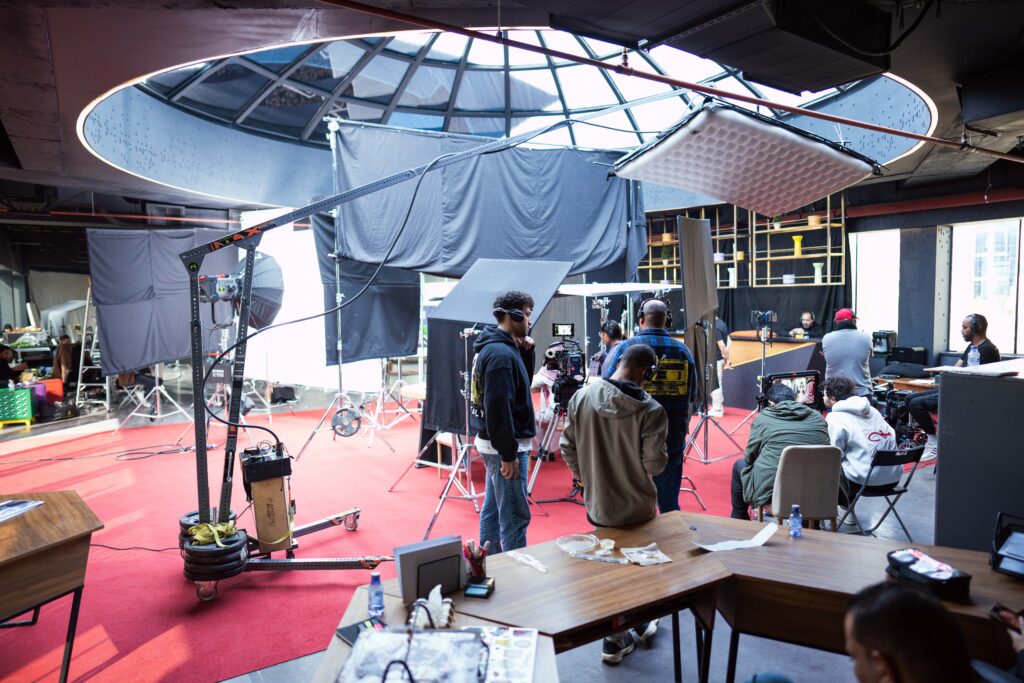
Enterprise clients in New York or London do not need to fly to Dubai to oversee a shoot. We deploy advanced remote viewing infrastructures. Using encrypted, low-latency streaming hardware, your global stakeholders can sit in their home offices and watch the camera feed live, communicate directly with the director on set, and approve takes in real-time. This entirely eliminates the “logistical hesitation” of remote production, giving you absolute control over the final product thousands of miles away.
A beautiful video is useless if it crashes your company’s Learning Management System. High-volume post-production requires a deep, technical understanding of enterprise platforms like Cornerstone, SAP Litmos, Docebo, or Canvas.
At scale, post-production shifts from an artistic endeavor into a rigorous data management pipeline. Managing 200+ video files across three languages requires strict adherence to technical standards.
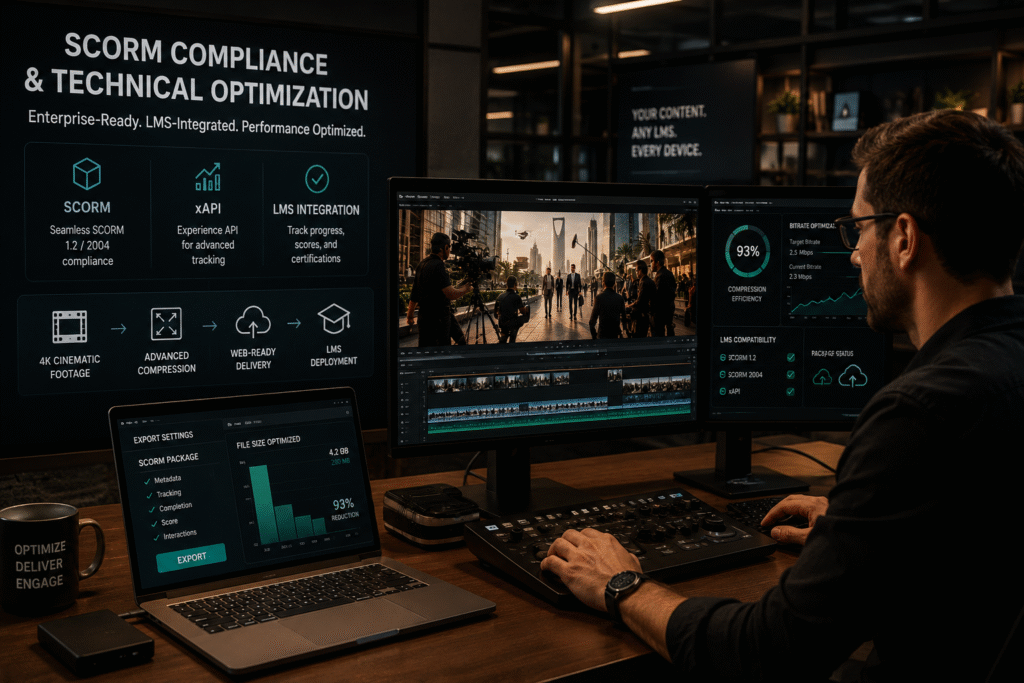
Enterprise LMS platforms have strict file size and bitrate limitations. Our post-production pipeline compresses massive 4K cinematic footage into highly optimized, web-ready formats without sacrificing visual fidelity. We ensure every module is exported to integrate flawlessly with SCORM (Sharable Content Object Reference Model) or xAPI standards, allowing your HR team to track viewer progress, pause/resume states, and quiz completions flawlessly.
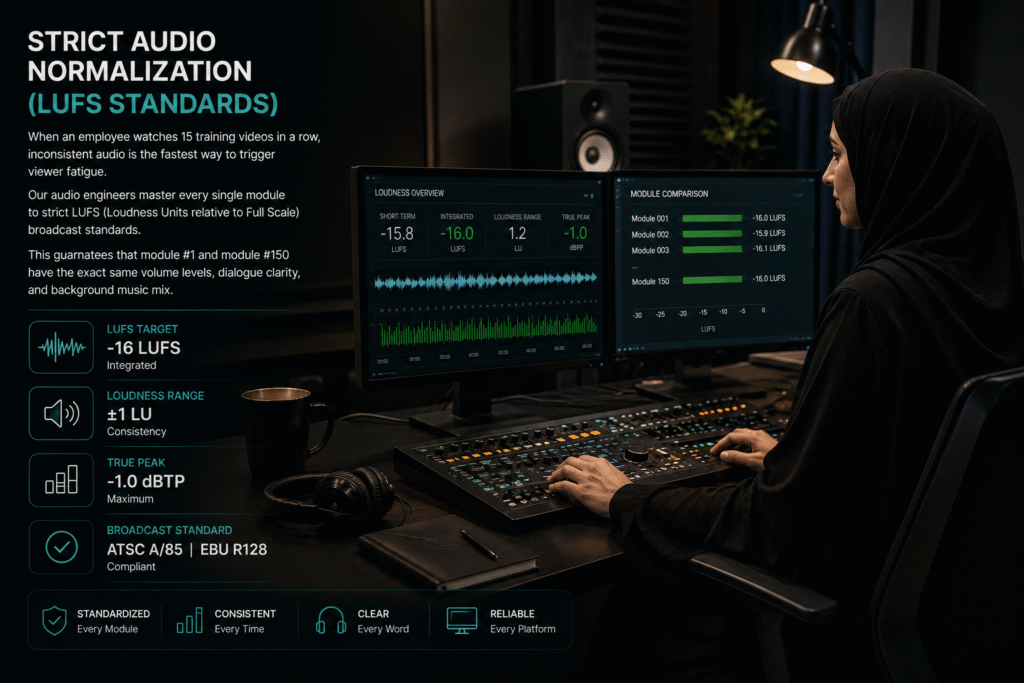
When an employee watches 15 training videos in a row, inconsistent audio is the fastest way to trigger viewer fatigue. Our audio engineers master every single module to strict LUFS (Loudness Units relative to Full Scale) broadcast standards. This guarantees that module #1 and module #150 have the exact same volume levels, dialogue clarity, and background music mix.
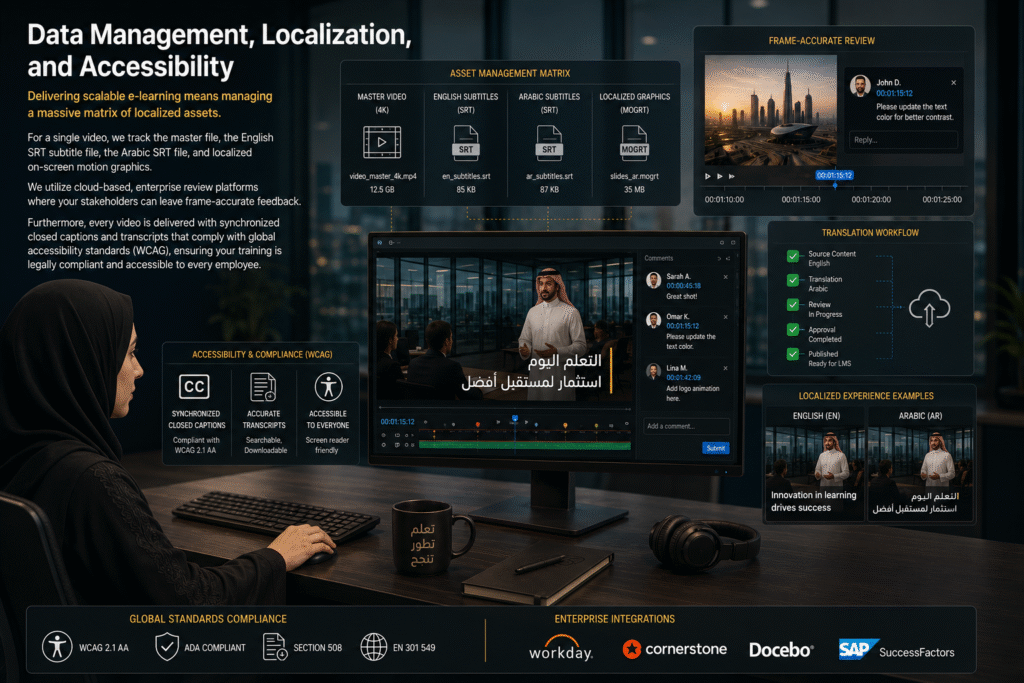
Delivering scalable e-learning means managing a massive matrix of localized assets. For a single video, we track the master file, the English SRT subtitle file, the Arabic SRT file, and localized on-screen motion graphics. We utilize cloud-based, enterprise review platforms where your stakeholders can leave frame-accurate feedback. Furthermore, every video is delivered with synchronized closed captions and transcripts that comply with global accessibility standards (WCAG), ensuring your training is legally compliant and accessible to every employee.
When executing global curricula for global EdTech partners like Emeritus or regional enterprise networks like Barn’s Coffee, the logistical friction compounds exponentially.
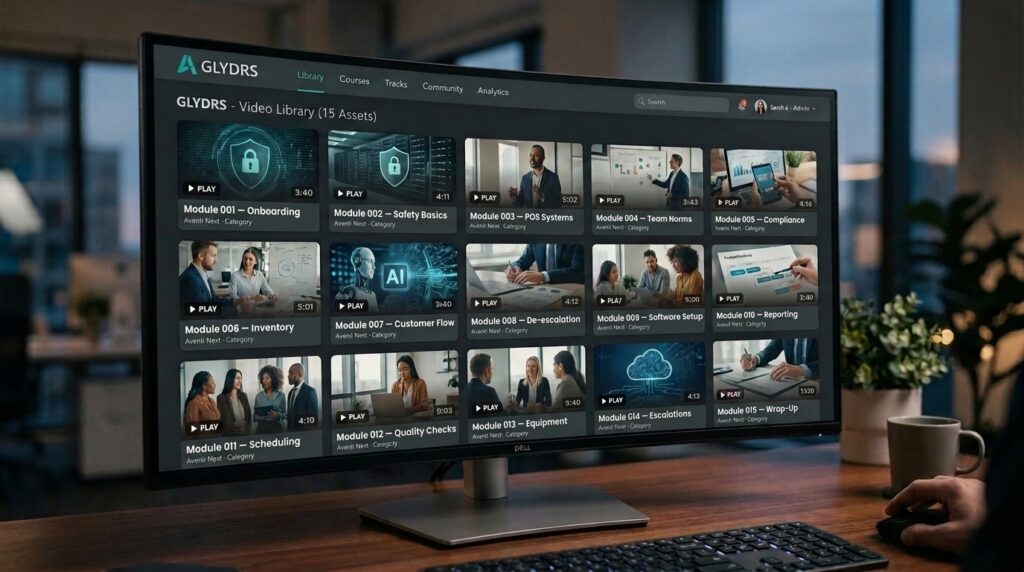
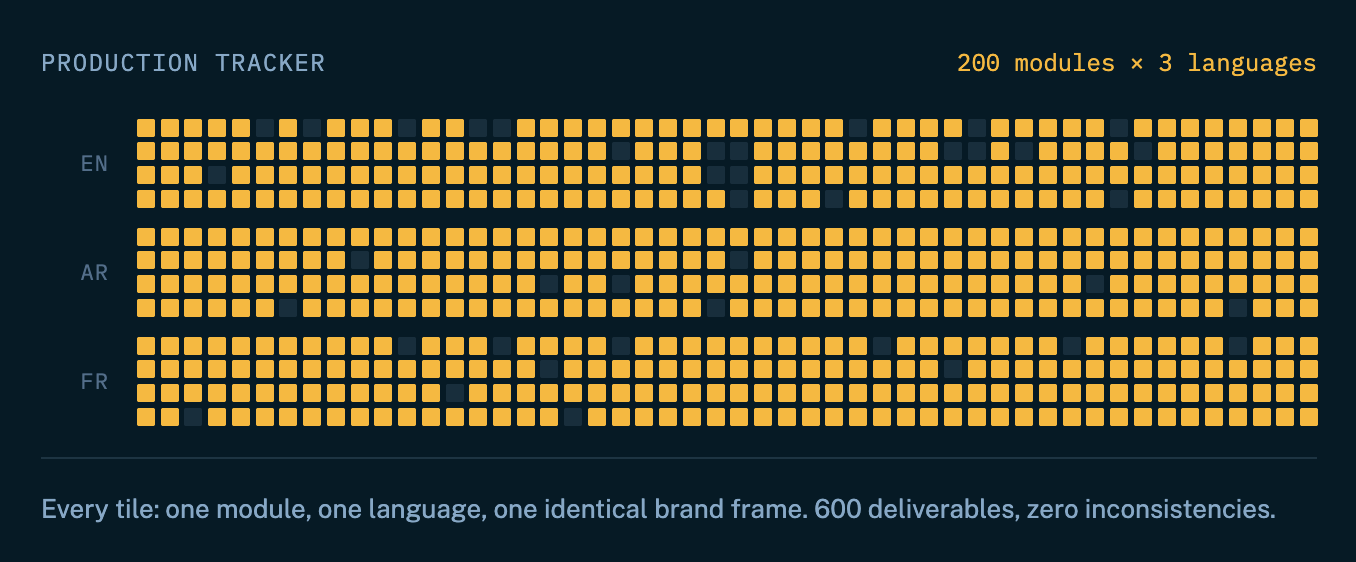
In a recent deployment, we were tasked with architecting and producing a comprehensive e-learning library encompassing 201 individual training modules, fully localized across three distinct languages.
The challenge was not merely linguistic translation, but maintaining strict visual continuity, technical LMS compliance, and pedagogical pacing across hundreds of discrete video assets without bottlenecking the client’s aggressive launch timeline.
To execute this volume without sacrificing premium quality, we deployed our centralized regional hub model. By utilizing standardized studio environments and pairing bilingual creative directors with localized subject matter experts, we built a parallel production pipeline.
This framework allowed us to capture the exact same curriculum in English, Modern Standard Arabic, and localized regional dialects concurrently, dramatically reducing studio overhead.
The final 201 deliverables underwent rigorous audio normalization and SCORM-compliant exporting, resulting in a frictionless, plug-and-play handover directly to the enterprise learning management system.
When you need to standardize training across hundreds of employees and multiple languages, generic videos won’t cut it.
Consider this first paragraph. It has a beautiful drop cap styling its initial letter.
This is the second paragraph. It remains completely standard without any changes.
By shifting the focus from individual video files to comprehensive, cinematic e-learning libraries, organizations can significantly reduce manual training hours for management while guaranteeing an identical onboarding experience for an employee in Riyadh, Dubai, or London.
When you are ready to transition from fragmented training documents to a standardized, cinematic e-learning library, you need a partner with the infrastructure to deliver at scale.
Submit your project parameters below for a secure, confidential discovery review.
The MENA region’s premier execution hub for high-volume cinematic and e-learning deployments.
Al Moussa Towers, Al Olaya St.
Al Olaya
Riyadh,
Saudi Arabia
Al Naby Danial St,
El Raml Station,
Alexandria,
Egypt
© 2026 Glydrs. All rights reserved. | Privacy Policy | Terms & Conditions