

12 Nov The Future of AI in learning and development
AI in Learning and Development: Preparing for Your Future
The learning and development landscape you know today is about to undergo its most dramatic transformation yet. As we stand on the cusp of 2025, you’re witnessing the early stages of what promises to be a $500+ billion L&D revolution powered by artificial intelligence. This isn’t just another technological upgrade—it’s a fundamental reimagining of how your workforce learns, grows, and adapts in an increasingly complex business environment.
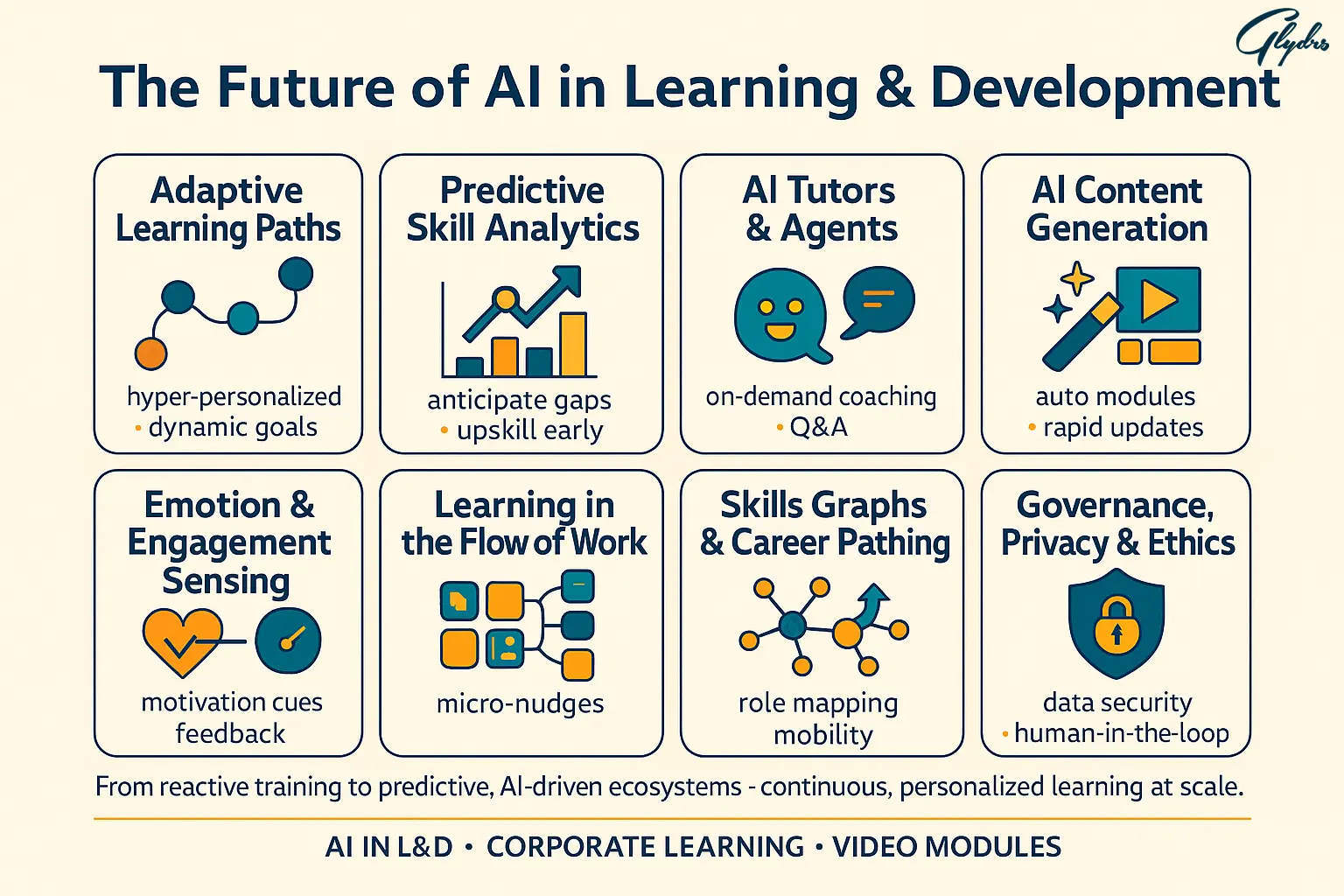
You’re no longer dealing with simple automation or basic recommendation engines. The AI in learning and development ecosystem is evolving into sophisticated, predictive systems that anticipate your employees’ learning needs before they even recognize them themselves. Your traditional reactive training approaches are giving way to proactive, intelligent learning ecosystems that adapt in real-time to changing business demands and individual career trajectories.
The shift you’re experiencing moves far beyond digitizing existing content. You’re entering an era where quantum computing will process learning data at unprecedented speeds, where emotional AI will understand your learners’ motivational states, and where predictive analytics will identify skill gaps months before they impact your business performance. The question isn’t whether this transformation will reach your organization—it’s whether you’ll lead it or be left behind by it.
Your workforce development strategy must evolve from reactive to predictive, from standardized to hyper-personalized, and from isolated training events to continuous, seamlessly integrated learning experiences. The future of work isn’t just changing—it’s demanding that you redefine what learning means in your organization.
Emerging AI Technologies Reshaping L&D Landscapes
You’re about to witness learning technologies that seemed like science fiction just five years ago become standard tools in your L&D arsenal. Machine learning algorithms are evolving beyond simple pattern recognition to create adaptive learning systems that understand not just what your employees need to learn, but how they learn best, when they’re most receptive to new information, and what learning formats will drive the highest retention rates.
Your next-generation learning platforms will leverage natural language processing advances that go far beyond chatbots answering basic questions. You’ll have conversational learning assistants that can engage in complex discussions about strategic concepts, provide nuanced feedback on leadership scenarios, and even facilitate peer-to-peer learning conversations across global teams in real-time.
Virtual and augmented reality integration
With AI is creating immersive learning experiences that adapt to your learners’ performance in real-time. Imagine your sales team practicing difficult client conversations in VR environments where AI adjusts the client’s personality, objections, and emotional responses based on each learner’s skill level and learning objectives. These systems learn from every interaction, continuously refining the experience for future learners.
The most exciting development you’ll encounter is predictive analytics moving beyond simple reporting to proactive skill gap identification. Your AI systems will analyze industry trends, your company’s strategic direction, competitor movements, and individual career trajectories to predict which skills will become critical 18-24 months before you actually need them. This foresight allows you to begin upskilling initiatives before skill shortages impact your business performance.Quantum computing’s emergence will revolutionize how you process and analyze learning data. You’ll be able to run complex simulations of learning scenarios, analyze vast datasets of global learning patterns, and optimize personalized learning paths with computational power that makes today’s AI seem primitive by comparison.
The Rise of Hyper-Intelligent Learning Ecosystems
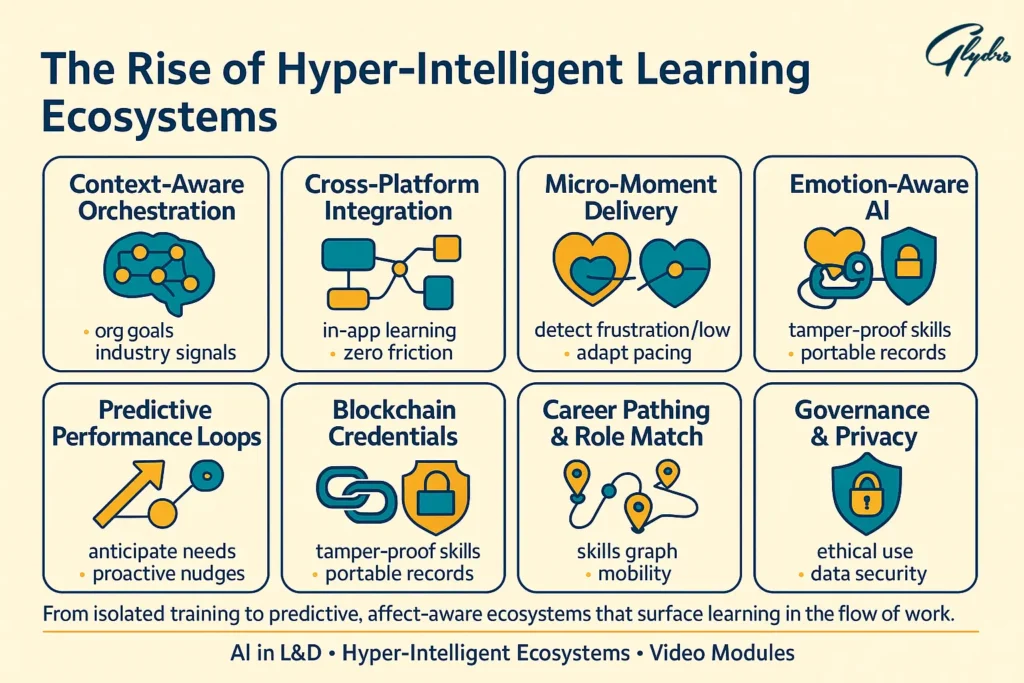
You’re moving into an era where learning doesn’t happen in isolated training sessions but within hyper-intelligent learning ecosystems that orchestrate every aspect of your employees’ development journey. These systems understand your organizational context, business objectives, industry challenges, and individual employee aspirations to create learning experiences that evolve continuously based on real-world performance and changing business needs.
Your future learning platforms will feature cross-platform integration that creates seamless experiences across all the tools your employees use daily. Whether they’re in your CRM, project management system, or communication platform, relevant learning opportunities will appear contextually when they’re most needed. This isn’t just about convenience—it’s about eliminating the friction that prevents learning from translating into improved performance.
Micro-moment learning delivery represents a paradigm shift in how you think about training timing. Your AI systems will identify the precise moments when employees are most receptive to specific types of learning—perhaps just after they’ve encountered a challenge, before they begin a new project, or when they’re showing signs of high engagement with related content. These systems deliver learning in perfectly timed, bite-sized pieces that maximize retention and immediate application.
You’ll witness the emergence of emotional AI that understands not just what your learners need to know, but how they’re feeling about their development journey. These systems recognize frustration, excitement, confidence, and confusion, adapting content delivery, pacing, and support accordingly. When your employees are struggling with complex concepts, the system provides additional scaffolding. When they’re highly engaged, it accelerates the learning pace and introduces more challenging material.
Blockchain technology will transform how you verify and track skill development, creating tamper-proof credentials that follow employees throughout their careers while providing you with unprecedented visibility into your workforce’s capabilities. These verified skill credentials will enable more accurate role matching, career pathing, and strategic workforce planning.
Transforming Human Roles in an AI-Driven Learning Future
Your L&D professionals aren’t being replaced by AI—they’re being elevated to roles that didn’t exist five years ago. AI in learning and development is creating new career paths and transforming existing ones in ways that emphasize uniquely human capabilities while leveraging AI’s computational power.
You’ll see the emergence of AI Learning Architects—professionals who design the logic, parameters, and ethical guidelines that govern AI-powered learning systems. These specialists understand both learning science and AI capabilities, creating the frameworks that ensure your AI systems deliver meaningful, effective learning experiences aligned with your business objectives.
Learning Experience Designers represent another evolution in L&D roles. These professionals focus on the human elements that AI cannot replicate—emotional engagement, cultural relevance, and complex problem-solving scenarios. They work collaboratively with AI systems, using AI-generated insights to create more compelling and effective learning experiences while ensuring the human connection remains central to development.
Your traditional training roles are evolving into AI-Human Collaborative Models where human expertise guides AI capabilities. Your instructional designers now spend less time creating content from scratch and more time curating, refining, and contextualizing AI-generated materials. This shift allows them to focus on higher-level strategic thinking about learning architecture and business alignment.
AI Training Specialists are emerging as critical roles within L&D teams. These professionals ensure your L&D staff can effectively leverage AI tools, understand their capabilities and limitations, and maintain ethical oversight of AI-driven learning initiatives. They serve as the bridge between technical AI capabilities and practical learning applications.
You’ll notice that successful L&D professionals in this new landscape are those who embrace continuous learning themselves, developing AI fluency while deepening their expertise in areas where human insight remains irreplaceable—complex facilitation, emotional support, strategic thinking, and ethical decision-making.
Revolutionary Applications on the Horizon
The applications of AI in learning and development that you’ll encounter in the next three to five years will fundamentally change how your employees acquire and apply new skills. AI-powered simulation environments are moving beyond simple scenario-based training to create dynamic, realistic practice environments where employees can experiment with new approaches, make mistakes, and learn from failures without any real-world consequences.
You’ll have access to predictive learning paths that don’t just respond to current skill gaps but anticipate future needs based on career trajectory modeling. These systems analyze successful career progressions within your industry, identify the skills and experiences that correlate with success in specific roles, and create development plans that prepare employees for positions they haven’t even considered yet.
Real-time performance coaching through AI-enabled feedback loops will transform how you support employee development. Instead of waiting for annual reviews or scheduled check-ins, your employees will receive continuous, contextual feedback on their performance, with AI systems identifying improvement opportunities and suggesting specific learning resources to address them immediately.
Personalized mentorship matching using algorithmic compatibility analysis will connect employees with mentors based on far more sophisticated criteria than traditional programs. AI will analyze personality traits, communication styles, career goals, skill complementarity, and even optimal timing for mentorship relationships to create more effective developmental partnerships.
The most transformative application you’ll experience is continuous learning integration with daily work processes. Learning becomes invisible, woven into the fabric of work itself. Your employees won’t need to set aside time for training—they’ll be learning continuously as they work, with AI providing just-in-time knowledge, skill reinforcement, and performance optimization suggestions.
Future-Proofing L&D Strategy for AI Integration
You need to start building your AI readiness infrastructure now, even if you’re not ready for full implementation. This means ensuring your learning management systems can integrate with AI tools. Your data collection practices generate the insights AI needs to function effectively, and your organizational culture embraces data-driven decision making.
Governance frameworks for ethical AI deployment will become non-negotiable requirements for your L&D strategy. You’ll need clear policies about data privacy, algorithmic bias prevention, transparency in AI decision-making, and human oversight requirements. These frameworks protect both your organization and your employees while ensuring AI enhances rather than undermines your learning objectives.
Your change management strategies must account for the reality that AI adoption in learning represents both a technological and cultural transformation. You’ll need to address fears about job displacement, resistance to data-driven approaches, and concerns about the “humanness” of AI-powered learning. Success requires comprehensive communication, involvement of skeptics in pilot programs. And demonstration of AI’s value in enhancing rather than replacing human capabilities.
Measurement frameworks for AI learning ROI must go beyond traditional training metrics to capture the full value of AI-enhanced learning. You’ll track not just completion rates and satisfaction scores, but predictive accuracy of skill gap identification. Time-to-competency improvements, retention rates of AI-personalized learning, and business impact of continuous learning integration.
Planning for scalable AI implementation across global workforces requires consideration of cultural differences. Regulatory variations, language requirements, and technology infrastructure disparities. Your AI strategy must be sophisticated enough to adapt to local contexts while maintaining consistency in learning outcomes and brand standards.
Navigating Tomorrow’s Challenges and Opportunities
The most significant challenge you’ll face with AI in learning and development is addressing algorithmic bias. That could create or perpetuate inequities in learning opportunities. You must implement robust testing and monitoring systems to ensure AI recommendations don’t favor certain demographic groups. Learning styles, or career paths. This requires diverse teams reviewing AI outputs and regular audits of learning outcomes across different employee populations.
Balancing automation with human connection presents an ongoing challenge as you integrate more AI into your learning ecosystem. While AI excels at personalization and efficiency. Your employees still need human mentorship, emotional support, and complex guidance that only people can provide. Your challenge is determining the optimal mix of AI and human interaction for different learning objectives and employee needs.
Data privacy concerns will intensify as your AI systems require increasingly detailed information about employee performance. Learning preferences, and career aspirations. You’ll need to navigate complex regulatory environments while building employee trust in how their data is collected, used, and protected. Transparency and employee control over their data will become competitive advantages in talent retention.
Resistance to AI-driven learning transformations often stems from fear of job displacement. Concerns about the dehumanization of learning, or skepticism about AI’s effectiveness. Your success depends on involving skeptics in the design process, demonstrating AI’s value through small wins. And maintaining clear communication about AI’s role as an enhancer rather than a replacement for human expertise. You’ll also need to prepare for evolving regulatory landscapes as governments develop frameworks for AI in workplace learning. Staying ahead of regulatory requirements while maintaining competitive advantages through AI innovation requires ongoing monitoring of policy developments and proactive compliance strategies.

Strategic Roadmap for L&D’s AI-Powered Tomorrow
Your AI readiness assessment should evaluate not just your technological capabilities but your organizational culture. Employee attitudes toward AI, data quality and accessibility, and leadership support for AI initiatives. Use comprehensive frameworks that examine infrastructure. Skills, governance, and change management capabilities to identify gaps that could impede successful AI adoption.
Investment priorities for emerging AI learning technologies should focus first on areas where you can demonstrate quick wins and build momentum for broader adoption. Consider starting with AI-powered content curation or basic personalization features before moving to more complex applications like predictive analytics or advanced simulation environments.
Your implementation timeline should follow a phased approach that allows for learning and adjustment between stages. Begin with pilot programs in controlled environments, expand to broader populations based on pilot success. And gradually increase AI sophistication as your organization builds experience ,and confidence with these technologies.
Building internal AI champions requires identifying employees who are both technically curious and influential within your organization. These champions should receive advanced training in AI capabilities and limitations. Participate in pilot programs, and serve as peer educators who can address concerns and resistance from their colleagues.
Strategic partnerships with AI learning technology providers will become increasingly important as the pace of innovation accelerates. Look for vendors who demonstrate not just technical capabilities but understanding of learning science. Commitment to ethical AI practices, and willingness to collaborate on customization and integration challenges specific to your industry and organizational context.
Keep reading and uncover secrets that can change the way you work. Manager Training: Why do your managers need it?
The Competitive Advantage of AI-Forward Learning Organizations
You’ll achieve accelerated time-to-competency through intelligent learning paths that eliminate redundant content. Focus on individual skill gaps, and provide optimal sequencing of learning experiences. Organizations implementing AI-personalized learning report 40-60% reductions in time required to reach proficiency in new roles. Giving you significant advantages in rapid scaling and market responsiveness.
Enhanced employee engagement through personalized development experiences creates a virtuous cycle where higher engagement leads to better learning outcomes. Which increases job satisfaction and reduces turnover. Your AI systems can identify engagement patterns and continuously optimize content delivery to maintain high levels of learner motivation and participation.
Improved talent retention through continuous, relevant upskilling addresses one of the primary reasons employees leave organizations—lack of growth opportunities. When your AI systems can predict skill needs and provide personalized development paths. Employees see clear connections between their current roles and future opportunities within your organization.
Cost optimization through automated learning processes extends beyond simple efficiency gains to include reduced need for external training providers. Decreased travel and facility costs for training events, and minimized productivity loss through just-in-time learning delivery that doesn’t require employees to leave their work for extended periods.
Data-driven insights enabling strategic workforce planning give you unprecedented visibility into your organization’s skill development patterns. Learning effectiveness, and future capability needs. This intelligence supports more accurate hiring decisions, better succession planning, and more strategic approaches to organizational development.
Keep reading and uncover secrets that can change the way you work. How to Choose a Learning and Development Course
Preparing Today for Tomorrow’s Learning Revolution
You cannot afford to wait for perfect AI solutions. Or complete organizational readiness before beginning your AI journey in learning and development. The competitive advantage goes to organizations that start experimenting now. Learning from early implementations, and building the capabilities that will be essential as AI becomes standard in L&D.
Your immediate actions should include conducting comprehensive assessments of your current learning technology stack’s AI integration capabilities. Beginning conversations with AI learning vendors to understand emerging possibilities, and identifying pilot opportunities. Where you can test AI applications with manageable risk and clear success metrics.
Building a future-ready learning culture
Requires more than technology adoption. It demands fundamental shifts in how your organization thinks about skill development, career progression. And the relationship between learning and work. You must cultivate openness to continuous learning, comfort with data-driven personalization. And appreciation for AI as a tool that enhances human potential.
The convergence of AI, learning, and business strategy means that learning. And development can no longer be treated as a support function separate from core business operations. Your L&D strategy must be intimately connected to your business strategy. With AI in learning and development serving as a critical enabler of organizational agility, innovation, and competitive positioning.
Creating sustainable AI learning ecosystems that evolve with technology requires building internal capabilities rather than relying solely on vendor solutions. You need team members who understand AI principles, can evaluate new technologies critically. And can adapt AI applications to your organization’s unique needs and challenges.
The imperative for immediate action stems from the accelerating pace of AI development and adoption across industries. Organizations that delay AI integration in learning risk falling behind not just in training effectiveness. But in their ability to attract and retain talent who expect personalized. Technology-enhanced development opportunities.
Keep reading and uncover secrets that can change the way you work. Enterprise LMS: What is it and what are the Benefits?
Thriving in the Age of Intelligent Learning
Your journey into AI-powered learning and development isn’t just about adopting new technologies. It’s about positioning your organization to thrive in an economy where continuous learning, rapid adaptation. And intelligent use of data become the primary differentiators between successful and struggling organizations.
The transformation ahead of you will challenge many assumptions about how learning happens. What L&D professionals do, and how organizations develop their workforce capabilities. But it also offers unprecedented opportunities to create learning experiences that are more engaging, more effective. And more aligned with individual and organizational success than anything previously possible.
Your success in this transformation depends on starting now, learning continuously. And maintaining focus on the human elements that will always be central to meaningful learning and development. AI in learning and development will amplify your capabilities, but it will never replace the insight, creativity. And emotional intelligence that make great L&D professionals invaluable to their organizations.
The future of learning is intelligent, personalized, and seamlessly integrated into the flow of work. Your employees are ready for this future. The question is whether you’ll lead them into it or follow others who recognized the opportunity sooner.
Turn your goals into real achievements with our tailored services – request the service now.
Frequently Asked Questions
1- What timeline should organizations expect for full AI integration in L&D?
Most organizations will see significant AI integration within 3–5 years, with early adopters already experiencing 40–60% efficiency gains in content creation and delivery. Full integration depends on your current technology infrastructure, organizational readiness, and the complexity of your learning ecosystem. You should plan for phased implementation, starting with pilot programs in the next 12–18 months.
2- How will AI change the skills employees need to succeed?
Future workers will need enhanced critical thinking, emotional intelligence, and AI collaboration skills, with technical roles requiring AI literacy and creative roles focusing on uniquely human capabilities. The most valuable employees will be those who can work effectively alongside AI systems while providing the strategic thinking, complex problem-solving, and interpersonal skills that AI cannot replicate.
3- What are the biggest risks of AI implementation in learning and development?
Key risks include algorithmic bias, over-dependence on technology, data privacy concerns, and potential job displacement without proper reskilling initiatives. You can mitigate these risks through diverse design teams, human oversight requirements, transparent data practices, and comprehensive change management that emphasizes AI as an enhancement to human capabilities.
4- How much should organizations budget for AI-powered learning initiatives?
Investment typically ranges from 15–25% of total L&D budgets initially, with ROI expected within 12–18 months through efficiency gains and improved learning outcomes. Your specific investment will depend on current technology infrastructure, organizational size, and implementation scope. Consider starting with smaller investments in pilot programs before scaling successful applications.
5- Will AI completely replace human trainers and learning professionals?
AI will augment rather than replace human expertise, with professionals evolving into strategic roles focused on learning architecture, emotional support, and complex problem-solving guidance. The most successful L&D professionals will be those who develop AI literacy while deepening their expertise in uniquely human capabilities like relationship building, cultural sensitivity, and strategic thinking.

No Comments