

24 Dec The Value of Training Development Certification of an Employee
What Training Development Certification Means for Employees
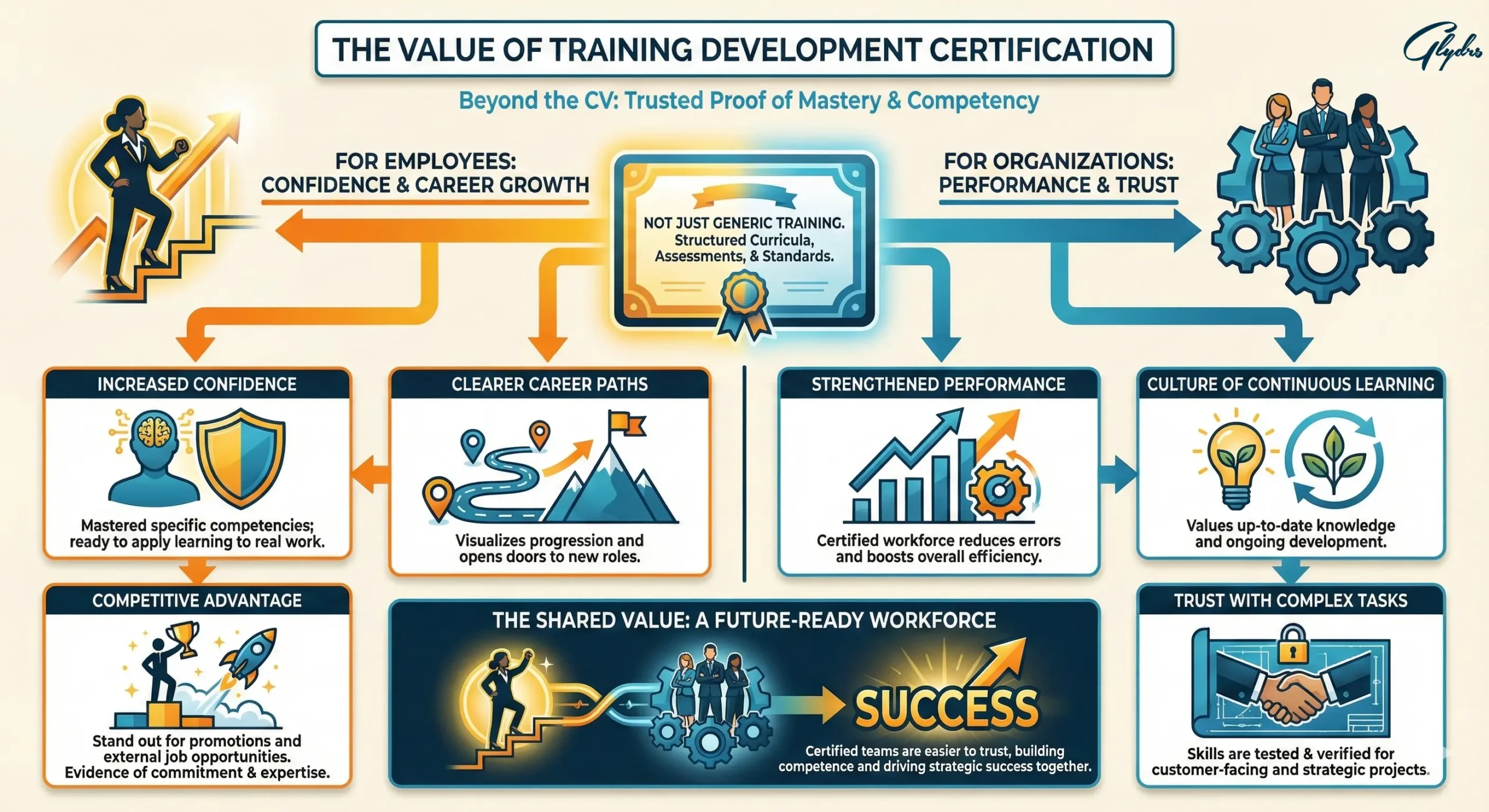
The value of training development certification goes far beyond adding a shiny line to an employee’s CV. In a market where skills are constantly evolving and roles change quickly, certifications provide clear, trusted proof that an employee has mastered specific competencies that matter to the business. Unlike generic training, certification programs usually include structured curricula, assessments, and standards set by external or reputable bodies.
That means they signal not only that someone has attended a course, but that they can actually apply what they have learned to real work. For employees, earning a training development certification can increase confidence, create clearer career paths, and make them more competitive when internal promotion or external job opportunities arise. Research on professional credentials shows that certified employees often progress faster in their careers because employers see certifications as evidence of commitment, expertise, and up-to-date knowledge.
For organizations, developing a workforce with relevant certifications can strengthen performance, reduce errors, and build a culture that values continuous learning. A certified team is easier to trust with complex tasks, customer-facing responsibilities, and strategic projects, because their skills have been tested and verified, not just assumed.
How Training Development Certification Aligns with Business Results
To understand the full value of training development certification, it helps to look at what these credentials actually represent. Professional training and development certifications can cover areas like learning and development (L&D), instructional design, leadership, project management, or specific technical fields. Many respected programs are built around competency frameworks that define exactly what a certified professional should know and be able to do—for example, designing learning experiences, aligning training with business goals, or using data to evaluate training impact.
For employees working in HR, talent development, or corporate training, L&D-focused certifications signal that they understand modern learning strategies and can create programs that deliver measurable results. For employees in other functions, role-specific certifications show they have achieved a recognized standard in areas like cybersecurity, finance, healthcare, or customer service.
Across industries, certifications help employees stay current with new tools and methods, especially as technology and best practices change. This combination of clarity, structure, and external validation makes training development certification a powerful bridge between individual growth and organizational performance.
Structured Growth: Why Certification Matters for Individual Development
One of the biggest advantages of training development certification is the way it connects learning directly to business results. Many organizations invest in training without a clear way to measure whether it is working. Certifications change that dynamic because they are built around defined competencies and assessments. When employees complete a certification program, leaders know exactly which skills have been developed—whether that is designing effective training, coaching others, managing projects, or using specific tools.
This clarity makes workforce planning easier: managers can see where certified talent is located in the organization and assign them to projects where their skills will have the most impact. Certifications also help standardize quality across teams and locations. Instead of relying on individual managers’ opinions about who is “strong,” companies can use certifications as a common benchmark for capability. This is especially valuable in highly regulated industries or technical fields, where mistakes are costly and compliance is essential.
In these environments, having employees with the right training development certification helps reduce risk, improve consistency, and build trust with customers, partners, and regulators. Over time, organizations that deliberately support and recognize certification tend to build stronger internal pipelines of talent, with more people ready to step into leadership or specialist roles when needed.
Choosing the Right Training Development Certification Path
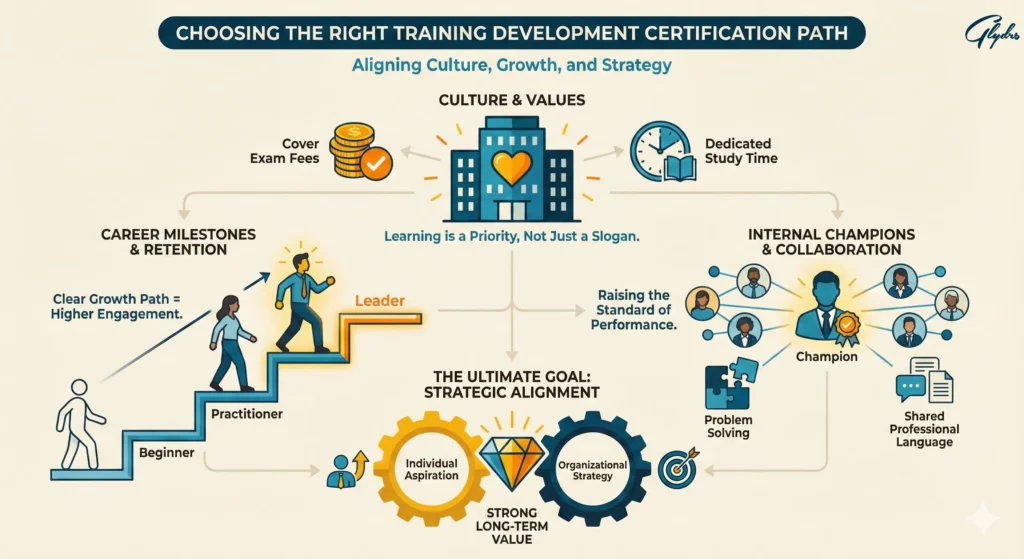
From a cultural perspective, training development certification also sends a powerful message about what the organization values. When companies encourage employees to pursue certifications, cover exam fees, or offer dedicated study time, they show that learning is not just a slogan but a real priority. This can significantly improve engagement and retention, especially among high-potential employees who want to grow rather than stay in static roles.
Certifications create visible milestones on a career path: employees can see what they need to learn to move from beginner to advanced, or from practitioner to leader. This transparency makes development feel fairer and more achievable. Furthermore, certified employees often become internal champions of best practices. They share updated methods, help colleagues solve problems, and raise the overall standard of performance in their teams.
In this way, each new training development certification does more than upgrade one person’s skills; it quietly upgrades the surrounding environment as well. As more employees earn credentials, the organization benefits from a network of people who speak the same professional “language” and can collaborate more effectively across departments. This alignment between individual aspiration and organizational strategy is a key reason why certifications add such strong long-term value.
Elevating Learning Quality with Certified L&D Professionals
For individual employees, one of the most practical benefits of pursuing a training development certification is the structure it brings to their growth. Instead of learning in a random, uncoordinated way, certification programs provide a clear roadmap of topics, skills, and milestones. For professionals in HR or learning and development, this often means mastering the full cycle of training: conducting needs analyses, designing engaging content, delivering sessions effectively, and measuring impact with data.
For managers or subject-matter experts, a training development certification can sharpen their ability to coach others, build onboarding paths, or lead internal workshops with confidence. In both cases, the certification process pushes people to move beyond intuition and adopt proven methods and frameworks. This reduces trial and error, shortens the learning curve, and leads to better results when they design or deliver training in real life.
It also boosts credibility: when employees present new training ideas or suggest improvements, certifications reassure stakeholders that these recommendations are grounded in recognized best practices. Over time, this combination of structure, confidence, and credibility makes certified employees more influential in shaping how knowledge is shared and developed across the organization.
Supporting Digital Transformation Through Training Development Certification
Choosing the right training development certification is essential to maximize this value. Not all programs are created equal. And the best choice depends on an employee’s role, career goals, and the organization’s strategy. A good starting point is to look for certifications that are well-recognized in your industry. Have clear competency frameworks, and include practical assessments—not just attendance certificates. It is also important to consider the balance between theory and application. Strong programs offer projects, case studies. Or real-world assignments that can be applied directly at work.
Flexibility matters too; online or blended formats allow employees to learn alongside their daily responsibilities. From the organization’s side, HR and leadership can increase impact by aligning recommended certifications with talent pipelines. For example, suggesting specific credentials for future trainers, team leaders, or change champions. Offering financial support, study resources, or dedicated learning time signals that the company is invested in employees’ success.
When individuals carefully select their path and employers actively support them. Training development certification becomes a powerful partnership. Employees grow their careers, and organizations gain skilled. Motivated people who can design and deliver training that truly moves the business forward.
Career Momentum and Confidence Through Certification
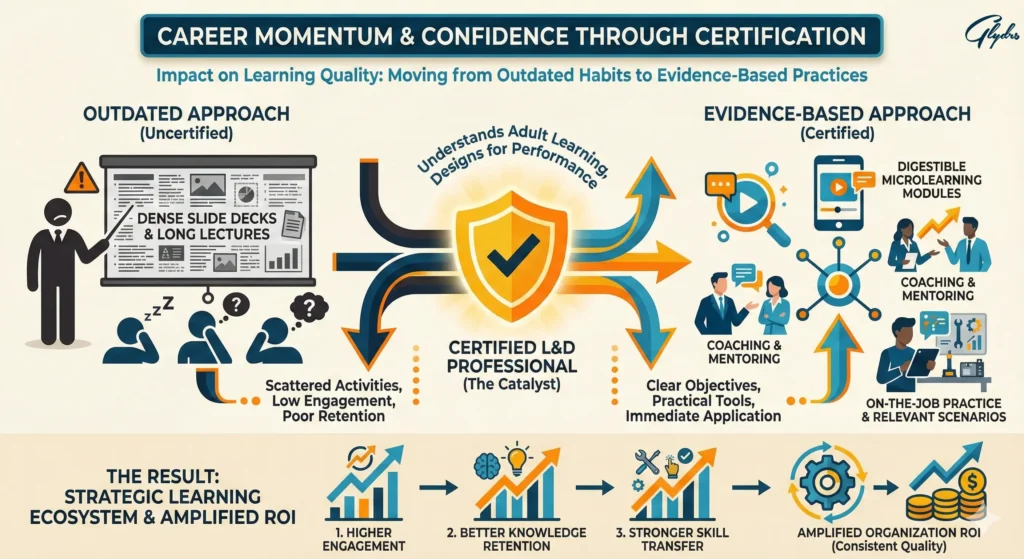
Another important dimension of training development certification is its impact on the quality of the learning experiences employees receive. When the people who design and deliver training are certified. They are more likely to use evidence-based practices instead of relying on outdated habits like long lectures and dense slide decks. Certified L&D professionals understand how adults learn. How to break complex topics into digestible modules. And how to blend formats such as microlearning, coaching, and on-the-job practice.
They also know how to align training with real performance metrics. Ensuring that each program has clear objectives, relevant scenarios. And practical tools that employees can use immediately. This level of professionalism shows up in higher engagement, better knowledge retention, and stronger transfer of skills to the workplace.
In other words, investing in training development certification for your L&D team amplifies the return on every training hour across the organization. Because the design quality behind all learning initiatives improves. Instead of scattered activities, you get a consistent, strategic learning ecosystem.
Keep reading and uncover secrets that can change the way you work. How to Build a Training Program For an Effective Employee?
Certification as a Portable, Recognized Professional Asset
At the organizational level, training development certification also supports digital transformation and innovation. As new technologies, systems, and ways of working are introduced. Companies need people who can translate change into clear, supportive learning journeys. Certified professionals are better equipped to select the right tools. Learning management systems, content authoring tools, analytics platforms. And integrate them into a cohesive strategy rather than a patchwork of disconnected solutions.
They understand how to use data from training platforms to identify skills gaps. Personalize learning paths, and continuously improve content based on real usage and feedback. This makes the learning function more agile and responsive to business needs. When organizations have a critical mass of certified talent in training and development. They can roll out new processes faster, prepare employees for future roles more effectively. And maintain a competitive edge in rapidly changing markets.
In this way. Training development certification becomes not just an individual achievement. But a strategic asset that strengthens the entire company’s ability to learn, adapt, and grow.
Keep reading and uncover secrets that can change the way you work. How to Create a Training Program: Simple Steps
Aligning Employee Ambitions with Organizational Needs
On a personal level, the decision to pursue a training development certification can be a turning point in an employee’s career. Certification turns vague ambitions like “I want to grow” into a concrete, trackable goal with a clear finish line. The study process exposes employees to fresh ideas, proven models. And practical tools they may never encounter in their day-to-day routines. As they progress through the program, many people report a noticeable boost in confidence. They can speak the language of learning and development more fluently. Back up their recommendations with recognized frameworks. And contribute more actively in cross-functional projects.
That confidence often translates into greater visibility. Certified employees are more likely to be invited onto task forces, pilot projects. Or change initiatives because stakeholders trust their expertise. The credential itself also becomes a portable asset; if employees move into new roles or geographies. Their training development certification remains a recognized signal of capability.
This combination of personal growth, professional recognition, and expanded opportunity is a powerful motivator. When employees feel that their company supports this journey—through funding, study time. Or mentoring—they are far more likely to stay loyal, give extra effort. And act as ambassadors for both the training function and the wider organization.
Keep reading and uncover secrets that can change the way you work. How to Choose a Learning and Development Course
Why Training Development Certification Is a Strategic Necessity for the Future
Ultimately, the real value of training development certification lies in the way it aligns the interests of employees and employers. Employees gain structure, credibility, and momentum in their careers. While organizations gain a more capable. Strategic learning engine that directly supports performance and growth. Certified professionals design better programs, connect learning to measurable outcomes. And help build a culture where development is expected rather than optional.
Over time, this reduces skill gaps, speeds up change initiatives. And makes it easier to promote from within instead of relying heavily on external hiring. In a world where competitive advantage increasingly depends on how fast people can learn and adapt. Having a strong base of certified training and development talent is no longer a luxury—it is a strategic necessity.
Companies that invest early and consistently in training development certification will be better positioned to innovate, retain key people. And respond to new challenges with confidence. For any organization serious about long-term success. Supporting employees on the certification path is one of the smartest. Most future-focused moves it can make.
Turn your goals into real achievements with our tailored services – request the service now.
FAQ- Training Development Certification
1- What does training development certification actually mean for employees in the U.S. job market?
Training development certification is proof that an employee has mastered specific, job-relevant skills—not just attended a course. In the U.S. market, it signals commitment, expertise, and up-to-date knowledge, making employees more competitive for promotions, lateral moves, and external opportunities.
2- How does training development certification support better business results for American companies?
Certifications are built on clear competency frameworks and assessments, so leaders know exactly what certified employees can do. This helps U.S. organizations reduce errors, improve consistency, meet compliance requirements, and assign the right people to high-impact projects with more confidence.
3- Why is certification important for L&D, HR, and training professionals in American organizations?
Certified L&D and HR professionals are more likely to design evidence-based programs that align with business goals, use data to measure impact, and avoid outdated “slide deck only” training. This raises the quality of learning across the company and increases ROI on every training hour.
4- How can U.S. employees and employers choose the right training development certification path?
They should look for certifications that are recognized in the U.S. market, based on clear competencies, and include practical assignments—not just attendance. Employers can align recommended certifications with key roles (future trainers, leaders, change agents) and support staff with funding, study time, and resources.
5- Why is training development certification becoming a strategic necessity for the future in the U.S.?
Because competitive advantage now depends on how fast people can learn and adapt. A strong base of certified training and development talent helps American companies close skill gaps faster, support digital transformation, promote from within, and respond to market change with more speed and confidence.
No Comments