

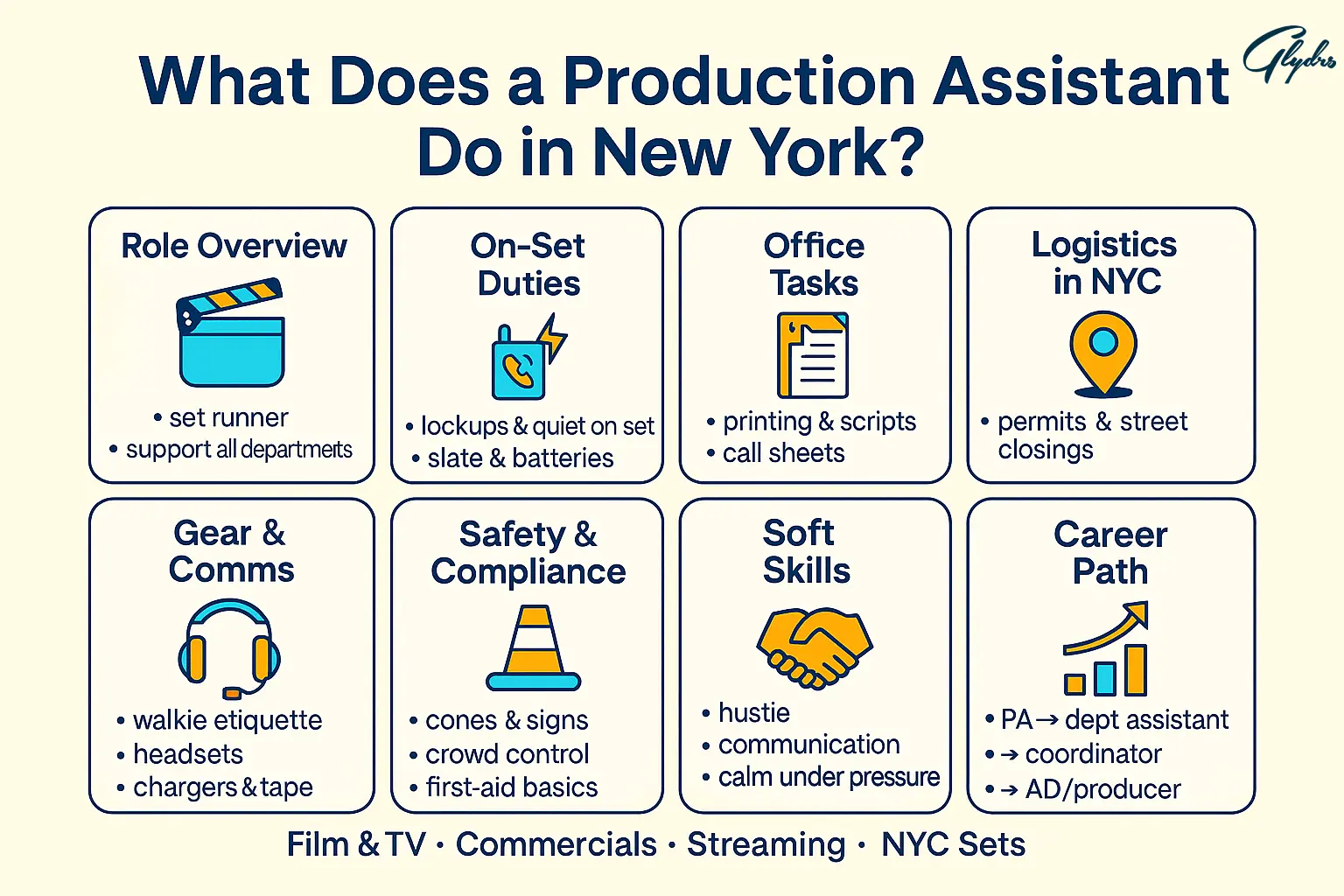
02 Dec What Does A production Assistant New York Do?
Production Assistant New York: Your Complete Guide
You’ve dreamed of being part of the magic that brings stories to life on screen, and there’s no better place to start that journey than as a Production Assistant New York. The Big Apple pulses with creative energy, hosting everything from major Hollywood blockbusters to indie films, streaming series to high-budget commercials. When you work as a production assistant in New York City, you’re not just entering the entertainment industry—you’re diving headfirst into one of its most dynamic and influential hubs.
New York’s entertainment landscape offers something you won’t find anywhere else: diversity. Within a single week, you might support the production of a gritty crime drama filming in Brooklyn, assist with a glossy commercial shoot in Manhattan, or help coordinate a romantic comedy taking advantage of Central Park’s iconic backdrop. This variety means you’ll gain exposure to different production styles, budgets, and creative approaches faster than you would in most other markets.
The unique energy of working as a Production Assistant New York stems from the city’s 24/7 nature. Productions here move at breakneck speed, matching the rhythm of the city that never sleeps. You’ll find yourself managing logistics in one of the world’s most complex urban environments, where a single street closure can affect an entire day’s shooting schedule, and your ability to navigate these challenges becomes your greatest asset.
The New York Production Assistant Role Explained
As a production assistant in New York, you serve as the essential support system that keeps productions running smoothly across all five boroughs. Your role extends far beyond the traditional “coffee runner” stereotype—though you’ll definitely master the art of knowing everyone’s preferred caffeine fix. You become the problem-solver, the communicator, and often the unsung hero who ensures that cast and crew can focus on their creative work while you handle the countless logistical details.
The types of productions hiring production assistants in New York span an incredible range. Major television networks like NBC, CBS, and HBO maintain significant operations here, while streaming giants like Netflix, Amazon Prime, and Apple TV+ have dramatically increased their New York productions. Feature films regularly choose NYC for both location shoots and studio work, taking advantage of the city’s generous film tax incentives and world-class crew base.
Your essential functions as a Production Assistant New York revolve around communication, coordination, and troubleshooting. You might start your morning distributing call sheets and script revisions, spend your afternoon coordinating with local vendors for last-minute equipment needs, and end your day ensuring that tomorrow’s locations are properly prepared and accessible. The fast-paced nature of New York productions means you’ll develop skills in multitasking and priority management that will serve you throughout your career.
Pro Tip: New York productions often have tighter timelines and more complex logistics than other markets, making reliable production assistants incredibly valuable to production teams.
Daily Responsibilities of a NYC Production Assistant
Your typical day as a production assistant in New York begins long before most of the city wakes up. You’ll often arrive at the production office or set location by 6 AM or earlier, ensuring that everything is prepared for the day’s activities. Your morning prep tasks might include setting up craft services, organizing and distributing the day’s paperwork, confirming transportation arrangements, and addressing any overnight issues that need immediate attention.
Throughout the day, you’ll coordinate with an incredible array of people—from A-list actors and their representatives to local business owners whose storefronts might appear in background shots. Managing these relationships in New York requires a special set of skills, as you’re dealing with people who are often under pressure and working with tight schedules. Your ability to remain calm, professional, and solution-oriented becomes crucial to the production’s success.
The logistical challenges of working as a Production Assistant New York are unlike anywhere else in the world.
You might need to coordinate the movement of equipment trucks through Manhattan traffic, secure last-minute permits from multiple city agencies, or find alternative locations when weather or other factors make original plans impossible. These responsibilities teach you to think creatively and act decisively under pressure.
Your administrative duties encompass everything from managing talent releases and location agreements to tracking equipment and supplies. You’ll become proficient with production management software, learn to read and update call sheets, and master the art of clear, concise communication across multiple departments. These skills form the foundation for advancement in the entertainment industry, regardless of which direction your career ultimately takes.
| Time of Day | Typical Responsibilities |
|---|---|
| 6:00-8:00 AM | Office setup, paperwork distribution, equipment checks |
| 8:00-12:00 PM | Vendor coordination, talent assistance, location management |
| 12:00-6:00 PM | Ongoing production support, problem-solving, department liaison |
| 6:00-8:00 PM | Wrap activities, next-day preparation, administrative tasks |
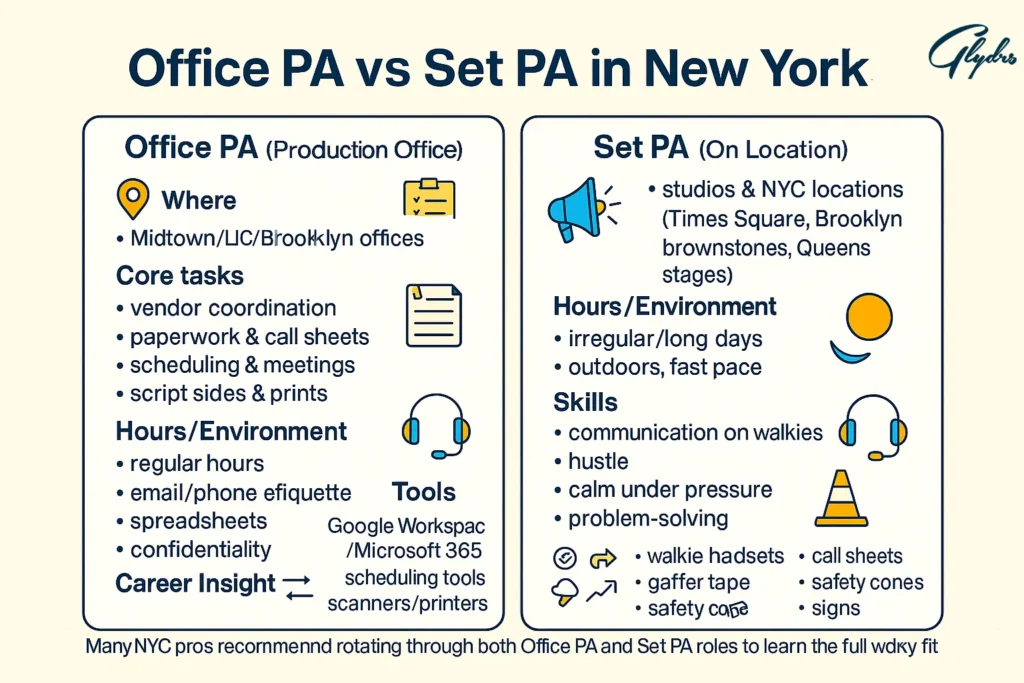
Office PA vs Set PA in New York City
The distinction between office-based and on-set production assistant roles becomes particularly important when you’re working as a Production Assistant New York. Each path offers unique advantages and challenges, and understanding these differences will help you make strategic career decisions based on your interests and long-term goals.
Office production assistants in New York typically work from production offices that might be located in Midtown Manhattan, Long Island City, or various locations throughout Brooklyn and Queens. Your responsibilities center around the administrative and logistical backbone of the production. You’ll handle vendor relationships, manage paperwork flow, coordinate meetings, and serve as the central communication hub for the entire production team. The office environment offers more regular hours and protection from weather-related challenges, making it an attractive option for many newcomers to the industry.
Set production assistants work directly on location
Whether that’s a studio in Silvercup Studios in Queens, a brownstone in Brooklyn Heights, or the bustling streets of Times Square. Your duties involve crowd control, equipment management, talent assistance, and ensuring that the immediate filming environment runs smoothly. Set PAs often work more irregular hours and face the physical demands of outdoor shoots, but they also get the excitement of being present when the actual magic of filmmaking happens.
The New York market presents unique considerations for both roles. Office PAs must navigate the city’s complex vendor relationships and understand local regulations, while set PAs deal with crowd management in one of the world’s most densely populated cities and weather conditions that can change rapidly. Both positions offer valuable learning opportunities and networking potential, but set PAs typically have more direct interaction with above-the-line talent and key creative personnel.
Career Insight: Many successful New York entertainment professionals recommend spending time in both office and set PA roles to gain a comprehensive understanding of production workflows and to determine which environment suits your working style and career aspirations.
Skills Every New York PA Needs
Success as a production assistant in New York requires a unique combination of interpersonal skills, technical competencies, and city-specific knowledge that sets you apart from PAs in other markets. Your communication skills must be exceptional, as you’ll interact with everyone from nervous first-time actors to seasoned directors, from local business owners to city officials. The ability to remain professional, calm, and helpful under pressure becomes your most valuable asset.
Adaptability ranks among the most critical skills for any Production Assistant New York. The city’s dynamic environment means that plans change constantly—weather disrupts outdoor shoots, traffic delays affect transportation schedules, and last-minute creative decisions require immediate logistical solutions. Your ability to roll with these changes while maintaining a positive attitude directly impacts your reputation and future job opportunities.
Technical competencies have become increasingly important in modern productions.
You’ll need basic proficiency with production management software like StudioBinder or Movie Magic, familiarity with communication equipment, including walkie-talkies and headsets, and an understanding of social media protocols for productions that maintain active online presences. While you don’t need to be a technical expert, comfort with technology will make you more valuable to production teams.
New York-specific skills include navigating the city’s transportation systems efficiently, understanding the unique challenges of filming in different neighborhoods, and building relationships with local vendors and service providers. Your knowledge of which neighborhoods are film-friendly, which restaurants can handle large catering orders on short notice, and how to navigate the city’s permitting processes becomes invaluable to production teams working under tight deadlines.
The professional traits that lead to success in New York’s competitive entertainment market include reliability, discretion, and genuine enthusiasm for the industry. Productions move quickly here, and there’s no time to micromanage or repeatedly explain tasks. When you demonstrate that you can handle responsibilities independently and professionally, you become the kind of production assistant that coordinators and producers specifically request for their projects.
New York Production Assistant Salary and Compensation
Understanding the financial reality of working as a Production Assistant New York requires looking beyond simple salary figures to consider the city’s unique cost of living, the nature of freelance employment, and the long-term investment aspect of starting your entertainment career. The average salary for production assistants in New York City ranges from $35,000 to $45,000 annually, significantly higher than the national average but reflecting the city’s elevated living costs.
Day rates for production assistants in New York typically range from $150 to $200 per day for non-union productions, with union productions offering higher rates that can reach $250 or more per day. These rates often include overtime provisions that kick in after 8 hours, though the entertainment industry’s standard 12-14-hour days mean you’ll regularly earn overtime compensation. Weekly rates for longer-term projects might range from $750 to $1,200, depending on the production’s budget and your level of experience.
The distinction between union and non-union work significantly impacts your compensation as a production assistant.
Non-union productions offer more flexibility in hiring but typically provide lower wages and fewer protections. Union productions, while more difficult to access initially, offer better pay, clearer working conditions. And paths toward joining industry unions like the Directors Guild of America (DGA). Which can dramatically improve your long-term earning potential.
Cost-of-living considerations make financial planning crucial for New York production assistants. Housing costs in particular can consume a large portion of your income. Leading many PAs to share apartments with multiple roommates or live in outer boroughs like Queens or Brooklyn. Where rent is more affordable. Transportation costs, while significant, can be managed through monthly MetroCards. And many production assistants find that working in the industry provides networking opportunities that lead to shared housing arrangements with other entertainment professionals.
| Production Type | Typical Day Rate | Weekly Rate | Overtime Policy |
|---|---|---|---|
| Independent Film | $150-175 | $750-875 | After 12 hours |
| Television | $175-200 | $875-1000 | After 8 hours |
| Commercial | $200-250 | $1000-1250 | After 10 hours |
| Major Studio | $225-275 | $1125-1375 | After 8 hours |
Breaking Into the NYC Film and TV Industry
Launching your career as a Production Assistant New York requires strategic thinking, persistent networking. And a willingness to start with smaller projects to build your reputation and skill set. The city’s entertainment industry operates on relationships and referrals. Making your approach to breaking in as important as your qualifications and enthusiasm.
The most successful entry strategy involves starting with smaller productions that are more accessible to newcomers. Independent films, student projects from NYU or Columbia, small commercials. And corporate video productions all need production assistants and are more likely to take chances on enthusiastic beginners. These projects provide hands-on experience, introduce you to industry professionals. And help you build a portfolio of work that demonstrates your reliability and competence.
Key production companies and studios in New York include major players like Silvercup Studios
Broadway Stages, and Steiner Studios, along with television networks maintaining significant New York operations. However, many production assistant opportunities come through smaller production companies, independent producers. And freelance coordinators who manage multiple projects throughout the year. Building relationships with these mid-level professionals often provides more consistent work opportunities than pursuing only high-profile productions.
Educational requirements for production assistant work remain minimal—most positions require only a high school diploma or equivalent. However, relevant coursework or certifications can set you apart from other candidates. Programs in film production, communications, or business administration provide useful background knowledge. While specific training in production software or equipment operation can make you more valuable to hiring teams.
Your professional portfolio should emphasize reliability, enthusiasm, and any relevant experience, even from outside the entertainment industry. Customer service experience, event planning, administrative work, and volunteer coordination all demonstrate skills that translate directly to production assistant responsibilities. References from any context who can speak to your work ethic, reliability. And ability to work under pressure are invaluable in securing your first position. Breaking In Strategy: Apply to multiple smaller productions simultaneously rather than focusing solely on high-profile projects. The relationships and experience you gain on independent films often lead to opportunities on larger productions.
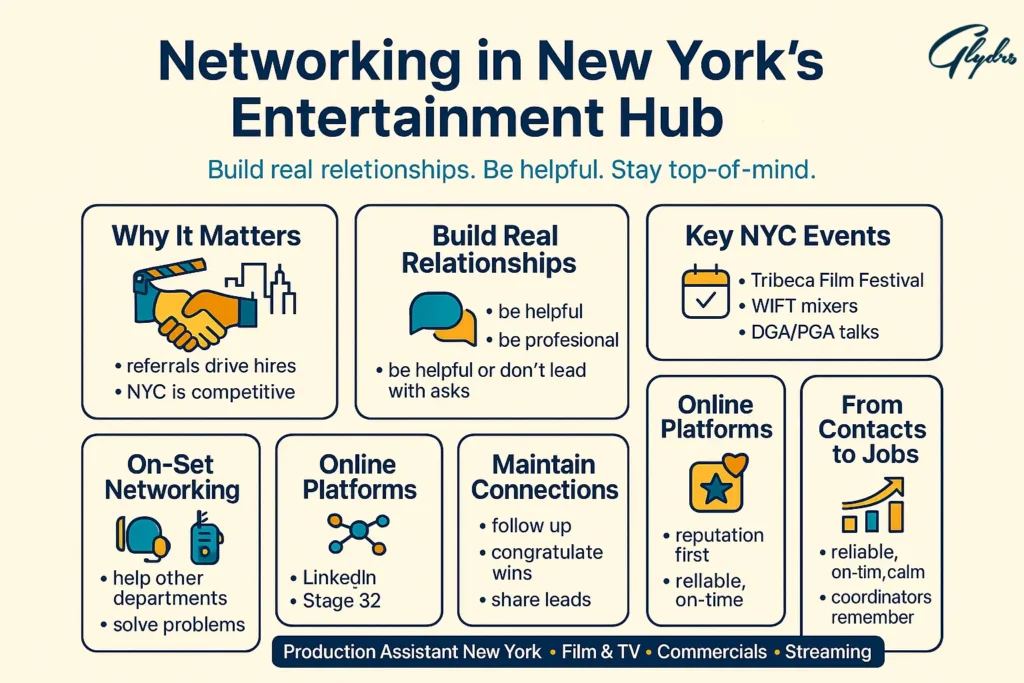
Networking in New York’s Entertainment Hub
The entertainment industry’s reliance on personal recommendations makes networking absolutely crucial for your success as a production assistant in New York. The city’s concentration of industry professionals creates unparalleled networking opportunities. But it also means you’re competing with many other talented. Ambitious individuals for attention and opportunities.
Essential networking strategies begin with genuine relationship building rather than transactional interactions. When you meet other production assistants, coordinators, or department heads. Focus on being helpful and professional rather than immediately asking for job leads. The entertainment industry’s small-world nature means that your reputation spreads quickly. And being known as someone who contributes positively to productions is far more valuable than being known as someone who’s always asking for favors.
Key industry events in New York include film festivals like the Tribeca Film Festival. Industry mixers hosted by organizations like Women in Film and Television. And educational events sponsored by the Directors Guild of America or Producers Guild of America. Regular attendance at these events helps you stay current with industry trends, meet professionals working on upcoming projects. And demonstrate your commitment to building a long-term career in entertainment.
Professional platforms
Like LinkedIn, Stage 32, and industry-specific Facebook groups provide opportunities to connect with other professionals and learn about upcoming projects. However, online networking should supplement rather than replace in-person relationship building. The personal connections you make on set, at industry events. And through mutual acquaintances remain the most reliable source of job opportunities.
Maintaining connections requires ongoing effort and a genuine interest in others’ careers and projects. Following up after working together, congratulating colleagues on their successes. And sharing relevant opportunities or information helps keep you top-of-mind when new projects begin staffing. The production assistant who remembers to check in with former colleagues and maintains friendly. Professional relationships often receives job offers before positions are officially posted.
Converting networking opportunities into job offers happens most naturally when you’ve established a reputation for excellent work and professional behavior. Production coordinators and producers maintain mental lists of reliable production assistants they prefer to hire. And getting on those lists typically results from consistently excellent performance rather than aggressive self-promotion.
Keep reading and uncover secrets that can change the way you work. A Step-By-Step Guide to Creating Amazing Video Filming
Career Growth Opportunities in NYC
The concentrated nature of New York’s entertainment industry creates exceptional opportunities for career advancement once you’ve established yourself as a reliable Production Assistant New York. The city’s diverse production landscape means you can explore different paths while maintaining the professional relationships that fuel career growth.
Advancement paths from production assistant positions typically lead toward specialized roles like production coordinator, assistant director. Or department-specific positions in areas like locations, casting, or post-production. The choice of specialization often depends on your interests, natural skills, and the types of productions you’ve worked on. Production coordinators handle the administrative and logistical aspects of productions, while assistant directors focus on on-set operations and crew management.
The transition from non-union to union positions represents a significant career milestone that can dramatically improve your earning potential and job security. Union membership requires accumulating specific numbers of work days on union productions. Making it important to seek opportunities on larger, union-sanctioned projects once you’ve gained experience on smaller productions. Union membership often serves as a gateway to higher-level positions and provides access to better working conditions and benefits.
Specialization opportunities in New York’s market reflect the city’s diverse production needs.
Television production, with its longer schedules and recurring staffing needs, often provides more stable employment and clear advancement paths. Film production offers variety and the excitement of working on different projects. While commercial production typically provides better daily rates and more manageable hours. Corporate video and digital content creation represent growing segments that often offer different work-life balance opportunities.
Long-term career trajectories from production assistant positions can lead anywhere in the entertainment industry. Many successful producers, directors, and executives began as production assistants. Using the broad exposure to different aspects of production to identify their areas of greatest interest and aptitude. The relationships you build and the reputation you establish as a production assistant often prove more valuable than any specific skills you learn in the role.
Career Advancement Tip: Volunteer for additional responsibilities that align with your career interests. If you want to become a producer, offer to help with budget tracking. If you’re interested in directing, assist with shot planning during prep days.
Keep reading and uncover secrets that can change the way you work. The Benefits of Multimedia Production in Video
Unique Challenges of Working as a PA in New York
Working as a production assistant in New York presents distinctive challenges that don’t exist in other entertainment markets. Requiring specific strategies and skills to navigate successfully. The city’s complexity, while providing incredible opportunities, also creates logistical, financial, and professional challenges that can overwhelm unprepared newcomers.
Transportation and logistics challenges in New York can make or break a production day. And as a production assistant. You’ll often be responsible for solving these problems quickly and efficiently. Moving equipment through Manhattan traffic, coordinating cast transportation across multiple boroughs. And managing location access in neighborhoods with complex parking regulations all require detailed planning and backup solutions. Understanding the city’s traffic patterns, alternate routes, and parking restrictions becomes essential knowledge for successful PAs.
The permitting process in New York involves multiple city agencies and can be incredibly complex. Especially for productions that want to film on public property or close streets. While production assistants don’t typically handle permit applications directly. Understanding the process helps you anticipate scheduling constraints and prepare for the logistical requirements that permits impose on productions.
Weather considerations affect New York productions year-round
From summer heat and humidity that can damage equipment to winter snow and ice that make outdoor filming dangerous or impossible. As a Production Assistant New York. You’ll need to help develop contingency plans for weather-related delays and understand how different weather conditions affect various aspects of production. From actor comfort to equipment protection.
The cost of living versus income balance presents perhaps the greatest ongoing challenge for New York production assistants. Even with higher day rates than most other markets, the city’s housing, transportation. And general living costs can strain entry-level entertainment industry salaries. Successful PAs develop strategies like sharing housing with multiple roommates. Taking advantage of craft services for meals, and building networks that provide mutual support during slower work periods.
Work-life balance in New York’s intense entertainment market requires deliberate effort and boundary-setting skills. The city’s 24/7 nature and the entertainment industry’s demanding schedules can blur the lines between work and personal time. Successful production assistants learn to use downtime between projects for rest and relationship maintenance. Recognizing that sustainable careers require periods of recovery and personal attention.
| Challenge Area | Common Issues | Success Strategies |
|---|---|---|
| Transportation | Traffic delays, equipment movement | Multiple route planning, early departures |
| Weather | Seasonal extremes, rapid changes | Contingency planning, equipment protection |
| Cost of Living | High housing costs, limited income | Shared housing, networking for opportunities |
| Work-Life Balance | Long hours, irregular schedules | Boundary setting, using downtime effectively |
Keep reading and uncover secrets that can change the way you work. What is the difference between corporate and commercial videography?
Making Your Mark in the Big Apple
Your journey as a Production Assistant New York represents more than just an entry-level job. It’s your initiation into one of the world’s most exciting and dynamic creative communities. The skills you’ll develop, relationships you’ll build. And experiences you’ll gain while working in New York’s entertainment industry will serve as the foundation for whatever career path you ultimately choose to pursue.
The persistence and professionalism that New York’s entertainment scene demands will transform you into a more capable. Confident professional, regardless of where your career takes you. The city’s fast pace and high standards create an environment where only genuine competence and reliability succeed. Meaning that when you establish yourself as a trusted production assistant in New York. You’ve proven your ability to handle challenging, high-pressure situations while maintaining quality work.
The rewarding aspects of contributing to New York’s creative output extend far beyond personal career advancement. You’ll be part of the team that brings stories to life. Whether that’s a major television series that entertains millions of viewers. An independent film that launches careers, or a commercial that becomes part of popular culture. The behind-the-scenes work you do as a production assistant makes the magic possible. Even when your contributions aren’t visible in the final product.
Building a sustainable career foundation as a production assistant in New York
Requires balancing immediate financial needs with long-term professional development. While the entry-level wages can be challenging in an expensive city. The investment in your future earning potential and career opportunities often pays dividends for years to come. The production coordinators, producers. And directors you work with as a PA may become the professional contacts who hire you for increasingly responsible positions throughout your career.
Your next steps toward landing that first production assistant position should focus on preparation, networking, and strategic application of opportunities. Update your resume to highlight relevant skills and experience, even from outside the entertainment industry. Begin attending industry events and joining professional organizations to start building your network. Research upcoming productions in New York and identify the production companies, coordinators, and casting directors who might need your services.
The exciting future that awaits dedicated production assistants in New York includes opportunities that don’t exist anywhere else in the entertainment world. The city’s unique combination of major studio productions, independent films, television series, commercials. And digital content creates a diverse landscape where motivated individuals can build exactly the career they envision. Your success as a Production Assistant New York opens doors to advancement opportunities, creative collaborations. And professional relationships that can shape your entire career trajectory. Your Next Step: Start today by researching three upcoming productions filming in New York and identifying their production companies. Reach out with a professional email expressing your interest and availability, even if they haven’t posted open positions yet.
Turn your goals into real achievements with our tailored services – request the service now.
1- How much can I expect to earn as a production assistant in New York?
Your earning potential as a production assistant in New York varies significantly based on the type of production, your experience level, and whether you’re working on union or non-union projects. Entry-level PAs typically start with day rates between $150–175 for independent productions, while more experienced assistants working on union productions can earn $225–275 per day. Annual earnings for full-time production assistants in New York typically range from $35,000 to $45,000, though this can vary dramatically based on how consistently you work throughout the year. Remember that overtime policies usually kick in after 8–10 hours, and the entertainment industry’s standard 12–14 hour days mean you’ll regularly earn overtime compensation that can significantly boost your daily earnings.
2- Do I need experience to get my first PA job in New York?
Production assistant positions are specifically designed as entry-level roles that don’t require previous entertainment industry experience. However, you do need to demonstrate relevant skills like reliability, communication abilities, problem-solving capabilities, and comfort working in fast-paced environments. Experience in customer service, event planning, administrative work, or volunteer coordination can all demonstrate these transferable skills to potential employers. The key to landing your first position is often starting with smaller, independent productions that are more willing to take chances on enthusiastic beginners, then using that experience and the relationships you build to access larger productions.
3- What’s the difference between working on a TV show vs a movie in NYC?
Television production typically offers more stable, longer-term employment opportunities since TV shows often film multiple episodes over several months, while movie productions usually wrap within a few weeks to a few months. TV shows also tend to have more established workflows and consistent schedules, making them potentially easier environments for new production assistants to learn industry practices. Movies often have larger budgets per day of filming and can offer more variety in locations and creative challenges, but the work is more project-based with gaps between productions. Both types of productions provide valuable experience and networking opportunities, though many production assistants find that TV work offers a better work-life balance and more predictable scheduling.
4- How do I handle the high cost of living in New York as an entry-level PA?
Managing New York’s high cost of living on a production assistant salary requires strategic planning and creative solutions. Most successful PAs share housing with multiple roommates, often with other entertainment industry professionals who understand the demands and irregular schedules of production work. Consider living in outer boroughs like Queens or Brooklyn, where rent is more affordable, and take advantage of the city’s public transportation system instead of owning a car. Many production assistants supplement their income during slow periods by working in related fields like event planning or freelance administrative work. Building a network of industry contacts can also lead to house-sitting opportunities or shared housing arrangements that reduce expenses.
5- What are the busiest seasons for production work in New York?
New York’s production calendar has distinct busy and slow periods that affect job availability for production assistants. Spring and fall are typically the busiest seasons, with many television shows filming during these periods to avoid extreme summer heat and winter weather challenges. Summer can be active for productions that specifically want the season’s look, while winter often sees reduced production activity, particularly for projects requiring outdoor filming. However, indoor studio productions, commercials, and corporate projects continue year-round. Planning for these seasonal variations by saving money during busy periods and potentially pursuing related work during slower seasons helps create a more stable income throughout the year.
6- Should I focus on union or non-union productions as a new PA?
As a new production assistant, you’ll likely need to start with non-union productions since union positions often require specific qualifications or recommendations from industry professionals. Non-union work provides essential experience, helps you build industry relationships, and allows you to develop the skills needed to eventually access union productions. Once you’ve gained experience and established a reputation for reliability, pursuing union work becomes more feasible and offers significant advantages, including better pay, clearer working conditions, and paths toward union membership. Many successful production assistants alternate between union and non-union work based on availability and their specific career goals, using non-union projects to maintain relationships and stay active during slower union periods.
No Comments