

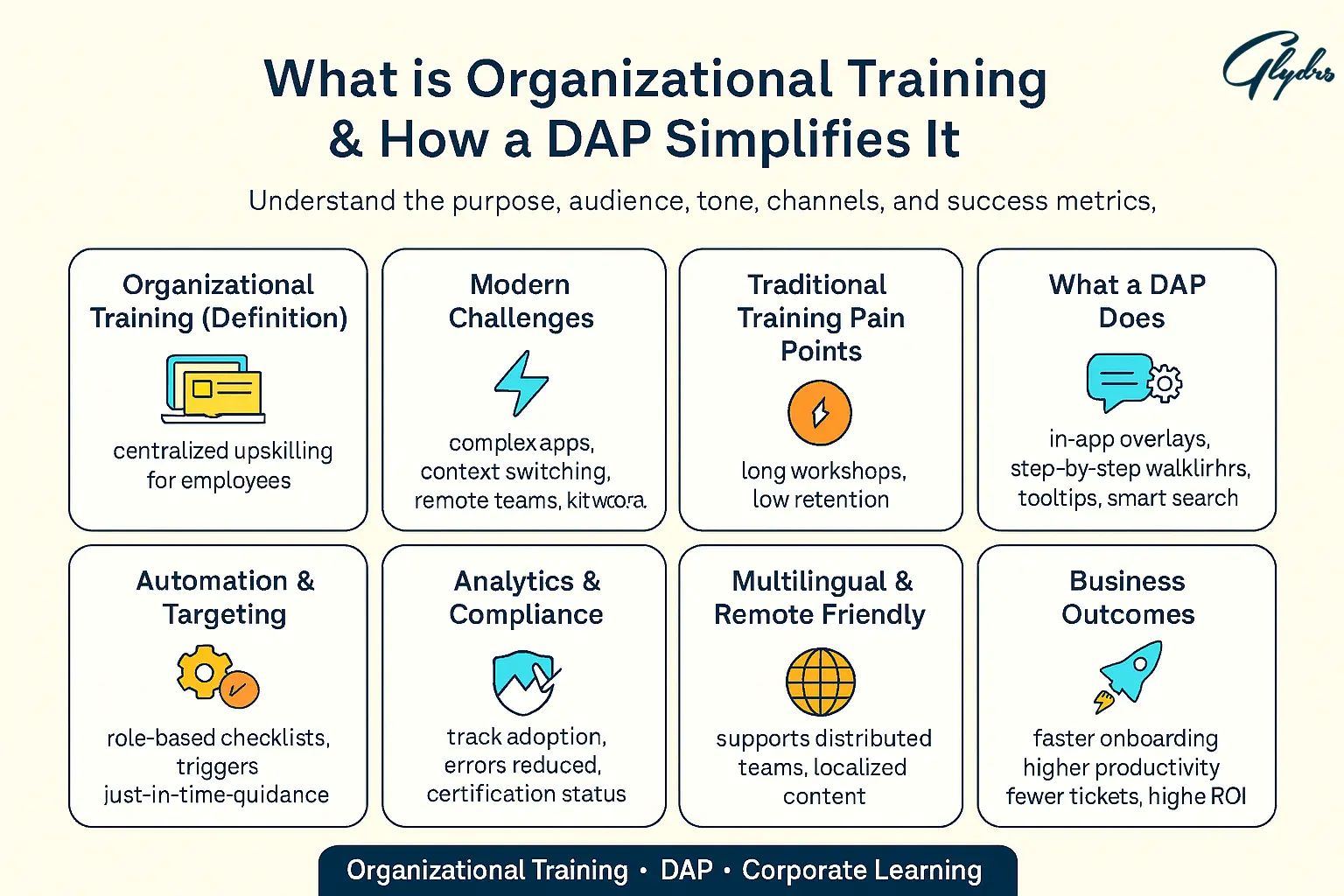
26 Nov What is Organizational Training, and how does a DAP simplify it?
Organizational Training: Importance and Benefits
You’ve likely experienced the frustration of sitting through lengthy training sessions that feel disconnected from your actual work. In today’s rapidly evolving workplace, you’re dealing with increasingly complex software systems, remote team members scattered across time zones, and the constant pressure to stay productive while learning new processes. Traditional training methods simply can’t keep pace with these modern realities.
When you’re juggling multiple applications, switching between different platforms, and trying to remember procedures from a workshop you attended weeks ago, the knowledge gaps become apparent. You need guidance precisely when you’re performing tasks, not during scheduled training sessions that may not align with your immediate needs. The challenge isn’t just learning new information—it’s applying that knowledge effectively in your day-to-day work environment.
Understanding Organizational Training: Definition and Core Purpose
Organizational Training represents the systematic process of transferring knowledge, skills, and competencies across your entire organization. Unlike individual development programs that focus on personal growth, organizational training ensures that everyone in your company acquires the same foundational knowledge needed to perform their roles effectively and support business objectives.
When you participate in organizational training, you’re receiving standardized instruction designed to align your capabilities with your company’s operational requirements. This type of training encompasses everything from software proficiency and compliance protocols to process standardization and safety procedures. The primary goal is ensuring that you and your colleagues can execute your responsibilities consistently and efficiently.
Organizational Training differs significantly from coaching or mentoring because it focuses on knowledge transfer rather than individual development. You’re learning specific skills and information that directly impact your job performance, with content that’s predetermined and delivered systematically across your organization. This approach ensures that everyone operates with the same baseline knowledge and follows established procedures.
Traditional Organizational Training Challenges and Limitations
You’ve probably sat through classroom sessions where the instructor covered generic scenarios that didn’t match your specific role or department. Traditional training approaches often follow a one-size-fits-all methodology that fails to address the diverse needs of different teams within your organization. When you’re in sales, you need different knowledge than someone in accounting, yet conventional training programs frequently treat all participants identically.
The scheduling constraints of traditional training create additional challenges for your productivity. You’re pulled away from critical projects to attend workshops that might cover information you already know or won’t use for months. This disruption affects not only your immediate work but also your team’s ability to maintain momentum on important initiatives.
Cost considerations significantly impact how much training your organization can provide. Between instructor fees, venue rentals, materials, and the opportunity cost of having multiple employees away from their desks simultaneously, traditional training requires substantial financial investment. These expenses often limit the frequency and scope of training programs, leaving knowledge gaps unfilled.
Measuring the effectiveness of traditional training presents another significant challenge. You might complete a program and receive a certificate, but determining whether you can actually apply that knowledge in real work situations remains difficult. Without contextual application opportunities, retention rates suffer, and the training investment yields minimal long-term value.

Digital Adoption Platforms (DAPs): The Game-Changing Solution
A Digital Adoption Platform represents a revolutionary approach to workplace learning that overlays directly onto your existing software applications. Instead of learning about systems in separate training environments, you receive guidance and instruction within the actual platforms you use daily. This technology creates an interactive layer that provides real-time assistance, step-by-step walkthroughs, and contextual help exactly when you need it.
DAPs integrate seamlessly with your current technology stack, whether you’re working in customer relationship management systems, enterprise resource planning platforms, or collaboration tools. The platform recognizes your actions, understands your workflow context, and delivers relevant guidance without requiring you to switch between applications or reference external training materials.
The core functionality includes interactive tooltips that explain features as you encounter them, guided walkthroughs that lead you through complex processes, and smart help centers that anticipate your questions based on your current activity. You’ll also benefit from analytics capabilities that track your progress and identify areas where additional support might be needed.
Modern DAP solutions offer extensive customization options, allowing your organization to create role-specific guidance, department-focused workflows, and personalized learning paths. Whether you’re using popular platforms like Salesforce, Microsoft 365, or industry-specific applications, DAPs can adapt to provide relevant, contextual training experiences.
How DAPs Transform Organizational Training Delivery
When you need to learn a new process or feature, DAPs eliminate the delay between identifying a knowledge gap and receiving assistance. Instead of submitting help desk tickets, searching through documentation, or waiting for scheduled training sessions, you access immediate guidance within your workflow. This on-demand approach means you’re learning precisely when the information is most relevant and useful.
The contextual nature of DAP-enabled training fundamentally changes how you acquire new skills. Rather than trying to remember abstract concepts from classroom sessions, you’re learning by doing within your actual work environment. This hands-on approach significantly improves knowledge retention because you’re immediately applying what you learn to real tasks and scenarios.
Personalization becomes possible at scale when DAPs analyze your role, department, and usage patterns to deliver customized guidance. You’ll receive training content that’s specifically relevant to your responsibilities, while your colleagues in different departments receive their own targeted instruction. This individualized approach eliminates the inefficiencies of generic training programs.
Organizational Training through DAPs integrates seamlessly with your existing workflows, eliminating the productivity disruption associated with traditional training methods. You continue working on your actual projects while receiving the guidance needed to complete tasks effectively, maintaining momentum while acquiring new capabilities.
Key Benefits of DAP-Enabled Organizational Training
Your time-to-proficiency improves dramatically when learning happens within the context of actual work. Instead of weeks or months to become comfortable with new systems or processes, you can achieve competency in days. This acceleration occurs because you’re practicing with real data, real workflows, and real scenarios rather than artificial training environments.
Cost reduction represents another significant advantage of DAP-enabled training. Your organization eliminates expenses associated with instructor fees, venue rentals, printed materials, and the productivity loss from having multiple employees away from their work simultaneously. The scalable nature of DAPs means training costs decrease on a per-employee basis as your organization grows.
Knowledge retention improves substantially when you learn within your work context. Instead of trying to recall information from training sessions that occurred weeks earlier, you’re receiving guidance precisely when you need to apply it. This just-in-time learning approach ensures that new information is immediately reinforced through practical application.
User adoption of new software and processes accelerates when DAPs provide supportive guidance during the transition period. Rather than feeling overwhelmed by unfamiliar interfaces or complex procedures, you receive step-by-step assistance that builds confidence and competency. This supportive approach reduces resistance to change and increases engagement with new tools.
Data-driven insights become available to your learning and development teams, providing visibility into which areas require additional support, which processes cause confusion, and which training approaches prove most effective. This intelligence enables continuous improvement of training programs based on actual usage patterns and performance metrics.
Best Practices for Implementing DAP-Enhanced Training Programs
Your implementation success begins with a thorough assessment of current training needs and workflow analysis. Understanding where knowledge gaps exist, which processes cause confusion, and how different roles interact with various systems provides the foundation for effective DAP configuration. This groundwork ensures that the guidance you receive addresses real challenges rather than perceived issues.
User-centric design principles should guide the creation of your training flows and content. The guidance you encounter should feel natural and intuitive, integrating smoothly with your work processes rather than interrupting them. Effective DAP implementations anticipate your questions and provide answers before confusion arises.
Role-specific customization ensures that you receive relevant guidance tailored to your responsibilities and authority level. Your training experience should reflect the features you actually use, the processes you perform, and the decisions you’re authorized to make. This targeted approach eliminates irrelevant information and focuses on practical, applicable knowledge.
Clear success metrics and key performance indicators enable your organization to measure the effectiveness of DAP-enabled training. These might include time-to-competency measurements, user adoption rates, support ticket reduction, and productivity improvements. Establishing these benchmarks before implementation provides objective criteria for evaluating success.
Seamless integration with your existing systems and workflows prevents the DAP from becoming another tool to learn. The platform should enhance your current work environment without requiring significant changes to established processes or additional software installations.
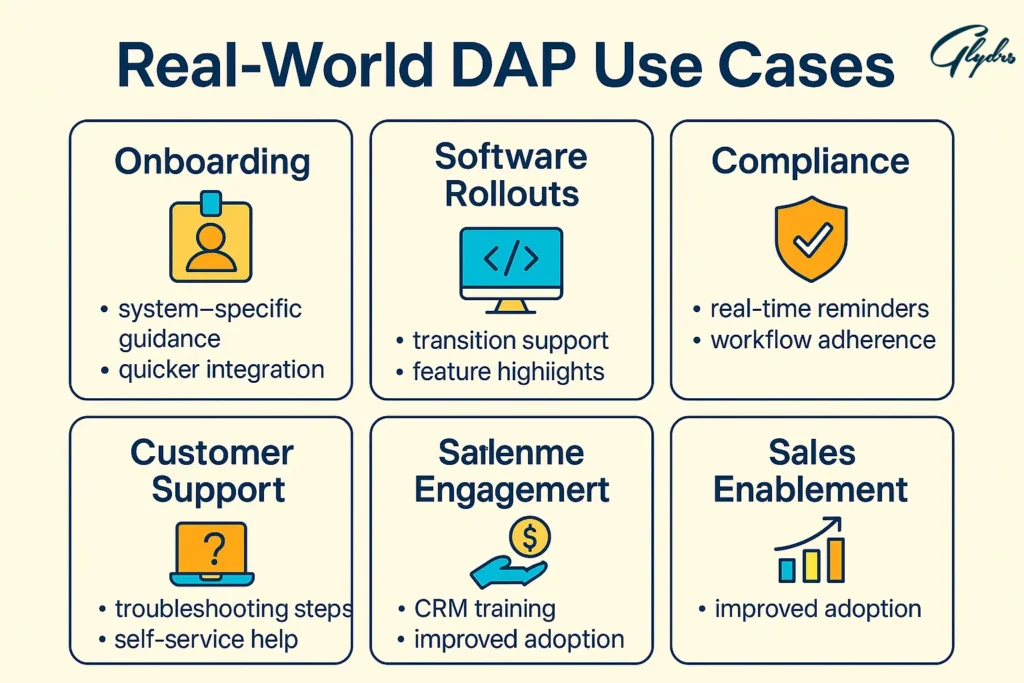
Real-World Applications: DAPs Across Different Use Cases
Your onboarding experience transforms significantly when DAPs guide you through actual systems and processes from your first day. Instead of spending weeks in orientation sessions learning about tools you haven’t yet accessed, you receive contextual guidance as you begin using each application. This approach accelerates your integration into the team and reduces the time needed to become productive.
Software rollouts and system migrations become less disruptive when DAPs provide transition support. As your organization implements new platforms or updates existing ones, you receive guided assistance that helps you adapt to changes without losing productivity. The platform can highlight new features, explain altered workflows, and provide comparative guidance between old and new systems.
Compliance training takes on new effectiveness when delivered through DAPs during actual work processes. Rather than completing abstract compliance modules, you receive guidance about regulatory requirements and proper procedures precisely when you’re performing activities that require compliance adherence. This contextual approach ensures that compliance becomes integrated into your workflow rather than existing as separate knowledge.
Customer support and help desk scenarios benefit significantly from DAP implementation. When you encounter issues or questions, the platform can provide immediate assistance or guide you through troubleshooting steps before you need to contact support teams. This self-service capability reduces ticket volume while improving your problem-solving capabilities.
Sales enablement through CRM training becomes more effective when DAPs guide you through actual customer interactions, deal progression, and data entry processes. You learn to use the system while working with real prospects and customers, ensuring that your training directly supports revenue-generating activities.
Measuring Success: Analytics and ROI of DAP-Enabled Training
Your organization gains unprecedented visibility into training effectiveness through comprehensive analytics provided by DAP platforms. User engagement metrics reveal which guidance elements you find most helpful, which processes require additional support, and where knowledge gaps persist. This data enables continuous improvement of training content and delivery methods.
Completion rates and progression metrics provide insights into how effectively you and your colleagues are acquiring new skills. Unlike traditional training where completion might simply mean attending a session, DAP analytics track actual task completion, feature usage, and process adherence. These behavioral indicators offer more accurate assessments of training success.
Time-to-competency measurements become precise when DAPs track your progression from initial guidance through independent task completion. Your organization can establish benchmarks for how quickly employees should achieve proficiency and identify individuals who might benefit from additional support or alternative training approaches.
| Metric Category | Traditional Training | DAP-Enabled Training |
|---|---|---|
| Time to Proficiency | 4-12 weeks | 1-3 weeks |
| Knowledge Retention | 20-30% after 30 days | 70-80% after 30 days |
| Training Cost per Employee | $1,000-$3,000 | $200-$500 |
| User Satisfaction | 60-70% | 85-95% |
Return on investment calculations become more straightforward when you have concrete data about productivity improvements, support ticket reductions, and error rate decreases. The platform provides quantifiable evidence of training impact, making it easier to justify continued investment in learning and development initiatives.
Keep reading and uncover secrets that can change the way you work. ENTERPRISE LMS: WHAT IS IT AND WHAT ARE THE BENEFITS?
The Future of Organizational Training with Digital Adoption
Emerging trends in workplace learning point toward increasingly intelligent and predictive training systems. Artificial intelligence and machine learning capabilities will enable DAPs to anticipate your training needs based on your role progression, project assignments, and usage patterns. This predictive approach will deliver guidance before you encounter challenges, preventing problems rather than simply solving them.
Mobile-first and microlearning approaches will become standard as DAPs adapt to support various devices and learning preferences. You’ll receive bite-sized guidance that fits into your workflow naturally, whether you’re working from a desktop computer, tablet, or mobile device. This flexibility ensures that training support remains available regardless of your work environment or device preference.
Integration with performance management systems will create more comprehensive pictures of individual and organizational capability development. Your training progress and skill acquisition will connect directly with performance reviews, career development planning, and succession preparation. This integration aligns learning activities with career advancement opportunities.
Organizational Training will evolve toward continuous, embedded learning experiences that adapt to changing business requirements and individual development needs. Rather than discrete training events, you’ll experience ongoing capability building that responds to new challenges, updated processes, and emerging technologies as they arise.
Keep reading and uncover secrets that can change the way you work. THE FUTURE OF AI IN LEARNING AND DEVELOPMENT
Transforming Your Training Strategy: From Traditional to Digital-First
Your evaluation of current training approaches should examine both effectiveness and efficiency metrics. Consider how much time employees spend in training versus applying knowledge, how quickly new hires become productive, and how well current programs support business objectives. This assessment provides the baseline for measuring improvement after DAP implementation.
Building the business case for DAP investment requires demonstrating potential returns through reduced training costs, improved productivity, and enhanced user adoption of technology investments. Calculate the current costs of traditional training, including direct expenses, opportunity costs, and inefficiency losses. Compare these figures with projected DAP costs and benefits to establish ROI projections.
Change management considerations become crucial as your organization transitions from familiar training methods to technology-enabled approaches. You’ll need to address concerns about screen time, technology dependence, and the human element of learning. Successful implementations balance technological capabilities with human needs for interaction, feedback, and support.
Creating a culture of continuous learning becomes easier when training is integrated into daily workflows and removes barriers to skill development. You’ll find that learning becomes a natural part of work rather than a separate activity that competes with productivity demands. This cultural shift supports long-term organizational adaptability and growth.Long-term strategic benefits of DAP-enabled Organizational Training programs extend beyond immediate productivity improvements. Your organization develops more agile capabilities, faster adaptation to change, and stronger employee engagement through effective support systems. These advantages compound over time, creating sustainable competitive advantages in rapidly evolving markets.
Keep reading and uncover secrets that can change the way you work. WHAT ARE AREAS OF LEARNING AND DEVELOPMENT?
Your Path Forward: Embracing the Training Revolution
The transformation from traditional training methods to DAP-enabled learning represents more than a technology upgrade. It’s a fundamental shift toward more effective, efficient, and engaging employee development. As you consider the challenges facing your organization in an increasingly complex business environment. The ability to provide immediate, contextual guidance becomes not just advantageous but essential.
Your success in implementing Organizational Training through DAPs depends on understanding that this technology serves people, not the other way around. When you focus on creating supportive. Intuitive experiences that enhance rather than complicate daily work. You’ll discover that learning becomes a natural, continuous process rather than a periodic disruption.
The future belongs to organizations that can adapt quickly, learn continuously, and support their people effectively. By embracing DAP-enabled training approaches. You’re not just solving today’s learning challenges. You’re building the foundation for long-term success in an ever-evolving business landscape. Your investment in this technology represents an investment in your people’s potential and your organization’s capacity to thrive regardless of what changes lie ahead.
Turn your goals into real achievements with our tailored services – request the service now.
Frequently Asked Questions
1- What’s the difference between a DAP and a Learning Management System (LMS)?
While LMS platforms manage traditional course content, tracking, and reporting, DAPs provide real-time, contextual guidance within your actual work applications. You use an LMS to complete formal training modules, but you interact with a DAP while performing your daily tasks. The two technologies complement each other, with LMS handling structured learning programs and DAPs supporting practical application.
2- How quickly can you see results with DAP-enabled training?
Most organizations observe improved user adoption and reduced support requests within 2–4 weeks of DAP implementation. Your experience may vary depending on the complexity of your systems and processes, but the immediate availability of contextual guidance typically produces rapid improvements in confidence and competency.
3- Can DAPs work with any software application?
Modern DAPs integrate with most web-based and desktop applications through various methods, including browser extensions, API connections, and overlay technologies. While compatibility varies by platform, leading DAP solutions support hundreds of popular business applications and can often accommodate custom or industry-specific software.
4- What’s the typical ROI timeline for DAP investments?
Organizations typically achieve positive return on investment within 6–12 months through reduced training costs, decreased support tickets, and improved employee productivity. Your specific timeline depends on factors such as organization size, training volume, and current inefficiencies in learning and support processes.
5- How do DAPs handle compliance and audit requirements?
DAPs provide detailed analytics and completion tracking that support compliance reporting and audit needs. You’ll have access to comprehensive data about who received training, when they completed required processes, and how they performed on compliance-related tasks. This documentation often exceeds the requirements of traditional training records.
No Comments