

07 Jan Why Top Companies Use Custom Training Modules to Upskill Teams
Training Modules: Why Top Companies Use It to Upskill Teams
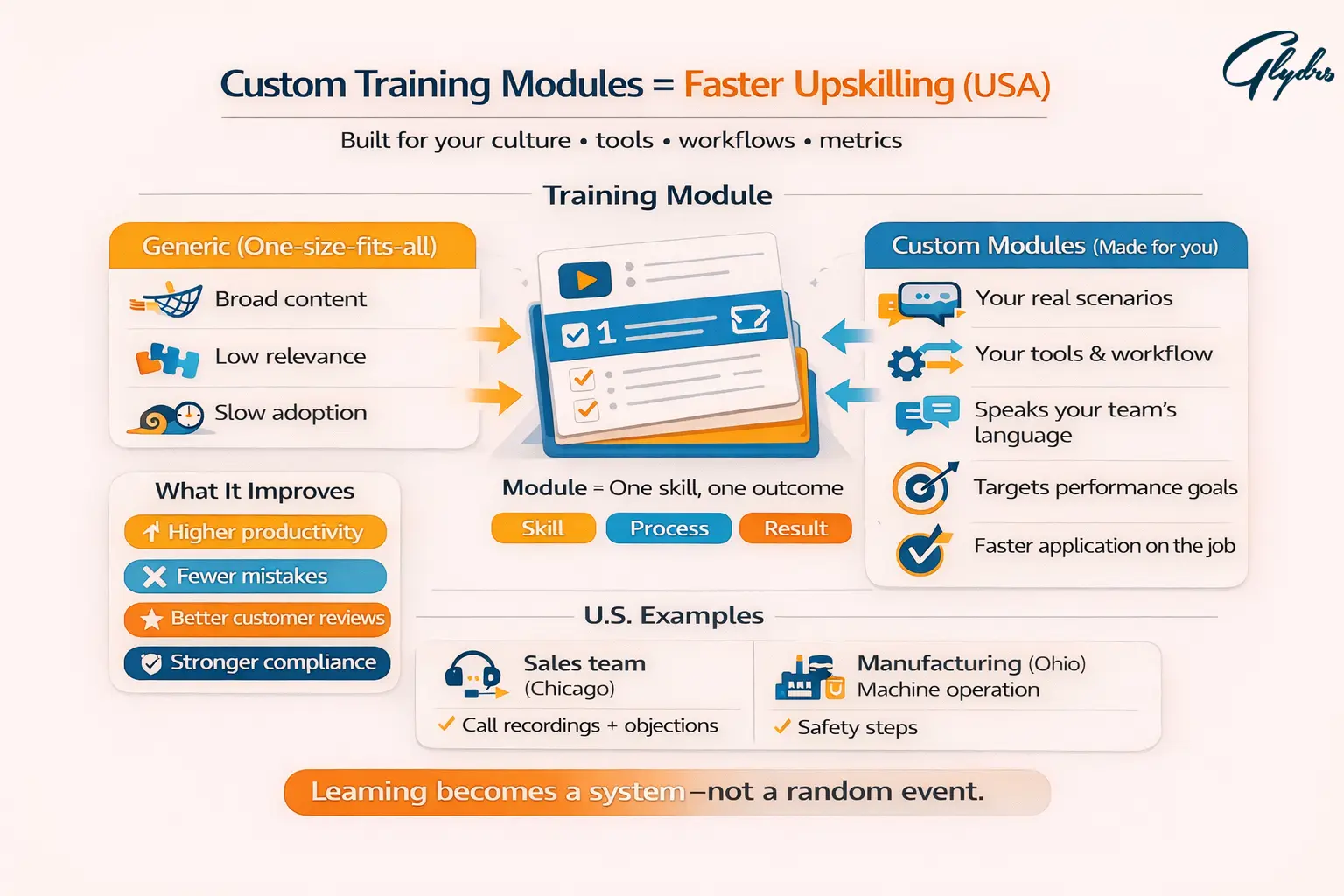
In today’s fast-changing US workplace, the companies that grow fastest are usually the ones that treat learning as a core business function, not a side project. That’s why so many top organizations now rely on custom training modules instead of generic, one-size-fits-all courses. A training module is an individual learning unit built around a specific skill, process, or outcome—like handling a customer complaint, using new software, or leading a one-on-one meeting. When these training modules are designed specifically for your culture, tools, and workflows, they become far more powerful than off-the-shelf content.
They speak your team’s language, use your real scenarios, and connect directly to the metrics that matter: higher productivity, fewer mistakes, better customer reviews, and stronger compliance. For a sales team in Chicago, that might mean modules built around actual call recordings and objections; for a manufacturing plant in Ohio, it could be step-by-step visual guides for operating machines and following safety protocols. Custom training modules let you zoom in on what your people truly need, instead of wasting their time on broad content that only partially applies.
In a tight American labor market.
Where employees have options and expectations, this targeted approach sends a clear signal: we are investing in you, specifically, and we want you to succeed in this role, on this team, in this company. It also helps managers feel more confident about assigning training because they know each module lines up with real performance goals, not just theoretical knowledge. When employees can see the direct connection between a training module and their daily tasks—closing a deal, resolving a ticket, running a machine—they pay more attention, engage more deeply, and apply what they learn faster. Over time, this creates a culture where learning is not a random event, but an ongoing, structured system that keeps your US business competitive and your teams ready for whatever comes next.
Flexible Training Modules for Different Roles, Locations, and Levels
Another reason top American companies invest heavily in tailored training modules is the flexibility they offer across different roles, locations, and experience levels. Instead of forcing everyone through the same long course, you can mix and match bite-sized modules to create learning paths that fit each person. A new hire might follow a structured sequence that covers company values, core tools, and basic procedures, while a senior employee only needs advanced refreshers on new products or updated regulations.
Training modules make this easy because each unit is self-contained but still connected to a bigger curriculum. You can plug modules into onboarding, performance improvement plans, leadership development programs, or compliance cycles without reinventing the wheel every time. For distributed US teams, this modular design is especially valuable: employees in New York, Dallas, and San Francisco can all access the same up-to-date content on their own schedule, whether they are in the office, on the road, or working from home.
From a business perspective.
Modular design also makes it easier to keep your training current. If a policy changes, a process is improved, or a new feature is released, you don’t have to rebuild an entire course—you simply update the relevant training module and reassign it. This saves time for L&D and HR teams and reduces confusion for learners, who always know they are seeing the latest version. Analytics built into modern platforms let you track which modules are being completed, where learners get stuck, and which units correlate with better KPIs like sales numbers, quality scores, or safety records.
You can then refine or replace underperforming modules and expand the ones that work best. Over time, your library of training modules becomes a living system that evolves with your US business, supporting faster rollouts, smoother change management, and more consistent performance across every department and location.
Turning Theory into Practice with Scenario-Based Training Modules
Custom training modules also help top US companies move beyond theory and into real-world practice, which is where true upskilling happens. Instead of dumping information in long slide decks or one-off workshops, they design modules around realistic scenarios, decisions, and tasks employees face every day. A customer support module might include branching situations where an agent chooses how to respond to an angry caller and sees the consequences of each choice.
A leadership module could walk managers through a difficult performance conversation, with options for what to say next and instant feedback on tone and impact. Technical training modules often combine short explainers with simulations, screen recordings, or step-by-step checklists that employees can follow while they’re actually using a system. This “learn → do → reinforce” cycle is especially important in the American business environment, where teams are judged on results, not just knowledge. When people practice skills inside the modules—rather than only reading about them—they build muscle memory and confidence.
They’re more likely to try new behaviors on the job because they’ve already rehearsed them in a safe space. Top US organizations also mix formats inside their training modules: video, text, quizzes, downloadable job aids, and short reflections. This variety keeps learners engaged and supports different learning styles without making the content overwhelming. By anchoring every module in real tasks and outcomes, companies ensure that time spent in training translates into visible performance improvements that managers and executives can actually see on the floor, in dashboards, and in customer feedback.

Personalizing Development at Scale with Targeted Training Modules
Another powerful benefit of modular design is that training modules make it easier to personalize development at scale, which is a huge challenge for US companies with large, diverse workforces. Instead of asking everyone to attend the same three-hour session, platforms can recommend specific modules based on role, performance data, or self-assessment results. A high-performing salesperson might skip basic prospecting content and focus on advanced negotiation modules, while a new rep receives a full path that covers fundamentals step by step.
Employees can also “pull” learning when they need it—searching for a targeted module on topics like “handling refunds,” “using the CRM,” or “leading stand-up meetings” right before the moment of need. This just-in-time access is critical in busy American workplaces where people can’t always block off large chunks of time. Managers benefit too: they can assign precise training modules to address specific gaps they see in one-on-ones, instead of giving vague advice like “improve communication.” Over time, data from these assignments reveal patterns—maybe many team members struggle with one process or policy—so L&D can improve or expand those modules.
This personalized, data-informed approach helps employees feel respected and supported, not micromanaged. They see that the company isn’t wasting their time with irrelevant content, but instead offering targeted modules that help them hit their goals faster. That perception directly boosts engagement and retention, especially among ambitious US employees who want clear, practical paths to grow inside the company rather than look elsewhere.
Measuring Real Impact with Data-Driven Training Modules
Top-performing US companies also love custom training modules because they make measuring impact much easier and more transparent. Instead of guessing whether a workshop “went well,” L&D and HR teams can track completion, quiz scores, time spent, and follow-up behavior at the module level. This granularity matters. If you roll out a new set of training modules on compliance, you can see exactly which topics employees breeze through and which ones cause confusion. If you launch sales enablement modules, you can compare usage data with pipeline and close-rate metrics to see what’s actually moving the needle.
Modern learning platforms let you tag modules to specific competencies or KPIs—like “first-call resolution,” “on-time delivery,” or “customer satisfaction”—then analyze trends across individuals, teams, and locations in the US. Over time, you’ll notice patterns. Maybe a certain module is always completed by high performers. Or maybe teams that finish a particular path have fewer quality issues. That insight helps you refine your training strategy, invest more in what works, and retire or redesign modules that don’t.
It also gives you credible data to share with senior leadership: you’re not just saying “people liked the training,” you’re showing how specific modules contributed to better business outcomes. This evidence-based approach upgrades training from a cost to an asset in the eyes of American executives who care about ROI, efficiency, and competitive advantage.
Keeping Remote and Hybrid US Teams Aligned with Modular Learning
Custom training modules also play a huge role in supporting remote and hybrid teams across the US, where employees may rarely meet in person but still need consistent standards and shared knowledge. When your workforce is spread across cities and time zones. Live training alone can’t keep everyone aligned. Modular content fills that gap. You can record a clear, concise module once—on topics like your service promise, security practices, or new product features—and make it available to everyone, from new hires to seasoned staff.
This reduces the risk of mixed messages and “tribal knowledge” that only lives in certain offices. It also helps you roll out change more smoothly: when you update a process or launch a new tool, you can create or tweak a small set of training modules and push them to the right groups with deadlines and reminders. Employees get the flexibility to complete them when it fits their schedule, while managers can still monitor progress and follow up where needed.
For American workers who value autonomy and clarity. This model works well. They can see exactly what’s expected, and learn at their own pace. And refer back to modules whenever they need a refresher. Meanwhile, your company maintains one coherent standard of “how we do things here,” regardless of where people sit. In a world where remote and hybrid work are here to stay, that combination of flexibility and consistency is a big reason top US companies are doubling down on high-quality training modules as the backbone of their upskilling strategy.
Using Training Modules to Protect Quality, Safety, and Compliance
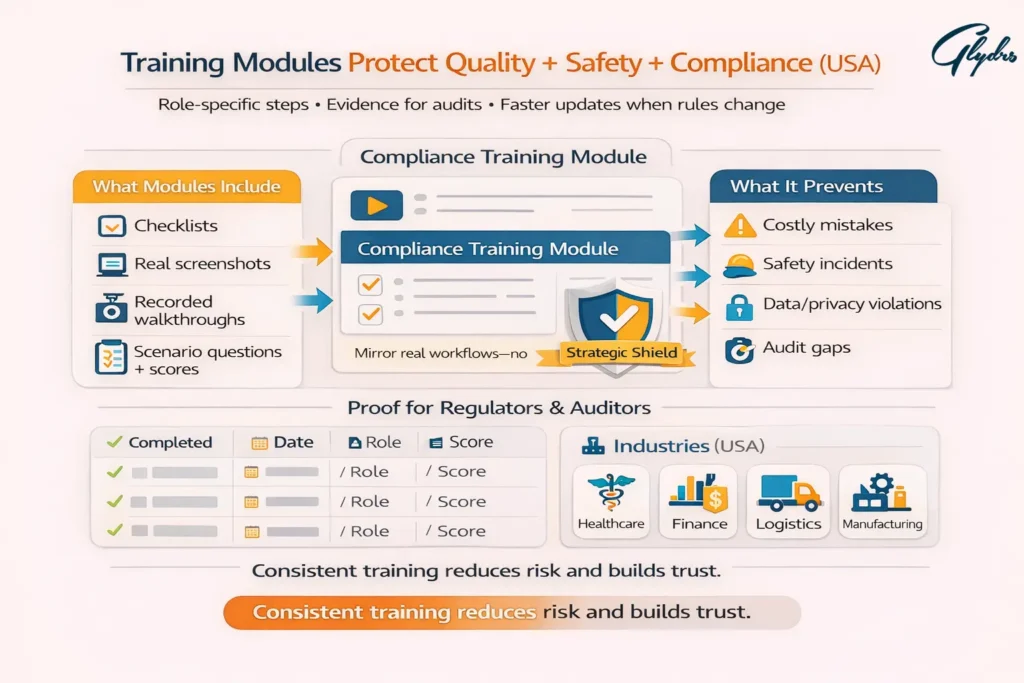
Custom training modules are also a powerful way for US companies to protect quality, safety, and compliance in industries where mistakes are expensive—or even dangerous. In sectors like healthcare, finance, logistics, and manufacturing, employees must follow strict procedures and regulations every day. Generic training rarely covers the exact steps, systems, and scenarios your teams handle on the ground. That’s why leading organizations build modules that mirror their real workflows: how to document a patient visit correctly, how to handle sensitive financial data, how to inspect equipment, or how to respond to an incident.
These training modules can include checklists, real screenshots, recorded walk-throughs. And scenario-based questions that test understanding before people are allowed to perform tasks independently. US regulators and auditors increasingly expect evidence that employees receive consistent, role-specific training—not just a one-time orientation. With modular content, you can easily prove who completed what, when, and with what score, while also updating modules quickly when rules change. This reduces legal and operational risk while giving employees more confidence that they’re doing things “the right way.”
It also helps managers avoid relying on informal, inconsistent shadowing, which can spread bad habits. Instead, everyone starts from the same clear baseline, reinforced by on-the-job coaching. For companies that care about brand reputation, safety, and trust, investing in accurate, well-designed training modules is not just good practice—it’s a strategic shield that protects the business in a demanding US regulatory environment.
Keep reading and uncover secrets that can change the way you work. The Value of Training Development Certification of an Employee
Embedding Culture and Values Inside Everyday Training Modules
Finally, top US companies use custom training modules to reinforce culture and values—not just technical skills. It’s easy to say “we care about customers,” “we move fast,” or “we act with integrity,” but those phrases mean little unless people see what they look like in real situations. Culture-focused training modules help connect big statements to everyday behavior. They can show examples of how to handle a mistake transparently, how to include different voices in a meeting, or how to go the extra mile for a client without burning out.
For new hires, these modules act like a guidebook to “how we work here,” making it easier to integrate into teams quickly, even in remote or hybrid US setups. For existing employees, they serve as gentle but consistent reminders of expectations—especially during times of growth or change. Stories, short interviews with leaders. And real case studies can be woven into the modules so people hear directly from colleagues, not just HR.
When culture is baked into the same training modules that teach systems and processes. Employees don’t experience values as abstract posters—they experience them as part of how they write emails, lead conversations, make decisions, and serve customers. Over time, this alignment between skills and values creates stronger, more cohesive teams, where upskilling is not just about “doing more,” but about doing the right things in the right way for your US business, your customers, and your people.
Keep reading and uncover secrets that can change the way you work. How AI in Training Can Help You Develop Your Employees?
Building Clear Career Paths with Progressive Training Module Paths
When you zoom out, one of the biggest advantages of using custom training modules in US companies is how they support long-term talent strategy, not just short-term skill fixes. Hiring new people has become more expensive and competitive across the American labor market—especially for specialized roles in tech, healthcare, operations, and customer-facing positions. Smart organizations respond by growing more of their talent from within. Modular training makes this realistic.
You can design clear learning paths that move employees from entry-level roles to more advanced positions—support rep to team lead, technician to supervisor, coordinator to project manager—using a series of connected training modules at each step.
Each path can include technical skills.
Soft skills and culture components, so people aren’t only learning “what to do,” but also “how to think” in more senior roles. Managers can use these paths to have concrete career conversations: instead of vague promises, they can say, “If you complete this set of modules and apply them successfully, you’ll be ready for X role.” This transparency is especially valued by ambitious US employees who want to see a future inside the company, not just a job.
It also helps organizations build a stronger internal pipeline and reduce risk when filling key positions; they already know who has completed critical training modules and demonstrated the associated behaviors. Over time, this approach makes development feel less like a random perk and more like a structured, fair system that rewards learning and performance. That perception strengthens your employer brand in a US market where people talk openly about career growth, and it helps you keep your best people longer—because they see a clear, supported path forward with you.
Keep reading and uncover secrets that can change the way you work. How to Choose a Learning and Development Course
Training Modules as a Long-Term Growth Engine for US Businesses
Ultimately, top companies in the US rely on custom training modules because they bring structure, flexibility. And a measurable impact on something that used to be vague and hard to control. Instead of sending employees to generic workshops and hoping for the best. They build targeted, modular content around real work, real goals, and real data. Training modules make it easier to onboard new hires consistently, upskill existing teams quickly. And adapt to new technologies, products, and regulations without chaos.
They help remote and hybrid teams stay aligned. Protect quality and compliance in sensitive industries, and turn culture from slogans into daily habits. Most importantly, they connect learning directly to performance. Every module exists for a reason. And its success can be tracked and improved over time. American businesses are facing constant pressure to do more with less. Serve customers better, innovate faster, and keep great people in a competitive market—this combination is powerful.
Well-designed training modules become a quiet engine behind the scenes. Continuously upgrading your workforce without pulling them too far away from their jobs. When you invest in building and refining that engine, you’re not just ticking a training box. You’re building a scalable system for growth, resilience, and long-term advantage in a rapidly changing US economy.
Turn your goals into real achievements with our tailored services – request the service now.
FAQ- Training Modules
1- Why do top U.S. companies prefer custom training modules over generic courses?
Because custom training modules are built around a company’s real tools, culture, and workflows. They use actual scenarios, language, and metrics that matter—leading to higher productivity, fewer mistakes, better customer reviews, and stronger compliance.
2- How do training modules support different roles, locations, and seniority levels in the U.S.?
Training modules are modular and bite-sized, so you can mix and match them into tailored learning paths. New hires get structured onboarding, while experienced staff receive focused refreshers—accessible anytime for distributed teams across U.S. cities and time zones.
3- How do scenario-based training modules turn theory into real performance gains?
They simulate everyday situations—like handling complaints, leading tough conversations, or using systems—so employees can practice decisions in a safe environment. This “learn → do → reinforce” approach builds confidence and muscle memory that shows up in real KPIs.
4- How do U.S. companies use training modules to protect quality, safety, and compliance?
They build modules that mirror real workflows and regulations, with checklists, screenshots, and scenario questions that must be passed before employees work independently. Platforms track completions and scores, giving clear evidence to regulators and auditors and reducing operational risk.
5- How can training modules help American businesses grow talent and build clear career paths?
Companies design progressive module paths that move employees from entry-level to advanced roles, combining technical, soft-skill, and culture content. Managers can point to specific module tracks as concrete steps toward promotion, making development feel fair, structured, and worth staying for.

No Comments